What is Debt: Meaning, Types, and Impact on Stocks

Written by Bidita Sen
Published on September 07, 2021 | 8 min read


Key Takeaways
- Debt represents borrowed funds that are repaid over time, usually with interest or other agreed charges.
- Borrowing splits structurally into secured versus unsecured and revolving versus instalment credit facilities.
- Enterprises utilise corporate debentures, bank term loans, and commercial papers to expand operations.
- Leverage can amplify equity returns, while excessive debt can increase balance-sheet and insolvency risks.
Whether you swipe a credit card for daily purchases or an enterprise borrows billions to construct a manufacturing facility, debt drives modern economic life. Borrowing can provide access to capital for consumption, investment and business activities, while excessive debt can increase financial obligations.
What is Debt and How Does It Work?
At its core, debt is a contractual financial agreement where a borrower receives funds from a lender. The borrower commits to repaying the principal sum according to agreed terms, along with any applicable interest or other charges. Interest serves as economic compensation to the lender for parting with liquidity and assuming credit risk.
For individuals, borrowing bridges personal income timing with major life expenditures. For corporations, debt provides growth capital without directly diluting equity ownership. While issuing new shares redistributes voting control and future earnings among new shareholders, raising debt allows promoters and management to finance projects while avoiding direct equity dilution, although lenders may impose contractual covenants and other conditions.
Structure of Borrowing: Revolving Debt vs Instalment Debt
From a repayment perspective, credit facilities fall into two distinct operational formats:
-
Installment Debt: The borrower receives a lump-sum amount upfront and commits to repaying it through scheduled, regular payments, commonly known as Equated Monthly Instalments (EMIs), over a fixed term. Each installment usually contains both principal repayment and accrued interest. Once fully repaid, the loan or facility is generally closed. Common examples include auto loans, home mortgages, and corporate term loans.
-
Revolving Debt: The lender grants an approved credit limit that the borrower can access, repay, and withdraw again continuously. Interest generally accrues on the amount utilised, subject to the terms of the facility, rather than the total sanctioned limit. As the balance is paid down, available credit replenishes. Popular examples include personal credit cards, retail lines of credit, and corporate bank overdrafts.
Common Types of Debt: Secured vs Unsecured
Beyond repayment structures, debt is broadly categorised by collateral backing:
-
Secured Debt: Backed by collateral, which may include physical or financial assets. If the borrower defaults, the lender may have rights under the loan agreement and applicable law to enforce the security and recover dues. Because collateral can reduce lender risk, secured facilities may carry lower interest rates than comparable unsecured facilities.
-
Unsecured Debt: Backed solely by the borrower's credit standing, income or cash flows, and repayment history (such as a CIBIL score). Because lenders hold no specific collateral in a default, unsecured instruments (like personal loans and credit cards) generally carry higher interest rates than comparable secured borrowing, although rates vary by borrower and product.
Major Types of Corporate Debt Instruments
Companies tap varied borrowing routes across debt capital markets depending on their tenure requirements and operational stage:
-
Bank Term Loans: Direct, medium-to-long-term borrowing from commercial banks, commonly earmarked for capital expenditures, machinery procurement, or factory construction.
-
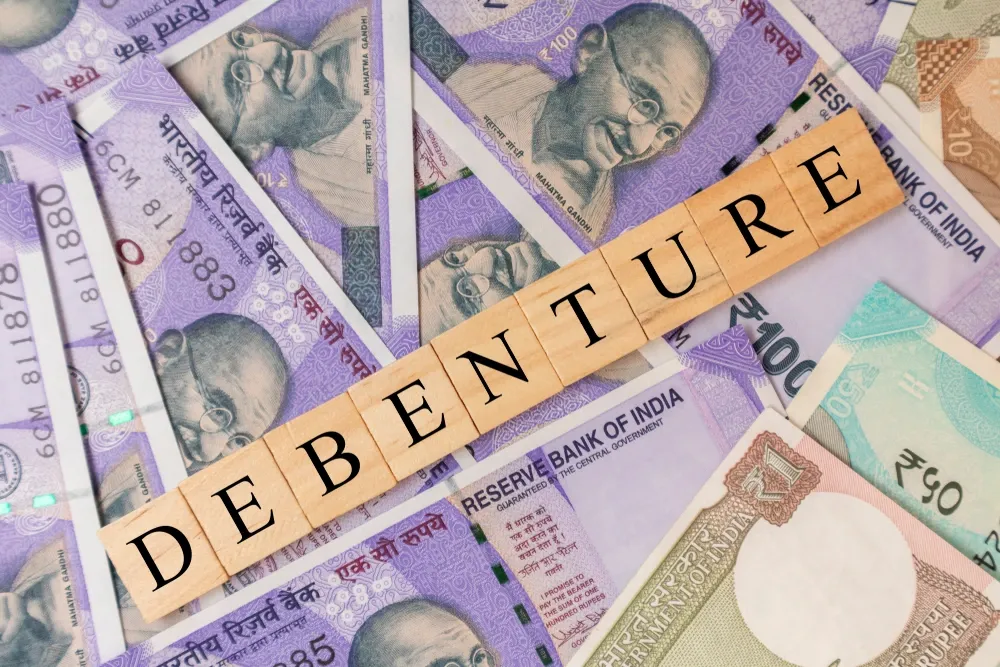
Debentures and Corporate Bonds: Transferable debt securities issued directly to institutional and retail investors. These instruments may pay periodic interest (coupon payments) and redeem the face value at maturity, subject to their terms.
-
Commercial Paper (CP): Short-term, unsecured promissory notes issued by eligible entities to fund immediate operational expenses and working capital gaps (maturities typically range from a few weeks up to one year).
-
Working Capital Facilities (Cash Credit & Overdraft): Short-term revolving credit arrangements provided by commercial banks, enabling businesses to manage daily inventory cycles and temporary cash mismatches.
Types of corporate bonds
Corporate bonds are classified into two types
Short-term bonds
Short-term bonds have a maturity of 1-3 years, these bonds help companies meet their working capital requirement.
Long-term bonds
These bonds have a maturity of more than 10 years and help companies fulfil their long-term capital requirements.
Callable bonds
In callable bonds, the company issuing the bonds has the right to redeem the bond before the maturity date if it wishes to.
Puttable bonds
When you invest in a puttable bond, you have the right to sell the bond back to the issuer before maturity.
Investment-grade bond
Investment-grade bonds are issued by financially strong companies that carry a low risk of default but offer low returns as well. These bonds generally have a good credit rating, showing the company’s capability to repay the debt.
High-yield bond
High-yield bonds, also known as junk bonds, are issued by companies having low credit ratings. These bonds provide higher returns to compensate for the high default risk borne by the bondholders.
Advantages and Disadvantages of Debt
Debt functions as a financial lever. It can magnify financial outcomes depending on the company's operating performance and cost of borrowing.
Advantages of Debt
- Preserves Equity & Control: Lenders generally do not receive ordinary equity voting rights, keeping operational control with existing shareholders, subject to the terms of the financing arrangements.
- Tax Deductibility: In corporate finance, interest expenses may be deductible for tax purposes, subject to applicable tax laws and limits, reducing taxable earnings in eligible cases.
- Enhanced Returns: Using borrowed funds to finance projects that generate returns above the cost of debt can increase Return on Equity (ROE) without requiring additional shareholder capital.
Disadvantages of Debt
- Mandatory Cash Outflows: Debt servicing remains a contractual obligation regardless of falling sales, industry downturns, or temporary cash flow pinches.
- Insolvency Risk: Excessive leverage leaves minimal safety buffer during cyclical slowdowns, raising the threat of loan defaults or restructuring.
- Operational Restrictions: Debt agreements frequently carry restrictive covenants that can limit future borrowing capacity or dividend payouts.
Good Debt vs Bad Debt: What Sets Them Apart?
The difference between productive and unproductive borrowing lies in the purpose of the borrowing, its cost, repayment capacity and the economic value generated by the borrowed capital:
-
Productive (Good) Debt: Borrowing deployed into income-generating or appreciating assets or activities where the returns may exceed the borrowing cost. Examples include education loans that support income-generating opportunities or a corporate loan at 8% funding a plant that generates a 15% return.
-
Unproductive (Bad) Debt: Financing consumption or assets that do not generate sufficient income or value to offset the cost of borrowing. Accumulating revolving credit card balances at high interest rates can be an example of costly debt.
How Debt Influences Companies and Share Prices
In equity analysis, evaluating corporate debt is a central pillar of balance-sheet inspection.
Leverage can amplify the effect of changes in operating performance on equity returns and earnings. Interest is generally a fixed or predetermined contractual expense over a given period. So, incremental operating profits can result in a larger increase in profits attributable to shareholders when other factors remain unchanged.
However, heavy leverage magnifies downside risk. In a slowdown, fixed interest obligations rapidly consume operating margins. When an over-leveraged enterprise initiates a credible deleveraging roadmap, paying down debt through free cash flow or non-core asset sales, lower debt levels can improve financial risk measures and may influence investor sentiment and valuation, although the effect on share prices depends on broader company and market factors.
Two Essential Ratios to Measure Company Debt
Investors can quickly assess balance-sheet leverage using two standard financial metrics:
1. Debt-to-Equity Ratio (D/E)
Debt-to-Equity Ratio = Total Debt ÷ Total Shareholders' Equity
This metric highlights the proportion of debt financing relative to net worth. There is no universal D/E level that defines conservative capital management, as appropriate leverage varies across industries and business models.
Capital-intensive sectors (infrastructure, utilities) may naturally operate with higher ratios than asset-light businesses (information technology, consumer goods).
2. Interest Coverage Ratio (ICR) Interest Coverage Ratio = Earnings Before Interest and Taxes (EBIT) ÷ Interest Expense
This ratio shows how many times a company can cover its interest expense using operating profits. Higher figures generally indicate a greater ability to meet interest obligations, although the ratio should be considered alongside other financial metrics and the company's debt structure.

Conclusion
Debt serves as an important source of financing that can help meet present capital requirements and support business and economic activity. Retail borrowers should understand the terms and costs of installment and revolving credit to ascertain their impact on borrowing obligations and credit profiles. For enterprises, the choice of capital structure affects financing costs, shareholder returns and financial risk.
By examining borrowing types, structural trade-offs, and core leverage ratios, investors can better understand a company's use of debt and its implications for financial performance and risk.
FAQs
What is debt?
Debt is money borrowed by an individual, business or government from a lender, with an obligation to repay the principal along with applicable interest or other charges.
What are the main types of debt?
Debt can be classified in several ways, including secured and unsecured debt based on collateral, and revolving and instalment debt based on the repayment structure.
What is the difference between secured and unsecured debt?
Secured debt is backed by collateral, while unsecured debt does not have specific collateral backing it. Unsecured borrowing generally carries higher interest rates than comparable secured borrowing.
What is the difference between revolving debt and instalment debt?
Revolving debt allows borrowers to repeatedly borrow, repay and reuse funds within a credit limit. Instalment debt involves receiving a fixed amount and repaying it through scheduled payments over a specified period.
How does debt affect a company's stock price?
Debt can affect a company's earnings, financial risk and valuation. Higher debt can increase interest obligations and financial risk, while manageable debt can provide funds for business expansion without directly diluting equity.
What is the Debt-to-Equity ratio?
The Debt-to-Equity (D/E) ratio compares a company's total debt with shareholders' equity. It is commonly used to assess a company's financial leverage, with appropriate levels varying across industries.
About Author
Bidita Sen
Senior Editor
Bidita Sen has spent over a decade first understanding the complex language of finance, then translating it into something humans can actually read. After a career spent chasing market trends, she now prefers chasing ghosts. When she's not working, you’ll find her reading or re-watching the Paranormal Activity series. Because, real-life math is much scarier than a haunted house.
Read more from Bidita








Upstox is a leading Indian financial services company that offers online trading and investment services in stocks, commodities, currencies, mutual funds, and more. Founded in 2009 and headquartered in Mumbai, Upstox is backed by prominent investors including Ratan Tata, Tiger Global, and Kalaari Capital. It operates under RKSV Securities and is registered with SEBI, NSE, BSE, and other regulatory bodies, ensuring secure and compliant trading experiences.
Related articles

Share Market
What Is a Market Correction? Meaning, Causes, and Strategy15 min read | Written by Bidita Sen

Share Market
Cyclical vs Defensive Stocks: Differences, Examples and Strategy15 min read | Written by Bidita Sen

Share Market
What is Efficiency Ratio: Meaning, Types, Formula and More12 min read | Written by Sachin Gupta

Share Market
What is a Solvency Ratio: Meaning, Types, Benefits, Limitations and More12 min read | Written by Sachin Gupta
Share Market
Profitability Ratios: Meaning, Formula, Benefits, Limitations and More11 min read | Written by Sachin Gupta

Share Market
A Guide to American Depository Receipts (ADR) for Indian Investors13 min read | Written by Subhasish Mandal