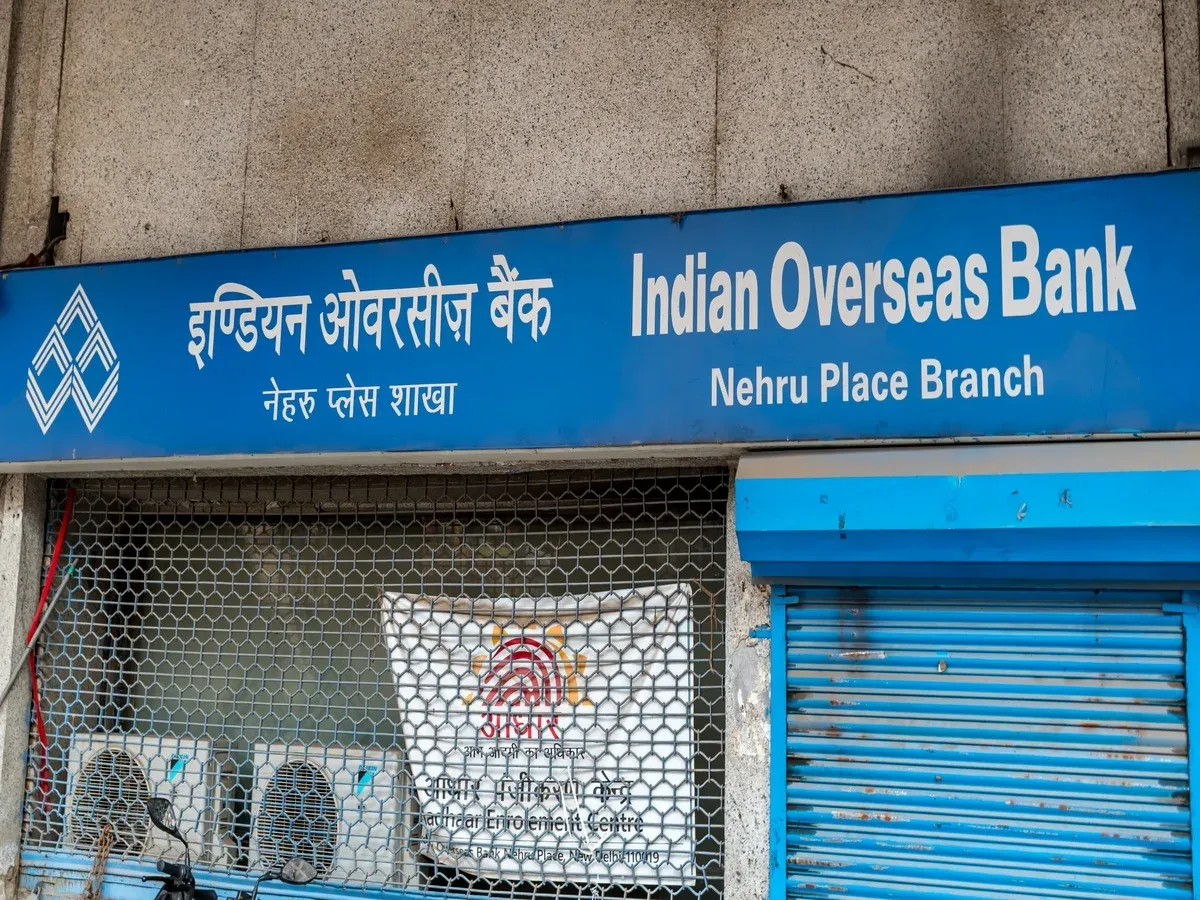
Indian Overseas Bank (IOB) is a leading public sector bank. IOB was founded in 1937 by M Chidambaram Chettyar and it was initially engaged in foreign exchange business. IOB started operations in Chennai and Rangoon (presently Myanmar) and later expanded its reach with a branch in Penang, Malaysia.
When India gained Independence, IOB had 38 branches within the country and 7 branches internationally. Its deposits amounted to ₹6.64 crore and advances stood at ₹3.23 crore. After the 1969 bank nationalisation, IOB turned into a public sector bank.
By 1969, the Indian Overseas Bank had expanded to 195 branches in India with aggregate deposits of ₹67.7 crore and advances totalling ₹44.9 crore.
Today, the bank has a significant international presence with operations in Singapore, Hong Kong, Thailand, Sri Lanka and South Korea.
The market capitalisation of IOB stood at over ₹82,000 crore as of December 22, 2023. IOB share price has surged 330% in the last three years.
Business operations
As of March 31, 2023, the Indian Overseas Bank had 3,220 domestic branches. This comprises 906 branches in rural areas, 961 in semi-urban regions, 655 in urban centres and 698 in metropolitan areas.
The bank manages 49 regional offices, 2 extension counters, 1 satellite office and 6 nodal audit offices. During the fiscal year 2022-23, the bank expanded by opening 4 rural branches, 2 digital banking units and one regional office. It has 3,477 ATMs and 3,190 business correspondents catering to the needs of over 4 crore customers.
The bank primarily offers financial services in retail banking, NRI banking and corporate banking segments.
Retail Banking:
IOB offers many services like savings and current accounts, term deposits, retail loans, home loans, mortgages, depository services, gold investment products, debit and credit cards, multi-city cheque facilities, insurance, mutual funds and real-time gross settlement services.
NRI Banking:
Catering to Non-Resident Indians (NRIs), the bank provides services such as remittances, resident foreign currency accounts, NRI home loans and various other products.
Corporate Banking:
For micro, small, and medium enterprises, IOB extends term loans, working capital loans, as well as loans for professionals, self-employed individuals and sectors like Information Technology, IT-enabled services (ITes) and Business Process Outsourcing (BPO).
It also offers agricultural short-term loans, agribusiness consultancy, and forex collection services. The bank also handles government transactions like direct and indirect tax payments, pension schemes and sales tax collections.
The subsidiaries and joint ventures of the bank are Odisha Gramya Bank, India International Bank (Malaysia) and Universal Sompo General Insurance Company Limited.
Indian Overseas Bank Financial Highlights
- Revenue: Indian Overseas Bank reported revenue of ₹37,532.15 crore in FY26 vs ₹33,689.62 crore in FY25. It showed an increase of 11.41% on a yearly basis.
- Operating Profit: Indian Overseas Bank reported an operating profit of ₹6,268.03 crore in FY26 vs ₹4,511.83 crore in FY25. It showed an increase of 38.92% on a year-on-year basis.
- Net Profit: Indian Overseas Bank reported a net profit of ₹5,208.03 crore in FY26 vs ₹3,334.82 crore in FY25. It showed an increase of 56.17% on a yearly basis.
Indian Overseas Bank Quarterly Result Highlights
- Indian Overseas Bank reported revenue of ₹10,937.80 crore in Jun 2026, compared with ₹9,779.87 crore in Mar 2026, representing an increase of 11.84% on a quarter-on-quarter (QoQ) basis.
- Indian Overseas Bank reported an operating profit of ₹1,859.07 crore in Jun 2026, compared with ₹1,659.09 crore in Mar 2026, representing an increase of 12.05% on a quarter-on-quarter (QoQ) basis.
- Indian Overseas Bank reported a profit of ₹1,659.24 crore in Jun 2026, compared with ₹1,505.45 crore in Mar 2026, reflecting an increase of 10.22% on a QoQ basis.
- The earnings per share (EPS) of Indian Overseas Bank stood at ₹2.70 during Jun 2026.
Data Source: BSE, Company announcements
Securities shown are illustrative, not recommendations. Past performance does not guarantee future results.