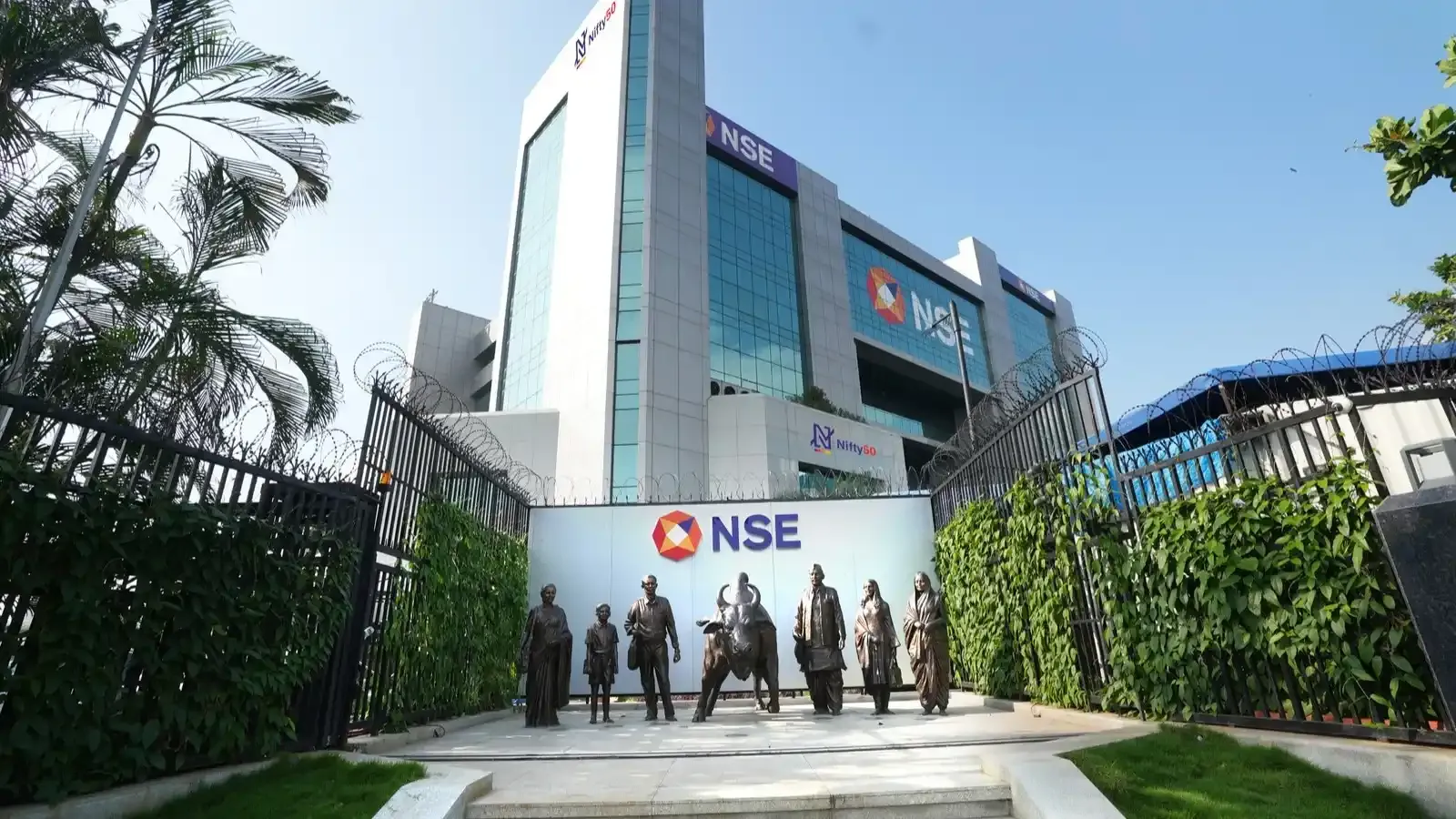
  1. IPO
National Stock Exchange of India IPO

6.62x

subscribed

National Stock Exchange of India IPO

Finance
listed
₹13,600Min. investment
  1. Pre-apply
    13 Sep
  2. Bid start
    17 Sep
  3. Bid end
    21 Sep
  4. Allotment
    22 Sep
  5. Release of funds
    23 Sep
  6. Demat transfer
    23 Sep
  7. Listing
    24 Sep

National Stock Exchange of India Limited IPO Details

SectorFinance
Price range₹1,700 – ₹1,785
IPO type
Regular
Lot size8 shares
Issue size₹22,561Cr
Draft Red Herring Prospectus
Read
Market Cap
₹4,41,787CrHigher than sector avg
RevenueApr 20NaN - Mar 20FY
₹16,601CrHigher than sector avg
Growth rate3Y CAGR
5.98%Higher than sector avg

National Stock Exchange of India Limited IPO Overview

National Stock Exchange of India (NSE) IPO date

NSE IPO will open for subscription on September 17, 2026, and the closing date for the IPO is September 21, 2026. After this, investors are expected to be updated about the allotment status on September 22, 2026.

Investors who got the IPO allotment can expect shares to be credited to their demat account on September 23, 2026. The shares will be listed on NSE and BSE on Thursday, September 24, 2026.

National Stock Exchange of India (NSE) IPO price band

NSE IPO is complete offer-for-sale (OFS) by exiting shareholders of over 12.64 crore shares. The IPO price band has been set between ₹1,700 and ₹1,785 per share. Interested investors can choose a price within this band to apply.

The IPO is a book-building issue, comprising an offer for sale of over 12.64 crore shares worth ₹22,561.6 crore. NSE IPO listing price will be determined on September 24, 2026. The listing price is the price at which a company’s shares debut on the stock exchanges.

National Stock Exchange of India (NSE) IPO lot size

NSE IPO lot size for retail individual investors is 8 shares, while the minimum investment is ₹14,280 per lot at the upper end of the price band. Total IPO issue size is ₹22,561.6 crore.

Checklist

Quality analysis
Revenue growth
Company valuation
Earnings expansion
The investment checklist helps you understand a company's financial health at a glance and identify quality investment opportunities easily

Compare

Companies in this sector
BSE LtdBSE Ltd
Max Financial Services LtdMax Financial Services Ltd
360 One Wam Ltd360 One Wam Ltd
Revenue
Higher revenue means strong sales and good market demand
This IPO
₹16,601Cr
This sector
₹2,201.91Cr
Compare with companies
3Y growth
Strong 3-year growth shows consistent progress and potential
This IPO
5.98%
This sector
0.04%
Compare with companies
PAT
Higher PAT means strong profitability and efficient cost management
This IPO
₹10,302Cr
This sector
₹158.94Cr
Compare with companies
Market cap
Higher market cap means strong confidence but may suggest overvaluation
This IPO
₹4,41,787Cr
This sector
₹15,153.53Cr
Compare with companies
P/E ratio
Lower ratio usually means stock is undervalued
This IPO
42.89
This sector
69.38
Compare with companies

Objectives

Carry out the offer for sale
The IPO is a complete offer-for-sale (OFS). Net IPO proceeds will go to selling shareholders.
Listing on stock exchanges
The company want to achieve the benefits of listing its shares on the stock exchanges.

Strength and Weakness

Leadership in core trading markets

NSE had FY26 domestic market shares of 92.9% in cash market turnover and 99.7% in equity futures turnover. It also included equity options with a 74.7% share in premium turnover. Such positions provide significant existing liquidity and reach across key trading products.

Large participant network

As of June 30, 2026, NSE had 1.328 crore unique registered investors, 1,328 trading members and 3,005 listed entities, with investors in over 99% of Indian postal codes.

Integrated clearing and risk infrastructure

Trading, clearing and settlement are delivered in a common ecosystem that enables cross-segment capital efficiency. For FY26, NSE Clearing’s (NCL) share of cleared value in equity-derivatives was 91.04%. core settlement guarantee fund of group clearing entities was ₹13,392.31 crore as of 30 June 2026.

High operating profitability

NSE operating EBITDA stood at ₹11,097.90 crore for FY26 with operating EBITDA margin of 66.85% and June 2026 quarter margin at 78.81%. The company outlines a scalable, technology-led operating model to support new products at low marginal cost.

Passive-investment franchise

As of June 2026, NSE had 435 indices. Domestic passive assets tied to Nifty indices stood at ₹8.95 lakh crore, which was 72.59% of the Indian index-fund and ETF AUM excluding gold and silver. In FY26, the index-licensing ecosystem was aided by the launch of 97 new Nifty-linked products.

Room to expand data and connectivity services

Data feeds and terminals earned ₹470.07 crore in FY26 while data connectivity earned ₹1,128.79 crore. NSE is planning for more granular real-time and historical datasets and value-added analytics. It also plans to add more than 1,800 colocation full rack equivalents based on market needs and service improvements.

Broader commodity and energy products

Electricity futures, electronic gold receipts and Indian natural gas futures expand the products available to users. National Coal Exchange of India Limited was incorporated in June 2026 to develop a domestic coal marketplace. These initiatives offer additional business avenues, with the coal platform described as a future opportunity rather than a mature earnings contributor.

International access through GIFT City

NSEIX held approximately 99.8% of equity-derivatives contracts traded among GIFT IFSC exchanges in FY26. Its approximately 21-hour trading window, Singapore Exchange partnership and wider product suite support international participation; NSEIX Global Access was launched in FY26 to facilitate access to global markets through an integrated digital account.

About National Stock Exchange of India Limited

NSE IPO will open for subscription on Thursday, 17 September. The IPO will remain open till Monday, 21 September, followed by listing on 24 September. NSE IPO is a complete offer-for-sale (OFS) with total issue size of ₹22,561.5 crore.
Established in November 1992, National Stock Exchange of India Limited (NSE) operates a vertically integrated, multi-asset exchange combining trading, clearing, settlement, listing, indices and market information services. Its products span cash equities, equity futures and options, currency and commodity derivatives, debt instruments, interest-rate futures and mutual fund transactions.
NSE also acts as a first-level regulator, overseeing market integrity and participant compliance. In FY26, it held market shares of 92.9% in cash-market turnover, 99.7% in equity-futures turnover and 74.7% in equity-options premium turnover.
NSE earns its revenue through transaction fees from trading members, listing fees from issuers, and charges for connectivity, data, licensing and post-trade services. FY26 revenue from operations was ₹16,601.3 crore, of which transaction charges contributed 78.6%. Options segment alone represented 60.22% of operating revenue, followed by cash-market transactions at 9.3% and futures at 8.9%.
Other revenue streams included data connectivity at 6.8% data feeds and terminals at 2.8%, listing at 2.1%, clearing and settlement at 1.5%, data-centre rack charges at 1.2%, and licensing at 0.9%. Income from investment activities contributed another 5.1%.
NSE connects issuers, brokers, institutional investors and individual investors across India. As of June 30, 2026, its platform had 13.2 crore unique registered investors, 26.1 crore registered investor accounts, 1,328 trading members and 3,005 listed entities, whose aggregate market capitalisation was ₹474.08 lakh crore.
Investors covered across 99% of Indian postal codes. The exchange provides mainboard and EMERGE platforms, alongside a Social Stock Exchange; 565 SME companies were listed as of June 2026, excluding specified migrated and institutional-platform companies. During FY26, its platform facilitated total fund mobilisation of ₹20.33 lakh crore, including ₹4.78 lakh crore of equity capital.
Over the years, NSE has formed various subsidiaries to expand its business beyond trading. NSE Clearing Limited provides domestic clearing and settlement, with FY26 shares of 88.4% in cash-market cleared value and 91% in equity-derivatives cleared value. NSE Indices managed 435 indices as of June 30, 2026, including the NIFTY50 index.
As of 30th June 2026, domestic passive funds tracking Nifty indices had assets of ₹8.95 lakh crore and accounted for 72.5% of Indian index-fund and ETF assets excluding gold and silver. NSE Data and Analytics (NSE DAL) and NSE Cogencis Information Services Limited (NSE Cogencis) provide market data, analytics, news and terminal services to institutional investors, asset managers, regulators and users across multiple financial markets.
Technology supports this nationwide network through seven data centres and more than 200,000 trading terminals across over 1,400 cities and towns. NSE had 1,868 member colocation full-rack equivalents till June 30, 2026. International access is provided through NSE International Exchange at GIFT City, offering foreign-currency products and approximately 21-hour trading.
NSE’s expansion initiatives include electricity futures launched in July 2025, electronic gold receipts, Indian natural gas futures launched in July 2026 and a coal-exchange subsidiary incorporated in June 2026. The latter remains in a development initiative; the RHP describes its proposed electronic marketplace and intended functions rather than an established operating business.
NSE operates in the exchange and capital-market infrastructure industry, which enables capital raising, securities trading, price discovery, risk management and post-trade settlement. Exchange groups have expanded from equity-trading venues into integrated platforms spanning derivatives, currencies, commodities, fixed income, indices and market data.
India’s cash-market turnover rose from ₹49.77 lakh crore in FY16 to ₹280.26 lakh crore in FY26 and the industry turnover is projected to be ₹473 to 507 lakh crore by FY30, implying a 14 to 16% CAGR. Growth drivers include economic expansion, capital formation, greater free float, digital trading and broader investor participation. Demat accounts increased from 5.51 crore in March 2021 to 22.45 crore in March 2026, a 32.4% CAGR. Mutual-fund assets reached ₹73.73 lakh crore in March 2026, growing at an 18.60% CAGR from March 2021.
NSE’s FY26 cash-market share of 92.9%, large registered-investor base and integrated trading and clearing infrastructure position it to participate in this expansion. Its Nifty ecosystem also provides exposure to passive investing: Nifty-linked domestic funds accounted for 72.59% of Indian index-fund and ETF assets excluding gold and silver in June 2026. The company’s stated growth plans include broader index and data offerings, commodity products and international access through GIFT City, extending its participation across capital-market activities. Now, National Stock Exchange of India is launching its initial public offering (IPO), which is complete offer-for-sale of over 12.6 crore shares worth ₹22,561.6 crore. NSE shares will be listed on BSE only on Thursday, September 24, 2026.
Several institutional shareholders are reducing their stakes in NSE via offer-for-sale, led by SBI (1.59 crore shares), SBI Capital Markets (87.8 lakh), New India Assurance (1.05 crore), Bank of Baroda (76.9 lakh), GIC (61.9 lakh) and Stock Holding Corporation (61.9 lakh). Other selling shareholders include Canada Pension Plan Investment Board (CPPIB), Aranda Investments, MS Strategic and United India Insurance.

How to apply for NSE IPO?

If you are interested in this investment opportunity but unsure how to apply for an National Stock Exchange of India IPO, follow these steps.
When the public issue opens for subscription, one can follow this step-by-step guide on how to apply for the National Stock Exchange of India IPO on Upstox:
  • Log in to your Upstox account, using your six-digit PIN
  • After logging in, click on ‘Discover’
  • On the ‘Discover’ tab, you will find the ‘Invest in IPO’ section
  • Under the Invest in IPO section, look for the ‘National Stock Exchange of India IPO’ tab and click on it
  • Now fill in all the required information, like ‘bid price’ and ‘lot size’
  • Confirm and click on ‘Apply’
  • Accept the mandate on your UPI app

IPO Analysis

video thumbnail
IPO REVIEW
National Stock Exchange of India IPO
Should you apply?

National Stock Exchange of India IPO Subscription Status

Date
QIB
NII
Retail
Total
17-Sep-26
0.08 times (X)
2.07 times (X)
0.43 times (X)
0.49 times (X)
18-Sep-26
0.25X
4.86X
0.72X
1.34X
21-Sep-26
7.91X
18.89X
1.35X
6.62X

Latest News on National Stock Exchange of India IPO

news logo
Leading stock exchange, the National Stock Exchange of India (NSE), will launch its public offer on September 17. The issue, with a price band of ₹1,700 to ₹1,785 per share, will end on September 21.

4 min read

news logo
NSE IPO: The initial public offering of National Stock Exchange of India Ltd is seeking to raise ₹22,561.57 crore via an offer for sale of 12.64 crore shares.

3 min read

news logo
The ₹22,561.57 crore NSE IPO, with a price band of ₹1,700 to ₹1,785 per share, is only an offer for sale (OFS) of 12.64 crore shares. There is no fresh issue component.

3 min read

news logo
NSE IPO Day 1 Live Updates: The initial public offering of the National Stock Exchange of India (NSE) opened for subscription on Thursday, with the issue getting subscribed 43% by the end of first day of bidding.

5 min read

news logo
NSE IPO is only an offer for sale of 12.64 crore shares worth ₹22,561.57 crore by shareholders, including SBI, SBI Capital Markets, Canada Pension Plan Investment Board, Aranda Investments (Mauritius), New India Assurance, MS Strategic (Mauritius), Bank of Baroda, General Insurance Corporation, Stock Holding Corporation and United India Insurance.

3 min read

news logo
The ₹22,561.57 crore initial share sale of the National Stock Exchange of India (NSE) comprises an offer for sale (OFS) of up to 12.64 crore shares by existing shareholders.

2 min read

news logo
NSE IPO allotment status: The initial public offering was solely an offer-for-sale (OFS) of 12.64 crore shares, with no fresh issuance of equity shares.

4 min read

news logo
NSE IPO Allotment Highlights: The basis of allotment for the National Stock Exchange of India Ltd was finalised on Tuesday, September 22. The details are available on the websites of the NSE, the BSE and MUFG Intime India.

5 min read

news logo
NSE IPO listing date: The initial public offering was only an offer-for-sale (OFS) component of 12.64 crore equity shares worth ₹22,561.57 crore. There was no fresh issuance of shares.

3 min read

news logo
The ₹22,561.57 crore NSE IPO was an offer-for-sale of 12.64 crore shares by existing shareholders, with no fresh issue component.

2 min read

Frequently asked questions

Investors can apply for the National Stock Exchange of India IPO through their Demat account via the stock exchange or through their broker.
The issue size of the National Stock Exchange of India IPO is 22561 Cr.
Pre-applying for an IPO allows you to submit your application before the official subscription period begins.
The IPO shares will typically list on major stock exchanges such as the National Stock Exchange (NSE) and Bombay Stock Exchange (BSE), as specified in the IPO prospectus.