Types of Orders in the US Stock Market

Written by Subhasish Mandal
Published on October 07, 2026 | 9 min read

Key Takeaways:
-
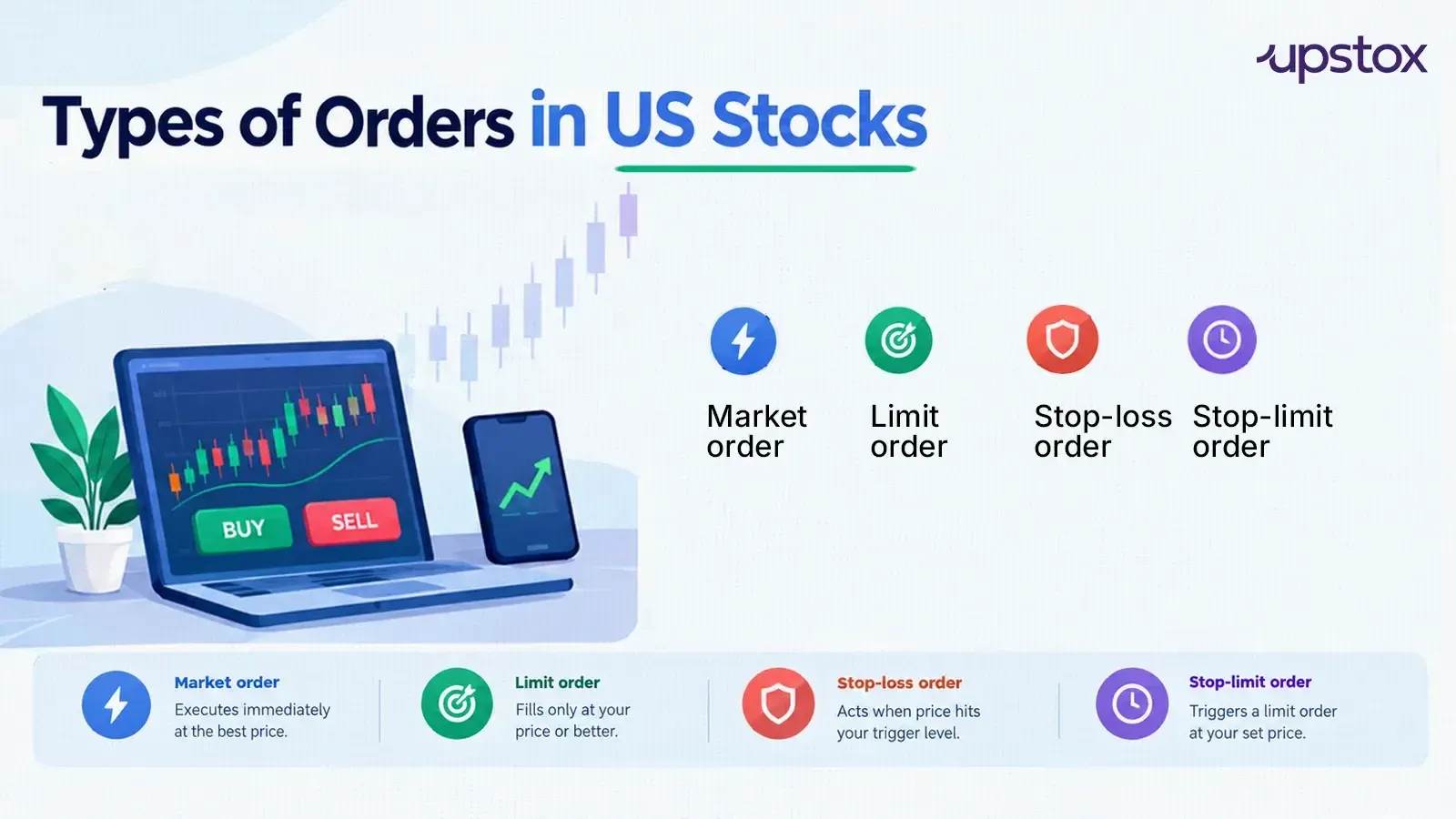
The US stock market offers several order types, including market orders, limit orders, stop-loss orders, stop-limit orders and trailing stop orders.
-
Brokers route all orders to exchanges or other market centres for execution, as clients request, and your trading terminal updates the status accordingly.
-
A good-till-cancelled (GTC) order is an advance order type that remains active until the order is filled, cancelled or expires under broker rules.
-
US stock markets operate in different time zones, therefore, orders placed by Indian investors may execute at different times depending on market sessions.
Investing in the US stock market from India requires more than selecting a stock and deciding how many shares to buy. Investors also need to understand the instructions given by the broker platform. These instructions are known as stock market orders.
There are various types of orders, such as market orders, limit orders, stop-loss orders, stop-limit orders, and more. Each order type has a specific purpose and can affect a trade's execution price, timing, and risk.
For Indian investors, understanding these order types is important because the US stock market operates in a different time zone.
What is an Order in the Stock Market?
An order in the stock market is an instruction an investor gives a broker through an online trading platform to buy or sell shares. The order specifies key details such as the stock name, quantity, price conditions, and how long the instructions remain active.
For example, an investor may place an order to buy 10 shares of ABC stock at the current market price. Alternatively, the investor may also specify that the shares should be purchased only if the price falls to a particular level.
Different Types of Orders in the US Stock Market
Broadly, there are five main types of orders used in the market. Let us understand them one by one with an example.
Market Order
A market order is an order type where investors enter only the quantity to buy or sell, and the trade executes at the best available price. The objective is quick execution rather than obtaining a specific price.
Market orders are commonly used when execution timing is more important than execution price. They can be helpful for highly liquid US stocks with narrow bid-ask spreads.
Example:
Suppose an investor wants to buy 10 shares of ABC company immediately. If the current available price is $200, placing a market order will execute the purchase near the current market price.
However, the final execution price can differ slightly because stock prices change continuously.
Limit Order
A limit order is an order type in which investors specify the maximum price they are willing to pay when buying or the minimum price they are willing to accept when selling. The order executes when the specific price conditions are met.
For a day limit order, if the price does not reach the specified level during the particular trading session, the order gets automatically cancelled.
Example:
Suppose an investor wants to buy 10 shares of ABC company but does not want to pay more than $195 per share.
Current market price: $200 per share.
In such scenarios, the investor can place a limit order at $195. When the stock price reaches $195, the order will be automatically executed.
In a sell limit order, investors set a selling price; if the stock reaches the target price, the order gets triggered and executed.
Note: The validity of such an order is limited to a particular trading session only.
However, a limit order can also have different validity periods depending on the time-in-force instruction selected.
Stop-Loss Order
A stop-loss order is an order type used to limit potential losses. It is a risk management tool that automatically triggers a market order to sell or buy a stock once it reaches the specified price.
Example:
If you bought an ABC stock at $200 and want to limit your potential loss to 5%, you can place a stop-loss order at $190. If the stock price drops to $190, the stop-loss order triggers and becomes a market order to sell. The eventual execution price may differ from $190.
Similarly, when doing short selling, you can place stop-loss orders above your selling price. It triggers a buy when the stock price rises to the stop price.
Stop-Limit Order
A stop-limit order combines the features of a stop-loss order and a limit order. Once the stock reaches the specified stop price, the order becomes a limit order rather than a market order.
Example:
An investor owns a stock trading at $100 and sets a stop price of $90 and a limit price of $88. If the stock reaches $90, the order is activated and becomes a sell limit order. But it executes at $88 or higher.
This order type gives you more control over the minimum selling price. However, if the stock falls rapidly below $88, the order may remain unexecuted.
Trailing Stop Order
A trailing stop order follows a stock’s price as it moves in a favourable direction while helping protect gains if the price reverses sharply. The trailing amount can be specified as a fixed amount or percentage.
Example:
An investor owns a stock trading at $100 and sets a trailing stop of 10%. Now, when the stock price rises to $120, the trailing stop may adjust to $108, depending on the order's terms and broker rules. If the stock price falls to $108, the order is triggered, and the resulting order may execute at the next available price, and profit is booked.
Also Read: How to Trade in US stocks from India?
What is a Day Order in the Stock Market?
A day order remains active only during the current trading session. If the order is not executed during the intraday market session, it automatically expires and is cancelled.
Day orders are useful when an investor wants to specify price conditions for the current trading session.
Example:
An investor places a limit order to buy an ABC stock at $150 during a trading session. If it does not reach $150 that day, the order expires rather than remaining active for the next trading session.
What is a Good-Till-Cancelled (GTC) Order?
A GTC order is an advanced order type that remains active until it is executed or cancelled by the investor, subject to the broker's rules.
GTC orders can be convenient for longer-term price targets. However, investors should understand their broker’s GTC validity period because brokers automatically cancel such orders after a specified number of days.
Example:
ABC stock is trading at $200 per share.
You want to buy ABC stock only when its price falls to $150. Instead of placing the same limit order every day, you can use the GTC order to set the buying price.
This order remains active until executed or cancelled, or until it reaches the broker's applicable validity limit. However, check whether your broker supports GTC orders.
Which Order Type Should Indian Investors Use for US Stocks?
The best order type depends on the investor’s objective, trading strategy, liquidity and market conditions. Investors should not assume one order type is suitable for all US stock transactions.
Consider market orders when immediate execution is needed, particularly for liquid stocks.
Use limit orders when setting entry and exit prices matters. Limit orders help you buy or sell a stock at a specified price or better, but do not guarantee execution.
Stop-loss orders are risk-management tools that active traders often use. When investing, stop-loss orders are not that relevant.
Trailing stop orders may be useful when investors want to protect gains while allowing the stock to continue moving upward.
US Stock Market Timings in IST for Placing Orders
When investing in US stocks from India, it is important to understand the US stock market's trading hours.
The table below shows the US stock market timings in Indian Standard Time (IST)
| Session | Standard Time (IST) | Daylight Saving Time (IST) |
|---|---|---|
| Pre-Market | 2:30 PM - 8:00 PM | 1:30 PM - 7:00 PM |
| Regular Market | 8:00 PM - 2:30 AM | 7:00 PM - 1:30 AM |
| After-Hours | 2:30 AM - 6:30 AM | 1:30 AM - 5:30 AM |
These timings correspond to the standard US market sessions of 4:00 AM - 9:30 AM ET for pre-market, 9:30 AM - 4:00 PM ET for regular trading, and 4:00 PM - 8:00 PM ET for after-hours trading. Broker availability and extended-hours order types may vary.
For detailed information, read: US Stock Market Timings

Understanding the different order types helps investors understand how orders may be executed in the US stock market more effectively.
A market order prioritises execution, while a limit order provides greater price control. A stop-loss order can help manage downside risk, while a stop-limit order combines a trigger with a specified execution price. A trailing stop order can help manage downside risk as the stock moves favourably.
Before placing an order for US stocks, investors should understand how their brokerage platform handles each order type, including execution conditions, validity periods and extended trading sessions.
FAQs
What are the main types of orders in the US stock market?
The main order types for investing in US stocks are market orders, limit orders, stop-loss orders, and stop-limit orders.
What are the differences between a market order and a limit order?
A market order aims to execute immediately at the best available price, whereas a limit order executes only at the price the investor specifies.
What is a GTC Order?
Good-Till-Cancelled (GTC) is an order type which remains active until it is executed or cancelled, or expires under broker rules.
What happens when a stop order is triggered?
When the stop order is triggered, it automatically converts into a market order and executes at the next available price.
Can I place orders outside regular US market hours?
Yes, you can place US stock orders during pre-market and after-hours trading sessions. However, these sessions have lower liquidity and wider bid-ask spreads.
Can I cancel a US stock order after placing it?
An open order can be cancelled even after placing it. However, if the order is executed, the cancellation option is not available.
About Author
Subhasish Mandal
Sub-Editor


A finance professional with strong expertise in stock market and personal finance writing, he excels at breaking down complex financial concepts into simple, actionable insights. Holding a Master’s degree in Commerce, he combines academic depth with practical knowledge of technical analysis and derivatives.
Read more from Subhasish

















Upstox is a leading Indian financial services company that offers online trading and investment services in stocks, commodities, currencies, mutual funds, and more. Founded in 2009 and headquartered in Mumbai, Upstox is backed by prominent investors including Ratan Tata, Tiger Global, and Kalaari Capital. It operates under RKSV Securities and is registered with SEBI, NSE, BSE, and other regulatory bodies, ensuring secure and compliant trading experiences.
Related articles
US Stocks
US Stock Dividends: Meaning, Types and How They Work11 min read | Written by Subhasish Mandal


US Stocks
How Does INR to USD Conversion Work When Buying US Stocks?10 min read | Written by Subhasish Mandal


US Stocks
US Stocks vs US ETFs: Differences Explained for Indian Investors13 min read | Written by Bidita Sen

US Stocks
What Is the Fed Interest Rate and How Does It Affect Stocks?10 min read | Written by Mariyam Sara