What is the Difference Between Shares and Debentures: Explain

Written by Sachin Gupta
Published on March 10, 2023 | 7 min read


Key Takeaways
- Shares represent ownership in a company, whereas debentures represent a loan provided to a company.
- Shareholders can earn returns through dividends and capital appreciation, while debenture holders generally receive interest income.
- Shares generally involve higher investment risk and offer greater potential returns, whereas debentures usually provide more predictable income.
- Shareholders may have voting rights in company decisions, while debenture holders generally do not have management or voting rights.
Shares and debentures are two popular financial instruments that companies use to raise capital from investors. However, they differ significantly in terms of ownership, returns, risk, and repayment. While shares provide investors with partial ownership in a company and the opportunity to earn dividends and capital gains, debentures represent borrowed funds that offer fixed or predetermined interest payments.
Understanding the difference between shares and debentures is essential for investors to make informed investment decisions based on their financial goals, risk tolerance, and expected returns.
What Are Shares?
Shares represent the lowest portion of the company's capital. Business organizations frequently issue stocks or shares to raise capital by offering a part of their ownership to third parties. The shares are offered for sale on the open market or the stock market to raise money for the company.
As soon as shares are purchased, shareholders are given the right to ownership in the corporation. The greatest shareholder is the one who owns at least 50% of the company's shares, while other shareholders may also be considered owners. In other words, you become a shareholder in the business in proportion to the number of shares you own.
Types Of Shares
There are two types of shares-
Equity Shares-
Equity shares can be compared to the company's capital or primary shares. Shares with voting rights on which the dividend rate is variable. The firm issues these bulk shares, also referred to as ordinary shares. These are transferable securities actively traded on the stock market by investors. Shares are returned in the event of a corporate wind-up after all liabilities have been settled.
Preference Shares-
Second-tier shares of a firm may include preference shares. When the corporation distributes its profits, the preferred shareholders get preference; preferred shareholders receive shares first, followed by common shareholders. They are compensated first, even during liquidation. The dividend rate is set despite the lack of voting rights on the shares.
What Are Debentures?
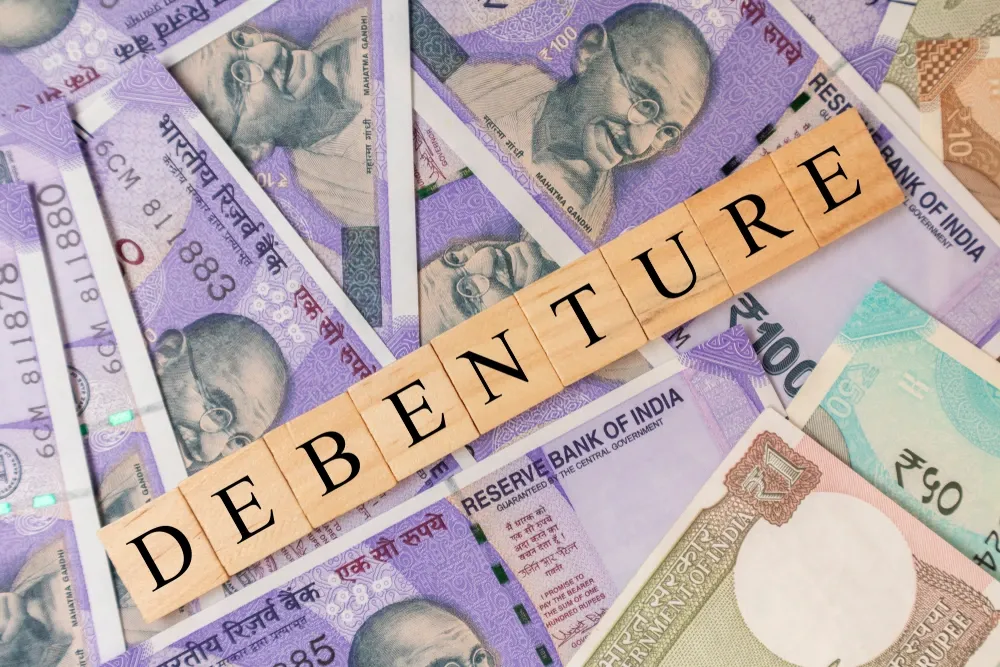
A debenture is a type of debt instrument that businesses and governments use to raise funds through loans from the general public. A debenture makes you a creditor of the company you buy it from. Debentures are unsecured debt instruments because one does not use any collateral to support them. Debentures also come with a set interest rate. The principal is repaid at maturity or when you sell the debenture on the open market. Although unsecured debentures are also permitted, debentures are typically secured by a levy on assets. They are not eligible to vote.
Types Of Debentures
The debentures are of the following types:
Secured And Unsecured Debentures
Debentures with a charge against the company's assets are known as secured debentures. As a result, the company's mortgaged assets may be used by secured debenture holders to recoup principal payments or unpaid interest. On the other hand, Unsecured Debentures do not fulfil any of the roles mentioned earlier.
Registered And Bearer Debentures
Debenture holders' names, residences, and other holding details recorded in the enterprise's register are all included in registered debentures. Bearer debentures, on the other hand, are issued by a business that exempts its holders from keeping records. In the case of unregistered debentures, the corporation pays the holder of the debenture, regardless of its name and the principal amount. Debentures that are not registered are easily transferred.
Redeemable And Non-Redeemable Debentures
A redeemable debenture allows the principal amount to be redeemed within a predetermined time frame, unlike non-redeemable debentures, which do not offer such a choice.
Convertible And Non-Convertible Debentures
Long-term debt obligations, known as convertible debentures, are those that the company issues and that, after a specified amount of time, may be converted into shares of equity capital. On the other hand, businesses can utilize non-convertible debentures as a financial instrument to solicit funding from the public. The company issues a debt paper with a predetermined tenor and agrees to pay the buyer fixed interest throughout that time.
Difference Between Shares And Debentures
| Basis of Difference | Shares | Debentures |
|---|---|---|
| Meaning | Shares represent ownership in a company. | Debentures represent borrowed capital or debt taken by a company. |
| Investor Status | Shareholders are the owners of the company. | Debenture holders are creditors of the company. |
| Returns | Investors earn returns through dividends and capital appreciation. | Investors generally earn fixed or predetermined interest. |
| Voting Rights | Equity shareholders generally have voting rights. | Debenture holders do not have voting rights. |
| Risk | Shares generally carry higher investment risk. | Debentures generally carry lower risk than equity shares, depending on the issuer and security. |
| Security | Shares are not secured against company assets. | Debentures may be secured or unsecured. |
| Repayment | Share capital is generally not repayable during the company's existence. | Debentures are generally repayable according to their terms and maturity date. |
| Payment During Liquidation | Equity shareholders are paid after creditors and other preferential claims. | Debenture holders generally receive payment before shareholders, subject to their legal priority. |
| Convertibility | Shares cannot ordinarily be converted into debentures. | Convertible debentures can be converted into equity shares under specified conditions. |

Shares and debentures are important investment instruments that offer different benefits and risks to investors. While shares provide ownership in a company and the potential for higher returns through dividends and capital appreciation, debentures offer interest income and make investors creditors rather than owners.
Shares generally suit investors with a higher risk appetite and long-term investment goals, whereas debentures may appeal to those seeking relatively stable income. Ultimately, investors should carefully evaluate their financial goals, risk tolerance, and investment horizon before choosing between shares and debentures. Including both instruments in a diversified portfolio can also help balance potential returns and investment risks.
FAQs
What is the main difference between shares and debentures?
The main difference is ownership. Shares represent ownership in a company, making shareholders part-owners of the business. Debentures represent borrowed funds, making debenture holders creditors of the company.
Which is better for investment: shares or debentures?
The choice depends on your financial goals and risk tolerance. Shares may be suitable for investors seeking long-term capital appreciation and willing to accept higher risks. Debentures may be suitable for investors seeking relatively predictable interest income and comparatively lower risk.
Do shareholders and debenture holders receive returns in the same way?
No. Shareholders generally earn returns through dividends and capital appreciation, whereas debenture holders receive interest payments according to the agreed terms of the debenture.
Do debenture holders have voting rights in a company?
Generally, no. Debenture holders are creditors rather than owners of the company. Therefore, they do not usually have voting rights in company management decisions.
What happens to shareholders and debenture holders if a company goes into liquidation?
Debenture holders generally receive repayment before shareholders because they are creditors of the company. Shareholders receive any remaining amount only after the company's liabilities and other legally prioritised claims have been settled.
About Author
Sachin Gupta
Senior Sub-Editor

is a seasoned financial writer with over eight years of experience across global markets, including Australia, the UK, and New Zealand. He specialises in simplifying complex financial concepts, making them accessible and engaging for a wide range of readers. When he’s not writing or traveling, he can often be found exploring the mountains, drawing inspiration from the calm and clarity of the outdoors.
Read more from Sachin











Upstox is a leading Indian financial services company that offers online trading and investment services in stocks, commodities, currencies, mutual funds, and more. Founded in 2009 and headquartered in Mumbai, Upstox is backed by prominent investors including Ratan Tata, Tiger Global, and Kalaari Capital. It operates under RKSV Securities and is registered with SEBI, NSE, BSE, and other regulatory bodies, ensuring secure and compliant trading experiences.
Related articles


Share Market
What are DVR Shares and Why Do Companies Issue Them?7 min read | Written by Subhasish Mandal

Share Market
Ready-Made or DIY Screener? Two Ways to Explore the Market5 min read | Written by Sachin Gupta

Share Market
Understanding Markets in Real Time: Inside Live Market Analysis Sessions4 min read | Written by Sachin Gupta

Share Market
Why Market Buzz Fails and How to Track Real Stock Signals?9 min read | Written by Bidita Sen

Share Market
What Is a Market Correction? Meaning, Causes, and Strategy15 min read | Written by Bidita Sen

Share Market
Cyclical vs Defensive Stocks: Differences, Examples and Strategy15 min read | Written by Bidita Sen