Benefits of trading in futures

Written by Upstox Desk
Published on December 01, 2017 | 5 min read

Key Takeaways:
-
Futures trading is the buying and selling of standardised futures contracts of an underlying asset at a predetermined price on a specific future date.
-
In futures trading, both the buyer and the seller are obliged to fulfil the contract terms on the expiration date.
-
While trading futures, you only need to pay initial margin to enter the contract, not the full contract value.
-
Profits and losses are calculated and settled daily at the end of each trading session.
What are Futures?
A futures contract is a contract or agreement between two parties to conduct a transaction at a predetermined locked down price at some point in the future. It is essentially a bet on the prospects of a stock, one of the multiple financial trades you can perform. Two parties take opposing stances, with one agreeing to buy shares and the other agreeing to sell them at a certain price sometime later, irrespective of the prevailing market price then.
To illustrate, consider two trading entities A and B. A holds the view that the value of a stock would rise from its present value in the future while B believes the opposite. A and B enter into a contract with A agreeing to buy shares of the stock from B at the present price sometime in the future. If A’s bet comes true, that is, if stock value rises, A can get shares of the stock at a discounted price from B. Conversely, if the share value drops, B can sell shares to A at a premium, that is, at a value greater than the market price.
How does futures trading work?
In reality though, people don't really exchange stocks to fulfill a futures contract. Rather, they pay the price differential, which is the difference between the market price and the agreed upon futures price. Thus, from the earlier example, if the market price of the stock goes up, B doesn't really sell shares to A at a lower price. Rather, B pays the increase in stock price to A which is equivalent to selling shares at a discount.
- In India, both the Bombay Stock Exchange and National Stock Exchange offer futures.
- A person can either place a buying order, which means agreeing to buy stocks at a fixed price in future, or a selling order, which is agreeing to sell stocks at the fixed price.
- The exchange connects buyers and sellers and thus a futures contract is created between them.
- A buyer takes a bullish stance while a seller takes a bearish stance on stock price.
- Every contract expires on the last Thursday of a month and all payments are settled along with the creation of new contracts.
- Once one has bought futures in a stock, one can sell it to other market participants.
- The futures price rises when the stock value rises and falls when the stock value falls.
- One needn't pay the full price of stock futures to buy or sell futures. Only a fraction of the amount needs to be paid, which is called margin. This differentiates futures from equity.
- Futures can only be bought in lots. The lot size varies between different futures. For example, a lot could be 25, 50 or 125 shares.
Benefits of trading in futures
There are 2 primary benefits to future trading - the leverage you receive, and the risk mitigation it offers.
Margins and leverage
Unlike buying equity, one needn't pay in full to buy futures. One need to only pay a percentage of the total contract value to buy or sell in futures. This percentage is called margin and varies between different stock futures. Thus you could buy/sell a lot more shares of futures than equity with a certain amount of money. For example, if the margin is fixed at 20% for futures in a stock, one could buy/sell 5x times more shares in futures than in equity. This ratio is called leverage. Thus, with 20% margin, the leverage is 5. Leverage is a double-edged sword. It multiplies profits manifold but also multiplies losses.
If futures in a stock has a leverage of 5, it means that profits would be five times than that of equity profits. If the equity returns a profit of 20%, the futures offer a return of 100% ( Futures profit percentage = Equity profit percentage*Leverage). This is possible because only a fraction of the price is paid to buy futures (margin). But losses would be equally magnified too. A 20% loss in equity would cause 100% loss in futures having a leverage of five.
Hedging against risks
Futures can be used to mitigate or hedge against systemic risks to investment in a single stock or a portfolio of stocks. For single stocks, hedging can be done easily by selling futures at a higher price than the price at which equity was bought. The number of futures sold must be equal to the number of equity shares held by one. Thus, if prices fall, the profit from the selling order in stock futures would offset fall in equity value and vice versa. A fixed return is guaranteed and market fluctuations don't affect the returns. Futures can also be used to hedge against risks to investment in a portfolio of stocks.

Futures trading offers a unique way for market participants to hedge the risk, speculate on price movements and capitalise on trending markets. With exchange-traded standardised contracts and leverage, it has become one of the most actively traded derivatives.
However, trading futures contracts carries significant risk. Therefore, it is important to manage risk and trade with proper stop-loss.
About Author
Upstox Desk
Upstox Desk
Team of expert writers dedicated to providing insightful and comprehensive coverage on stock markets, economic trends, commodities, business developments, and personal finance. With a passion for delivering valuable information, the team strives to keep readers informed about the latest trends and developments in the financial world.
Read more from Upstox






Upstox is a leading Indian financial services company that offers online trading and investment services in stocks, commodities, currencies, mutual funds, and more. Founded in 2009 and headquartered in Mumbai, Upstox is backed by prominent investors including Ratan Tata, Tiger Global, and Kalaari Capital. It operates under RKSV Securities and is registered with SEBI, NSE, BSE, and other regulatory bodies, ensuring secure and compliant trading experiences.
Related articles

Futures and Options
Options Trading Strategies: Why Expiry Days Can Wipe Out Profits10 min read | Written by Bidita Sen
Futures and Options
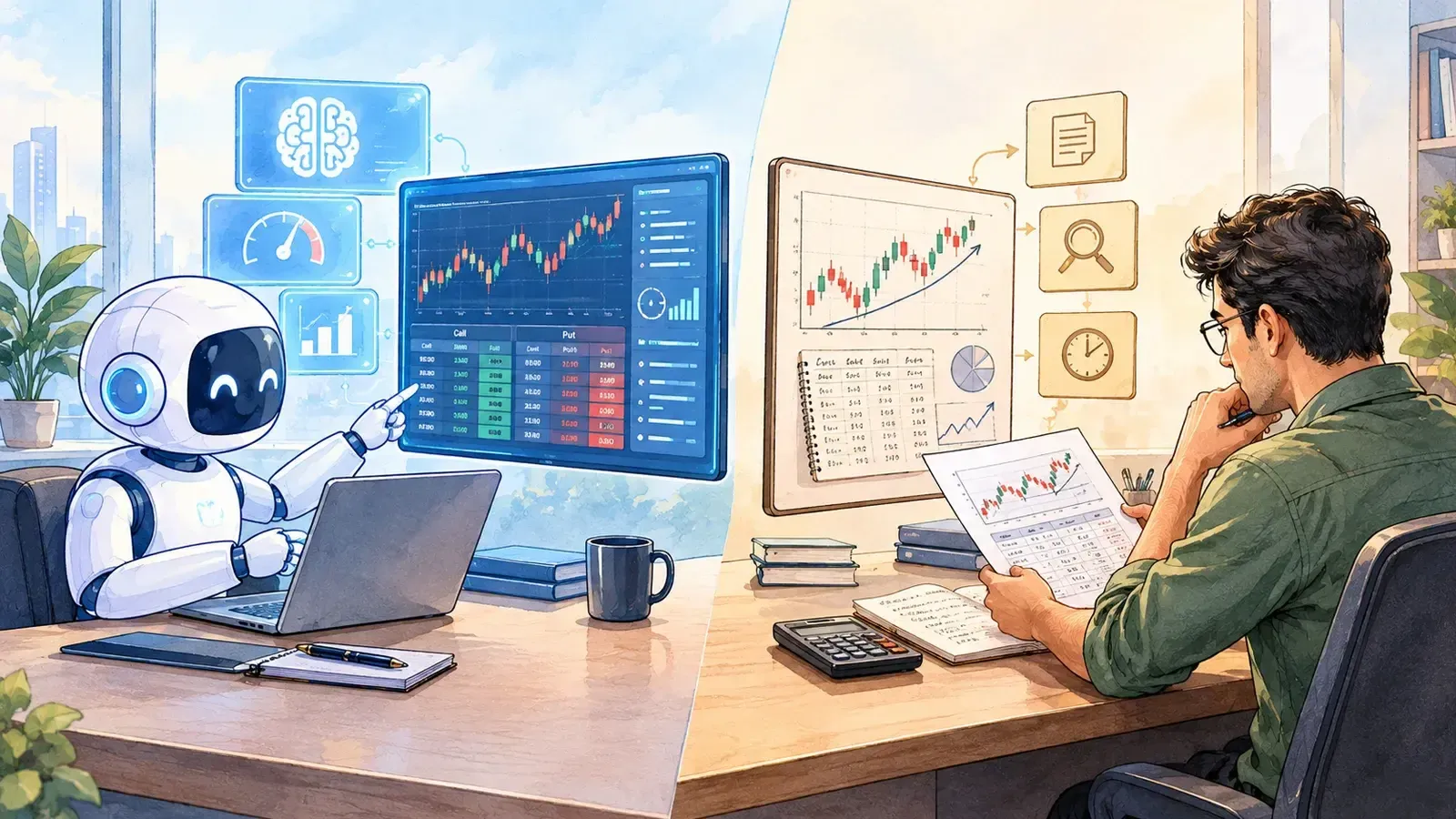
AI Option Chain Analysis vs Manual Option Analysis: A Quick Comparison5 min read | Written by Subhasish Mandal
Futures and Options
What Is AI Option Trading and How Does It Work?4 min read | Written by Subhasish Mandal
Futures and Options
What are ITM, OTM, ATM in Call and Put Options12 min read | Written by Subhasish Mandal
Futures and Options
What is Forward Market and How They Work? A Complete Guide15 min read | Written by Subhasish Mandal