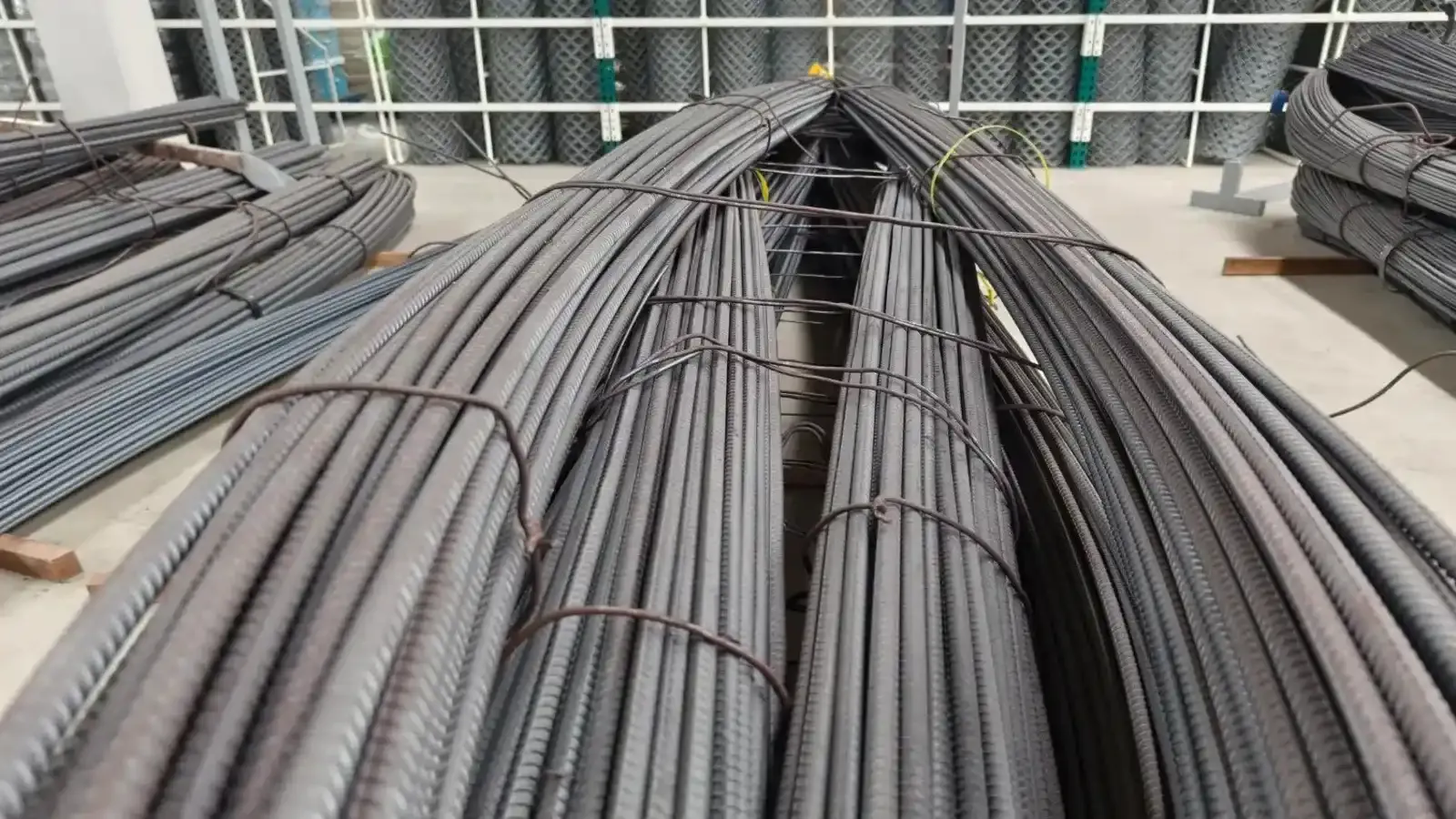
German Green Steel and Power is a vertically integrated iron and steel manufacturing company that mainly manufactures TMT bars in western India.
Incorporated in 2008, the company bought the Samakhiyali plant via a process of liquidation under the Insolvency and Bankruptcy Code for ₹35.70 crore in 2018 and began production in 2019. In 2024, the company bought 97.41% shares in German TMT Private Limited to bring the Viramgam plant into its fold. It has now ventured into value-added products, including cut-and-bend bars and epoxy-coated TMT bars, and made a contract manufacturing agreement with JSW One Distribution Limited in 2025.
The company operates two Gujarat manufacturing facilities. Samakhiyali is an integrated facility producing sponge iron, MS billets and TMT bars, while Viramgam, operated through its material subsidiary, manufactures MS billets and TMT bars. Its TMT portfolio spans Fe500, Fe500D, Fe550, Fe550D and corrosion-resistant grades in sizes from 8 mm to 40 mm. FY26 combined installed capacities were 66,000 MT for sponge iron, 3,57,060 MT for MS billets and 3,01,950 MT for TMT bars, with utilisation of 95.21%, 79.44% and 87.79%, respectively.
Vertical integration extends from sponge iron and billet production to rolling, quenching and testing of finished TMT bars. Sponge iron and billets remaining after captive consumption are sold externally. The facilities use Thermex quenching technology, while chemical and mechanical testing is undertaken before dispatch; the Samakhiyali testing laboratory is NABL-accredited. The group has also introduced cut-and-bend and epoxy-coated products to broaden its value-added portfolio. These capabilities provide greater control over intermediary inputs and product specifications, although the business remains dependent on externally procured scrap, iron ore, coal, silico-manganese and dolomite.
The manufacturing system is supported by captive and renewable energy assets. Samakhiyali has 16 MW of coal-based and 4 MW of waste-heat-recovery capacity, alongside wind-solar installations serving both facilities. During FY26, the parent company’s captive plant supplied 75.44% of its consumed electricity, and hybrid generation supplied another 5.31%, while 19.25% was purchased from the grid. At the consolidated level, captive and hybrid plants supplied 50.34% and 16.64%, respectively. This reduces, but does not eliminate, exposure to grid availability and energy costs.
TMT bars were the dominant revenue stream, contributing 78.7% of FY26 product revenue, up from 63.1% in FY24. MS billets accounted for 6.02% in FY26, sponge iron 1.8% and by-products and other items 13.3%. The business is predominantly B2B with customers in the areas of roadways, engineering services, thermal plants and real estate in the form of distributors, dealers and institutional customers. FY26 revenue was split 37.5% from distributors, 20.8% from dealers and 41.5% from institutional customers. The network included 12 distributors, 148 dealers and 343 direct institutional customers as at March 31, 2026.
Geographically, the company remains highly concentrated in Gujarat, which contributed 97.74% of FY26 revenue from operations. Exports commenced in FY26 and contributed 1.13%, across Cape Verde, Tanzania and Sri Lanka. Customer concentration also remains material: the largest customer represented 10.67% of FY26 revenue, while the top three and top ten accounted for 21.83% and 50.62%, respectively. Seven of the ten largest customers had relationships exceeding three years, but sales are generally based on purchase orders rather than long-term supply contracts.
FY25 revenue growth of 33.4% was because of the consolidation of German TMT Private Limited from May 21, 2024. FY26 revenue grew 11.3%, primarily through higher sales volumes and manufacturing activity; PAT grew 33.2%, notwithstanding higher employee, finance, depreciation, power and freight costs.
The Indian TMT market is at ₹2,17,000 crore in FY25, rising to ₹4,11,200 crore by FY32P. Infrastructure and organised residential construction are projected as the strongest end-user segments, with FY27P-FY32P CAGRs of 12.1% and 13.9%, respectively. Demand is linked to roads, railways, metros, housing, commercial construction, industrial facilities and urban utilities but remains sensitive to steel prices, interest rates, construction cycles, raw-material availability and government infrastructure spending.
The company’s 78.74% TMT revenue exposure, broad 8-40 mm size range, institutional customer base and proposed coated and structural products provide direct participation in these demand segments. It plans to expand Samakhiyali sponge-iron capacity from 66,000 MTPA to 1,48,500 MTPA, billet capacity from 2,14,500 TPA to 4,12,500 TPA and TMT capacity from 1,81,500 MTPA to 3,46,500 MTPA. The proposed project also adds renewable power and upstream capacity. However, converting industry growth into company growth depends on timely capex execution, expansion beyond Gujarat and the ability to maintain utilisation and margins in a cyclical pricing environment.
Now, German Green Steel & Power Ltd is launching its initial public offering (IPO), which consists of a Fresh issue of ₹290.00 crore and an Offer for sale of ₹14.00 crore only. The total issue size of the IPO is ₹304.00 crore. Its shares will be listed on the NSE and BSE.
How to apply for German Green Steel & Power IPO?
If you are interested in this investment opportunity but unsure how to apply for an German Green Steel & Power IPO, follow these steps.
When the public issue opens for subscription, one can follow this step-by-step guide on how to apply for the German Green Steel & Power IPO on Upstox:
- Log in to your Upstox account using your six-digit PIN
- After logging in, click on ‘Discover’
- On the ‘Discover’ tab, you will find the ‘Invest in IPO’ section
- Under the Invest in IPO section, look for the ‘German Green Steel & Power IPO’ tab and click on it
- Now fill in all the required information, like ‘bid price’ and ‘lot size’
- Confirm and click on ‘Apply’
- Accept the mandate on your UPI app
 JSW Steel Ltd
 Tata Steel Ltd
 Jindal Stainless Ltd