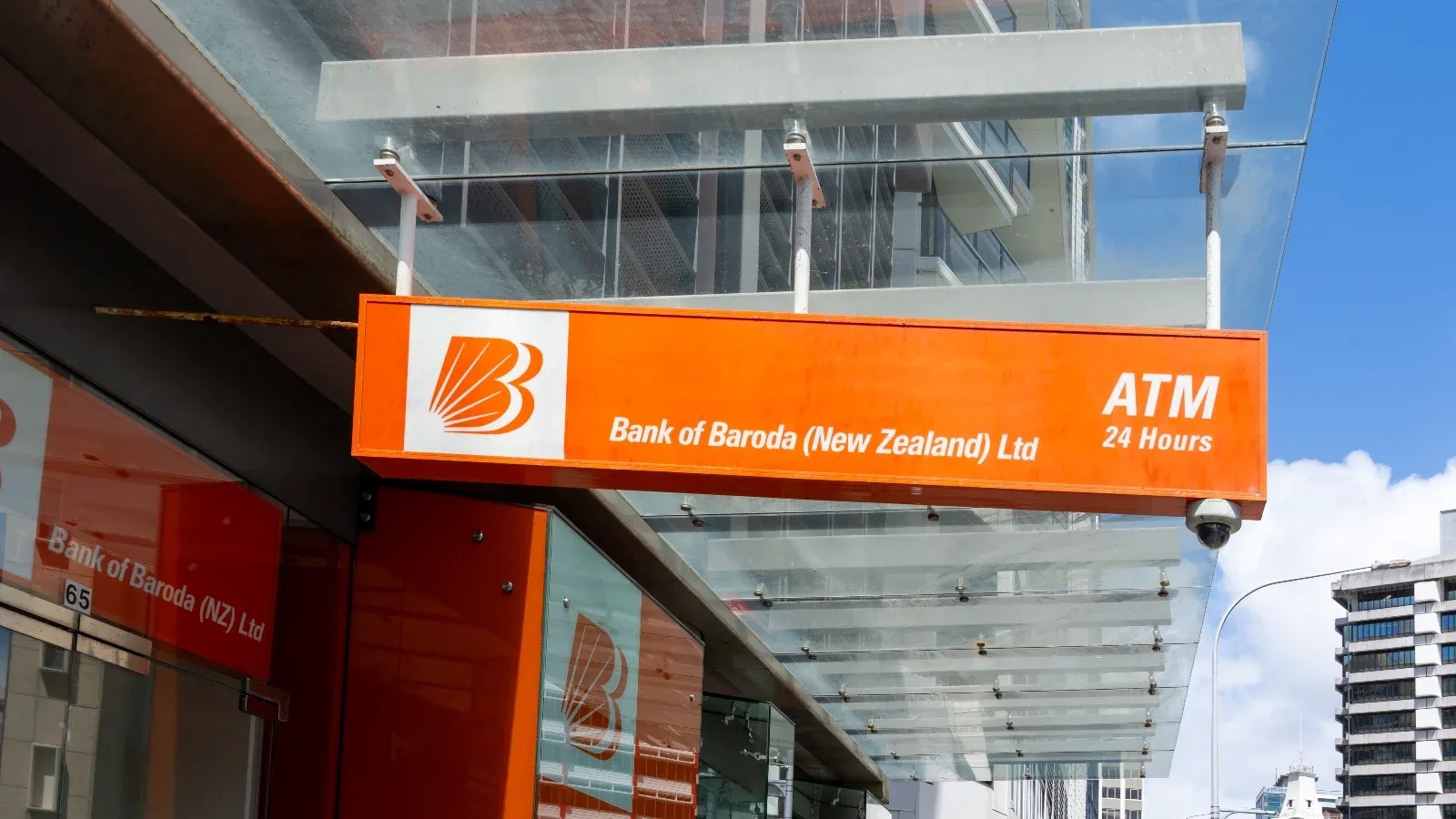
Established in: 1908
CEO & Managing Director: Dr Debadatta Chand
Bank of Baroda is India’s second-largest public sector bank and operates under the Ministry of Finance, Government of India. The bank has over 8200 branches and 9700 plus ATMs spread all over the country.
The bank doesn’t stop at Indian borders; it also has an impressive international presence with over 107 plus branches and offices across 24 countries.
In recent years, the Bank of Baroda has invested heavily in making digital banking not just functional but safe and trustworthy.
BoB World, the bank’s mobile app, has crossed 3 crore installs, and in FY24, it processed over 17 crore transactions.
History of the Bank of Baroda
Bank of Baroda was founded on July 20, 1908, by Maharaja Sayajirao Gaekwad III, a visionary leader of the princely state of Baroda in Gujarat.
The bank was formed with the motive to create a financial institution that could fulfil the banking needs of the people of Baroda and drive the economic growth of the region.
The bank opened its first branch in Ahmedabad, signalling its ambition to grow beyond the Baroda region.
The bank slowly grew through the pre-independence era, surviving two World Wars and India’s freedom struggle. On July 19, 1969, the government nationalised the Bank of Baroda, along with 13 other major commercial banks. This event transformed Bank of Baroda from a private entity into a public-sector-undertaking (PSU).
Business Verticals
Bank of Baroda has structured its business into distinct, focused verticals. It’s a kind of well-managed conglomerate where each division knows its mandate.
1. Retail Banking: This segment serves individual customers with home loans, personal loans, auto loans, education loans, salary account and fixed deposits.
2. Corporate and Wholesale Banking: In this segment, the bank serves large enterprises, infrastructure companies and government bodies. It includes financing for working capital, term loans, cash management and trade finance.
3. MSME and Agri Banking: In this segment bank lends money to small businesses and farmers, running schemes like Baroda Kisan Pakhwada, a farmer outreach programme that connected over 2.32 lakh farmers in FY25 and sanctioned agri loans worth ₹1,225 crore.
4. International Banking: Through its overseas branch network and subsidiaries like Bank of Baroda UK, Bank of Baroda (Kenya) and others. It serves the international trade clients.
5. Treasury Operations: This segment manages the bank’s investment portfolio, foreign exchange operations and liquidity. This vertical plays a crucial role in managing interest rate risk and optimising returns on the bank’s balance sheet.
6. Wealth Management and Insurance: It’s a new but rapidly growing segment. The bank had 44% stake in IndiaFirst Life Insurance Company, through which the bank is making a presence in Insurance.
On the asset management side, BOB partnered with BNP Paribas and formed Baroda BNP Asset Management India, which manages mutual fund projects. The bank is aggressively targeting 40% of wealth origination through digital channels only.
Bank of Baroda Financial Performance (FY25 vs FY24)
Revenue: Bank of Baroda reported consolidated revenue of ₹1,52,884.14 crore in FY25 vs ₹1,41,778.70 crore in FY24. It showed an increase of 7.83% on a yearly basis, reflecting robust growth.
Operating Profit: The company reported an operating profit of ₹27,618.97 crore in FY25 vs ₹25,799.35 crore in FY24. It showed a rise of 7.05% on a year-on-year basis, indicating that the company's operating profit is growing well.
Net Profit: Bank of Baroda reported a net profit of ₹20,459.35 crore in FY25 compared to ₹18,409.64 crore in FY24. It showed a jump of 11.13% on a yearly basis, indicating an improvement in overall performance.
Bank of Baroda Financial Highlights
- Revenue: Bank of Baroda reported revenue of ₹1,56,825.44 crore in FY26 vs ₹1,52,884.14 crore in FY25. It showed an increase of 2.58% on a yearly basis.
- Operating Profit: Bank of Baroda reported an operating profit of ₹24,944.69 crore in FY26 vs ₹27,618.97 crore in FY25. It showed a decrease of 9.68% on a year-on-year basis.
- Net Profit: Bank of Baroda reported a net profit of ₹19,477.16 crore in FY26 vs ₹20,459.35 crore in FY25. It showed a decrease of 4.80% on a yearly basis.
Bank of Baroda Quarterly Result Highlights
- Bank of Baroda reported revenue of ₹41,316.71 crore in Jun 2026, compared with ₹39,988.18 crore in Mar 2026, representing an increase of 3.32% on a quarter-on-quarter (QoQ) basis.
- Bank of Baroda reported an operating profit of ₹2,205.54 crore in Jun 2026, compared with ₹6,056.53 crore in Mar 2026, representing a decrease of 63.58% on a quarter-on-quarter (QoQ) basis.
- Bank of Baroda reported a profit of ₹1,572.59 crore in Jun 2026, compared with ₹5,647.96 crore in Mar 2026, reflecting a decrease of 72.16% on a QoQ basis.
- The earnings per share (EPS) of Bank of Baroda stood at ₹38.38 during Jun 2026.
Data Source: BSE, Company announcements
Securities shown are illustrative, not recommendations. Past performance does not guarantee future results.