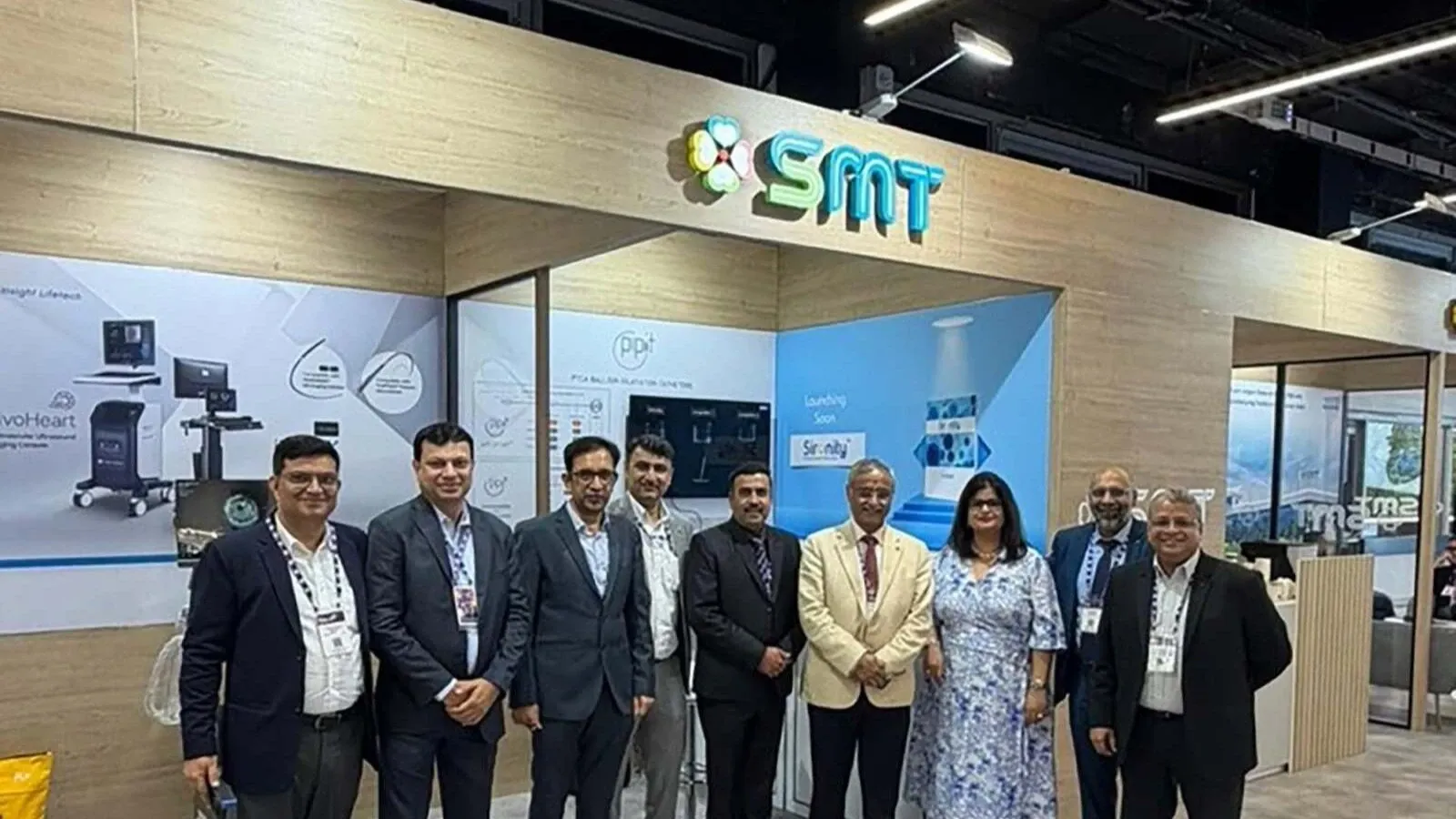
Sahajanand Medical Technologies (SMT), founded in 2001, develops and manufactures high-risk Class III and Class C/D cardiovascular medical devices. Its portfolio spans vascular intervention (VI), comprising coronary stents, PTCA balloon catheters and coronary drug-coated balloons; structural heart (SH), comprising transcatheter aortic valve implantation (TAVI) systems and occluders; and other products, including own-brand renal stents, peripheral drug-coated balloons and traded products.
The company’s operating model combines in-house R&D, integrated manufacturing, proprietary brands, clinical evidence generation and multi-channel distribution. The company marketed its products in 77 countries in FY26.
VI devices remain the principal revenue contributor, generating 61.1% of FY26 revenue, compared with 68.5% in FY24. SH revenue share increased from 12.2% in FY24 to 16.7% in FY26. Other products contributed 22.09% in FY26. Supraflex Cruz, SMT’s flagship biodegradable-polymer drug-eluting stent (DES), remained the largest individual product, contributing 37.1% of FY26 revenue.
International revenue increased from ₹587.8 crore in FY24 to ₹894.2 crore in FY26 and represented 73.8% of FY26 revenue. Europe contributed 38.6%, the rest of the world 35.2%, and India 26.1%. SMT operated across six direct, 20 hybrid and 39 distributor-led markets as of June 30, 2026, supported by 118 distributors in India and 265 overseas. The top 10 countries accounted for 78.7% of FY26 revenue, implying broad international operations but continuing concentration in the largest markets.
The company manufactures in-house at Hyderabad, Sachin SEZ in Surat and Nonthaburi, Thailand. FY26 annual capacity and utilisation were 900,000 stents at 78.3%, 11,40,000 catheters at 91.7%, 56,000 drug-coated PTCA balloons at 1.8%, 9,000 TAVI devices at 19.8%, and 42,000 occluders at 34.6%. The Hyderabad facility used approximately 33% of its available area, providing room for expansion. In-house processes include laser cutting, electropolishing, balloon-catheter production, nitinol processing, polymer formulation, valve manufacture and advanced delivery-catheter production.
The company operates R&D centres in India and Thailand, supported by 156 professionals, including four consultants. FY26 R&D expenditure was 8.6% of revenue. As of the RHP date, the company had 119 granted patents globally, 78 pending patent applications and five Indian design registrations. Its clinical repository covered 75 studies, comprising 66 completed and nine ongoing studies. Supraflex/Supraflex Cruz had 35 completed trials involving 28,383 patients, while Cocoon occluders had 26 completed trials involving 7,199 patients.
The company held nearly 25% of Indian DES sales volume in FY26. It was also among the top five companies by DES volume in Germany, Spain, Poland and Brazil, and among the top five by occluder volume in Thailand, South Korea and India. The company’s acquisitions of Spanish distributor Imex and Brazilian distributor Zarek strengthened control over overseas channels, while the acquisition of Vascular Concepts and Vascular Innovations added occluders and TAVI.
The global cardiovascular-device market was valued at $26.3 billion in 2025 and is forecast to reach $37.8 billion by 2030, a 7.5% CAGR. The global DES market is forecast to grow from $4.30 billion to $5.90 billion over the same period, while India’s DES market is forecast to increase from $205.1 million to $307.2 million at an 8.4% CAGR. India’s DES volumes are forecast to grow at 11.0%, supported by cardiovascular-disease prevalence, affordability, reimbursement coverage and wider access to catheterisation laboratories. SMT’s established DES franchise and planned Tier 2/3 expansion provide direct exposure to this opportunity, although regulated pricing and competitive intensity may constrain monetisation.
The global structural-heart market is forecast to grow from $12.1 billion in 2025 to $17.1 billion in 2030 at 7.1%, while India’s market is forecast to rise from $53.3 million to $152.0 million at 23.3%. SMT participates through Hydra TAVI and Cocoon occluders, and its SH revenue has grown faster than its VI franchise. Planned initiatives include expanding TAVI accounts and tenders, launching next-generation Hydra products, developing coronary DCBs and speciality balloons, and localising additional components. Participation in industry growth will nevertheless depend on regulatory approvals, clinical acceptance, physician training, reimbursement and the company’s ability to manage supply-chain and product-quality risks.
Now, Sahajanand Medical Technologies is launching its Initial public offering (IPO), which consists of an offer for sale of ₹475 crore. Its shares will be listed on the NSE and BSE.

 Apollo Hospitals Enterprise Ltd
 Max Healthcare Institute Ltd
 Fortis Healthcare Ltd