What is the Nifty Sugar and Ethanol Index? Components, Returns, and Selection Criteria

Written by Mariyam Sara
Published on July 01, 2026 | 6 min read


Key Takeaways
-
The Nifty Sugar and Ethanol Index is a thematic Index that tracks the performance of the top 15 stocks belonging to the FMCG (Fast-Moving Consumer Goods) sector that are directly involved in the production of sugar or ethanol.
-
The constituent stocks are selected based on a six-month average free-float market capitalisation along with other eligibility criteria set by the NSE Indices Limited. The weight of each stock in the index is determined based on its free-float market capitalisation.
-
The Index is reconstituted semi-annually and rebalanced quarterly to ensure it accurately reflects the performance of the Sugar and Ethanol Sector.
-
Investing in the Nifty Sugar and Ethanol Index offers multiple benefits such as diversification, steady returns, strong government support and long-term growth.
-
The Nifty Sugar and Ethanol Index also carries certain risks such as sector concentration, regulatory risks, climate dependence, and change in ethanol policy.
The Nifty Sugar and Ethanol Index was launched on 17th June, 2026 to track the top 15 NSE-listed companies within the sector. It was introduced to provide a detailed representation of the sector’s performance.
Let’s explore what the Nifty Sugar and Ethanol Index is, how it works, its constituents, and historical performance.
What is the Nifty Sugar and Ethanol Index?
The Nifty Sugar and Ethanol Index is a thematic Index that tracks the performance of the top 15 companies belonging to the sector and listed on the NSE. Only the companies involved in manufacturing or producing sugar and ethanol are included in the Index.
The constituent companies are selected based on the eligibility criteria set by NSE Indices Limited, and their weight are calculated based on the free-float market capitalisation methodology.
The sugar and ethanol sector is considered a staple commodity with constant demand, serving as an essential input for the renewable energy transition. With the increasing production and use of ethanol-blended fuel, ethanol-related stocks are attracting many investors.
The Nifty Sugar and Ethanol Index has a maximum of 15 stocks. It has a base date of March 31, 2021, as its base year and a base value of 1000. It is reconstituted semi-annually and rebalanced quarterly by NSE Indices Limited, responsible for maintaining the NSE indices.
How Does the Nifty Sugar and Ethanol Index Work?
The Nifty Sugar and Ethanol Index tracks the performance of the top 15 companies from the FMCG sector that are involved in manufacturing and producing sugar and ethanol, listed on the NSE.
The Index must comprise a minimum of 10 and a maximum of 15 stocks, selected from the top 20 companies based on their six-month average full market Capitalisation and six-month average daily turnover. The constituents are selected based on six-month average free-float market capitalisation along with other eligibility criteria set by the NSE Indices Limited.
The Nifty Sugar and Ethanol Index is managed and maintained through a three-tier governance structure comprising the Board of Directors of NSE Indices Limited, the Index Advisory Committee (Equity), and the Index Maintenance Sub-Committee.
Constituents of the Nifty Sugar and Ethanol Index
The following are the top 10 stocks included in the Nifty Sugar and Ethanol Index, ranked by weight as of May, 2026.
| Company Name | Weight (%) |
|---|---|
| Balrampur Chini Mills Ltd. | 14.21% |
| E.I.D. Parry (India) Ltd. | 13.04% |
| Triveni Engineering & Industries Ltd. | 11.48% |
| Bajaj Hindusthan Sugar Ltd. | 11.06% |
| KRBL Ltd. | 9.61% |
| India Glycols Ltd. | 7.79% |
| Gujarat Ambuja Exports Ltd. | 7.54% |
| Shree Renuka Sugars Ltd. | 6.49% |
| Piccadily Agro Industries Ltd. | 5.21% |
| Globus Spirits Ltd. | 4.42% |
The top 5 companies within the Index carry a total weight of 59.40%, being a driving force for the Index. Investors seeking individual and a few stock investments can follow and invest in these top 5 companies.
Nifty Sugar and Ethanol Index Historical Performance
NSE Indices Ltd. calculated the historical performance of the newly introduced Nifty Sugar and Ethanol Index based on the historical performance of its constituents as per their respective weight.
As of May 2026, the Nifty Sugar and Ethanol Index delivered a 5-year Total Return of 11.24%, which is higher than the Nifty 50 Index's 9.87%.
The Nifty Sugar and Ethanol Index has a 5-year Beta of 1.04 in relation to the Nifty 50, meaning the Index is slightly more volatile than the broader market.
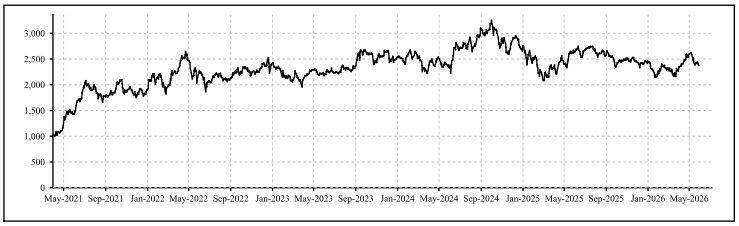
Source: NSE Indexogram
As illustrated on the chart above, the Nifty Sugar and Ethanol Index has experienced steady interim corrections.
Selection Criteria for the Nifty Sugar and Ethanol Index
The following are the eligibility criteria for the stocks included in the Nifty Sugar and Ethanol Index set by NSE Indices Limited.
- The Index has a base date of March 31, 2021, and a base value of 1000.
- All companies that are listed and traded on the National Stock Exchange (NSE) are eligible for inclusion in the Nifty Sugar and Ethanol Index.
- Stocks belonging to eligible basic industries or from the 'FMCG Sector' and are directly involved in the manufacturing or production of sugar or Ethanol are eligible to be included from the universe at the time of review.
- The Index consists of a maximum of 15 stocks.
- The weight of each stock in the Index is determined based on its free-float market capitalisation.
- The Index is reconstituted semi-annually and rebalanced quarterly.
- The weight of each stock is capped at 15%.
Benefits of Investing in the Nifty Sugar and Ethanol Index
The following are the benefits of investing in the Nifty Sugar and Ethanol Index.
Diversification
Investing in the Nifty Sugar and Ethanol Index offers exposure to 15 companies involved in sugar and ethanol production that are listed on the NSE. This helps diversify your investment across multiple companies, reducing the risk of overreliance on a single or few stocks.
Consistent Revenue
Sugar is an essential commodity, and its demand remains consistent regardless of prevailing economic conditions. However, the profitability of the sugar industry largely depends on favourable weather conditions and agricultural output.
In India, ethanol is being blended with petrol to fuel vehicles with the aim of reducing import reliance on crude oil. Hence, like petrol, ethanol is expected to become an essential commodity.
Government Support
The government is actively promoting ethanol-blended petrol through various policies and incentives to reduce dependence on crude oil imports. The Government of India launched the National Policy on Biofuel to boost rural economies, lower greenhouse gas emissions, and reduce crude oil imports by supporting domestic biofuel production.
Since sugar is an essential input in producing ethanol, the sugar industry benefits from the growth of the ethanol industry.
Long-Term Growth
Due to government policy support, the sugar and ethanol industry has potential for long-term growth, and investing in their Index can lead to capital appreciation.
Risks of Investing in the Nifty Sugar and Ethanol Index
The following are the risks associated with investing in the Nifty Sugar and Ethanol Index.
Sector Concentration
The Nifty Sugar and Ethanol Index tracks only the companies within the sugar and ethanol industry. As a result, investing in the index exposes investors to sector concentration risk. If the sector faces a downturn, the index may decline, adversely affecting your investments.
Regulatory Risks
If the government reduces its support for the ethanol sector and enforces state-mandated changes in Fair and Remunerative Price (FRP), export bans, or imposes limits on domestic stock, it can significantly impact the profitability of companies within the sugar and ethanol sector.
Climate Dependence
Sugar production is heavily dependent on climate and weather conditions. In case of drought or poor monsoon, the production of sugar can reduce, leading to lower sugar output and affecting the profitability of sugar and ethanol companies.
Change in Ethanol Policy
If the sugarcane procurement costs keep increasing while the government maintains low Ethanol procurement prices, it could impact the profit margins of sugar companies.

The Nifty Sugar and Ethanol Index is a thematic Index that tracks the performance of the top 15 NSE-listed companies engaged in the production of sugar and ethanol. The constituent companies included in the Index are involved in producing sugar or ethanol. Investors who are optimistic about the long-term growth of ethanol-blended fuel and want exposure to multiple companies within the sugar and ethanol industry can invest in the Nifty Sugar and Ethanol Index.
FAQs
What is the Nifty Sugar and Ethanol Index?
The Nifty Sugar and Ethanol Index is a thematic Index that tracks the performance of the top 15 NSE-listed companies' stocks belonging to the FMCG sector.
When was the Nifty Sugar and Ethanol Index launched?
The Nifty Sugar and Ethanol Index was launched by NSE Indices Ltd. on June 17, 2026.
How are stocks selected for the Nifty Sugar and Ethanol Index?
Stocks included in the Nifty Sugar and Ethanol Index are selected based on the eligibility criteria set by NSE Indices Limited.
When is the Nifty Sugar and Ethanol Index reconstituted and rebalanced?
The Nifty Sugar and Ethanol Index is reconstituted semi-annually and rebalanced quarterly by NSE Indices Ltd.
About Author
Mariyam Sara
Sub-Editor

holds an MBA in Finance and is a true Finance Fanatic. She writes extensively on all things finance whether it’s stock trading, personal finance, or insurance, chances are she’s covered it. When she’s not writing, she’s busy pursuing NISM certifications, experimenting with new baking recipes.
Read more from Mariyam




















Upstox is a leading Indian financial services company that offers online trading and investment services in stocks, commodities, currencies, mutual funds, and more. Founded in 2009 and headquartered in Mumbai, Upstox is backed by prominent investors including Ratan Tata, Tiger Global, and Kalaari Capital. It operates under RKSV Securities and is registered with SEBI, NSE, BSE, and other regulatory bodies, ensuring secure and compliant trading experiences.
Related articles

Share Market
What Is a Market Correction? Meaning, Causes, and Strategy15 min read | Written by Bidita Sen

Share Market
Cyclical vs Defensive Stocks: Differences, Examples and Strategy15 min read | Written by Bidita Sen

Share Market
What is Efficiency Ratio: Meaning, Types, Formula and More12 min read | Written by Sachin Gupta

Share Market
What is a Solvency Ratio: Meaning, Types, Benefits, Limitations and More12 min read | Written by Sachin Gupta
Share Market
Profitability Ratios: Meaning, Formula, Benefits, Limitations and More11 min read | Written by Sachin Gupta

Share Market
A Guide to American Depository Receipts (ADR) for Indian Investors13 min read | Written by Subhasish Mandal