What is the Nifty Retail Index? Constituents, Historical Performance, and Selection Criteria

Written by Mariyam Sara
Published on July 02, 2026 | 5 min read


Key Takeaways
-
The Nifty Retail Index is a sectoral index that tracks the performance of retail companies included in the Nifty Total Market Index.
-
The constituent companies in the Index are selected from the Nifty Total Market Index according to the eligibility criteria set by NSE Indices Ltd.
-
The Nifty Retail Index is reconstituted semi-annually and rebalanced quarterly to ensure that it accurately reflects the performance of the retail sector.
-
Investing in the Nifty Retail Index offers various benefits such as diversification, high liquidity, exposure to the retail sector, and a passive investment approach.
-
Before investing in the Nifty Retail Index, investors must consider risks such as sector concentration, valuation risk, inflation risk, and heavy stock concentration to make informed investment decisions.
The Nifty Retail Index was launched on June 15, 2026, to provide an accurate representation of the country’s retail sector’s performance.
Let’s explore what the Nifty Retail Index is, how it works, historical performance, and its selection criteria.
What is the Nifty Retail Index?
The Nifty Retail Index is a sectoral index that tracks the performance of the best retail companies listed on the National Stock Exchange (NSE) and included in the Nifty Total Market Index. These Nifty Retail Index companies serve as intermediaries between manufacturers, wholesalers, and end consumers by selling goods directly to customers.
The constituent companies of the Nifty Retail Index are determined from the Nifty Retail Index based on the criteria set by NSE Indices Ltd. The index can be used for benchmarking of fund portfolios and issuance of exchange-traded funds (ETFs), index funds, and other investment products related to retail.
How Does the Nifty Retail Index Function?
The objective of the Nifty Retail Index is to measure the performance of the top retail companies included in the Nifty Total Market Index. There must be a minimum of 10 stocks in the Nifty Retail Index as per the regulations set by NSE Indices Ltd.
The Nifty Retail Index is governed through a three-tier governance structure comprising the Board of Directors of NSE Indices Limited, the Index Advisory Committee (Equity), and the Index Maintenance Sub-Committee.
Constituents of the Nifty Retail Index
The following are the top 10 prominent constituent companies in the Nifty Retail Index, ranked by weight as of May, 2026.
| Company | Weight (%) |
|---|---|
| Trent Ltd. | 20.41 |
| Eternal Ltd. | 19.70 |
| Avenue Supermarts Ltd. | 13.00 |
| Info Edge (India) Ltd. | 8.28 |
| FSN E-Commerce Ventures Ltd. | 7.81 |
| Swiggy Ltd. | 7.71 |
| Vishal Mega Mart Ltd. | 5.65 |
| Lenskart Solutions Ltd. | 3.34 |
| CarTrade Tech Ltd. | 1.59 |
| Medplus Health Services Ltd. | 1.40 |
Nifty Retail Index Historical Performance
NSE Indices Limited calculated the historical performance of the newly introduced Nifty Retail Index based on the historical performance of its constituent stocks and their respective weights in the index.
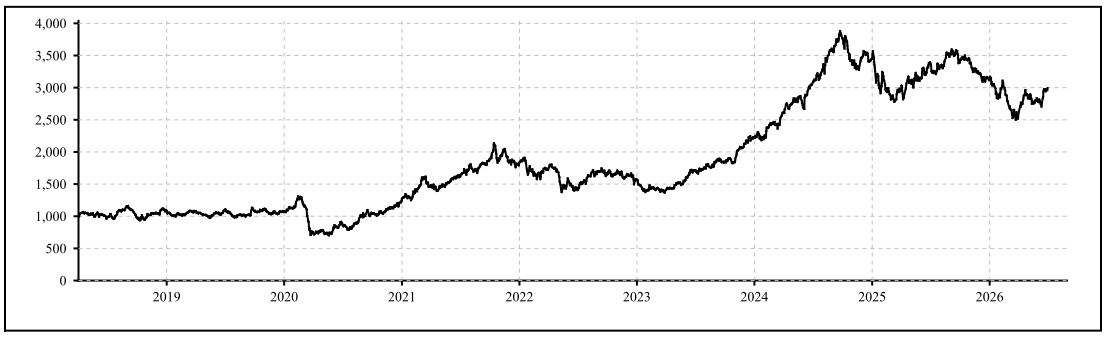
As per NSE data of May 2026, over the past 5 years, the Nifty Retail Index delivered a total return of 12.61%, higher than the Nifty 50 Index's 9.87%.
The Nifty Retail Index has a 5-Year Beta of 1.03 in relation to the Nifty 50, indicating that it is slightly more volatile than the broader market. For example, if the overall market rises or falls by 10%, the Nifty Retail Index may rise or fall approximately by 10.30% in the same direction.
Source: NSE Indices
As shown in the Nifty Retail Index chart above, the index established a strong upward trend from 2023, with interim corrections in 2025 and 2026.
Selection Criteria for the Nifty Retail Index
The following are the selection criteria for the stocks included in the Nifty Retail Index.
- The index has a base date of April 02, 2018, and a base value of 1000
- Stocks included in the Nifty Total Market Index at the time of review are eligible for inclusion in the index.
- Stocks belonging to the eligible basic industries within the Retail sector are eligible for inclusion at the time of review.
- The weight of each stock in the index is based on free-float market capitalisation.
- The weight of each stock in the index is capped at 20%.
Benefits of Investing in the Nifty Retail Index
The following are the benefits of investing in the Nifty Retail Index.
Diversification
The index offers a diversified approach to investing in the Indian retail sector by spreading your investment across the top retail companies included in the Nifty Total Market Index. This reduces the risk of overrelying on certain stocks.
Exposure to the Retail Sector
As Indian’s disposal income increases, their spending on clothes, footwear, cosmetics and other non-essential items increases. With more people opting for online shopping, organised retail companies can benefit and earn higher profits.
Passively Managed
The index is managed by NSE Indices Limited and is reconstituted semi-annually and rebalanced quarterly to ensure that the index provides a true representation of the retail sector’s performance. During each reconstitution, the companies that no longer fulfil the eligibility criteria are removed from the index; if the index has fewer than 10 stocks, they are replaced by other eligible companies.
High Liquidity
The stocks within the Index are weighted based on their free-float market capitalisation to ensure liquidity, enabling investors to enter and exit positions quickly and efficiently.
Risks of Investing in the Nifty Retail Index
The following are the risks of investing in the Nifty Retail Index.
Sector Concentration
Investing in the Nifty Retail Index could lead to sector concentration risk as it exclusively tracks retail stocks. If the sector faces a downturn due to unfavourable economic conditions, the index and your investments may decline.
Inflation Risk
The sector is highly sensitive to inflation, which impacts consumers’ spending and increases the cost of inputs for the producers. This phenomenon could reduce the profitability of retail companies.
High Valuation
Organised retail stocks often have high price-to-earnings (P/E) ratios, meaning investors are optimistic regarding the company’s future and hence these stocks trade at a premium.
Heavy Stock Weight
In the Nifty Retail Index, a few companies have significantly higher weight; if these companies face sharp structural changes or business failure, it could significantly pull down the entire Index.

The Nifty Retail Index is a sectoral Index that aims to track the performance of the retail companies included in the Nifty Total Market Index. The constituent stocks are selected for the index based on the eligibility criteria set by the NSE Indices Ltd, which is responsible for managing, maintaining, and rebalancing the index.
Investors must evaluate the benefits and risks of investing in the Nifty Retail Index prior to making smart and informed investment decisions.
FAQs
What is the Nifty Retail Index?
Nifty Retail Index is a sectoral index that tracks the performance of all the Retail stocks within the Nifty Total Market Index.
When was the Nifty Retail Index launched?
The Nifty Retail Index was launched by NSE Indices Ltd. on June 15, 2026.
How are stocks selected for the Nifty Retail Index?
Stocks included in the Nifty Retail Index are selected from the Nifty Total Market Index based on the eligibility criteria set by NSE Indices Limited.
When is the Nifty Retail Index reconstituted and rebalanced?
The Nifty Retail Index is reconstituted semi-annually and rebalanced quarterly by NSE Indices Ltd.
About Author
Mariyam Sara
Sub-Editor

holds an MBA in Finance and is a true Finance Fanatic. She writes extensively on all things finance whether it’s stock trading, personal finance, or insurance, chances are she’s covered it. When she’s not writing, she’s busy pursuing NISM certifications, experimenting with new baking recipes.
Read more from Mariyam





















Upstox is a leading Indian financial services company that offers online trading and investment services in stocks, commodities, currencies, mutual funds, and more. Founded in 2009 and headquartered in Mumbai, Upstox is backed by prominent investors including Ratan Tata, Tiger Global, and Kalaari Capital. It operates under RKSV Securities and is registered with SEBI, NSE, BSE, and other regulatory bodies, ensuring secure and compliant trading experiences.
Related articles

Share Market
What Is a Market Correction? Meaning, Causes, and Strategy15 min read | Written by Bidita Sen

Share Market
Cyclical vs Defensive Stocks: Differences, Examples and Strategy15 min read | Written by Bidita Sen

Share Market
What is Efficiency Ratio: Meaning, Types, Formula and More12 min read | Written by Sachin Gupta

Share Market
What is a Solvency Ratio: Meaning, Types, Benefits, Limitations and More12 min read | Written by Sachin Gupta
Share Market
Profitability Ratios: Meaning, Formula, Benefits, Limitations and More11 min read | Written by Sachin Gupta

Share Market
A Guide to American Depository Receipts (ADR) for Indian Investors13 min read | Written by Subhasish Mandal