What is the Nifty Construction Index? Constituents, Historical Performance, and Selection Criteria

Written by Mariyam Sara
Published on June 24, 2026 | 5 min read


Key Takeaways
-
The Nifty Construction Index is a sectoral index that tracks the performance of the top companies from the construction sector within the Nifty Total Market Index.
-
The constituent companies are selected from the Nifty Total Market Index and other eligibility criteria set by NSE Indices Ltd.
-
The Nifty Construction Index is reconstituted semi-annually and rebalanced quarterly.
-
Investing in the Nifty Construction Index offers benefits such as diversification, GDP-linked growth, predictable revenue, and potential capital appreciation.
-
The Nifty Construction Index carries risks such as sector concentration, cyclical nature, regulatory risk, high debt, and project delays.
On June 15, 2026, NSE Indices Limited introduced 11 new sectoral indices to provide a more detailed and accurate representation of the Indian economy. One of those indices is the Nifty Construction Index.
Let’s understand what the Nifty Construction Index is, how it works, its constituents, historical performance, and selection criteria.
What is the Nifty Construction Index?
The Nifty Construction Index is a sectoral benchmark index that tracks the performance of top construction companies included in the Nifty Total Market Index. According to the NSE Indexogram of May 2026, the index consists of 23 companies from the construction sector. These companies are reconstituted semi-annually, and the index is rebalanced quarterly.
The constituent companies are selected from the Nifty Total Market Index and based on the other eligibility criteria prescribed by the NSE Indices Ltd.
The Nifty Construction Index can be used for benchmarking fund portfolios, launching exchange-traded funds (ETFs), index funds, and other construction-sector-related investment products.
How Does the Nifty Construction Index Work?
The Nifty Construction Index measures the performance of the top construction companies within the Nifty Total Market Index. The constituent companies are weighed based on their free-float market capitalisation, ensuring that the index value reflects the total free-float market value of their stocks relative to a base market capitalisation. The base date for the Nifty Construction Index is April 1, 2005, and the base value is 1000.
The Nifty Construction Index is managed by a three-tier governance structure, consisting of the Board of Directors of NSE Indices Limited, the Index Advisory Committee (Equity), and the Index Maintenance Sub-Committee.
Constituents of the Nifty Construction Index
The following are the top 10 prominent construction companies included in the Nifty Construction Index along with their weight as of May, 2026.
| Company Name | Weight (%) |
|---|---|
| Larsen & Toubro Ltd. | 21.16 |
| Kalpataru Projects International Ltd. | 10.19 |
| Rail Vikas Nigam Ltd. | 9.58 |
| NBCC (India) Ltd. | 7.14 |
| IRB Infrastructure Developers Ltd. | 5.77 |
| KEC International Ltd. | 4.46 |
| Engineers India Ltd. | 4.36 |
| NCC Ltd. | 4.27 |
| Cemindia Projects Ltd. | 4.09 |
| Techno Electric & Engineering Company Ltd. | 3.72 |
Nifty Construction Index Historical Performance
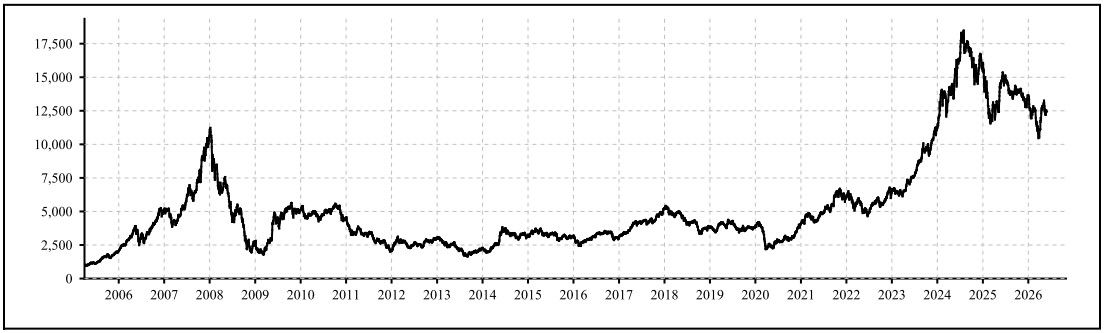
Though the Nifty Construction Index was introduced recently, NSE has calculated its historical performance based on the historical performance of its constituent stocks and their respective weight in the index.
As of May 2026, the Nifty Construction Index delivered a 5-year total return of 22.59%, which is significantly higher than the Nifty 50 index's 9.87%.
The Nifty Construction Index has a Beta of 1.29 relative to the Nifty 50, indicating it is more volatile than the broader market. For example, if the market rises or falls by 10%, the Nifty Construction Index may rise or fall by 12.9%.
Source: NSE Indexogram
From 2005 onwards, the Nifty Construction Index has exhibited moderate volatility with significant upswings during 2007-8 and 2024-25, and corrections around 2009 and 2020-21.
Selection Criteria for the Nifty Construction Index
The following are the stock eligibility criteria for the Nifty Construction Index set by the Nifty Indices Ltd.
- Stocks included in the Nifty Total Market Index at the time of review are eligible for inclusion in the index
- Stocks belonging to the Construction sector within the basic industries category are eligible for inclusion in the index universe at the time of review.
- The weight of each stock in the index is based on its free-float market capitalisation.
- The index must have a minimum of 10 constituents.
- The weight of an Individual stock is capped at 20%
Benefits of Investing in the Nifty Construction Index
The following are the benefits of investing in the Nifty Construction Index.
Diversification
Investing in the Nifty Construction index provides exposure to multiple leading companies rather than a few individual stocks. This helps reduce the risk of overreliance on a few stocks by spreading your risk across companies within the sector.
GDP-linked Growth
The growth of the construction sector is closely related to the country’s economic development. As economic activity expands and infrastructure development increases, the construction index may experience significant growth, which can positively impact the index.
Predictable Revenue
Most established companies maintain a large order book and project backlogs, which can provide greater visibility and predictability of future revenues.
Strong Government Support
Government initiatives and spending on infrastructure development, such as parks, smart cities, and national highways, provide a pipeline of contracts to construction companies. If these companies handle their projects well and maintain low debt levels, the Nifty Construction Index can offer capital appreciation in the long term.
Risks of Investing in the Nifty Construction Index
Though the Nifty Construction Index offers diversification and other benefits, investors must consider the following risk factors.
Sector Concentration
Investing in the Nifty Construction Index can lead to sector concentration risk. If the sector faces a downturn due to unfavourable economic conditions, the index and your investments may decline.
Cyclical Nature
The performance of the construction sector is directly linked to prevailing economic conditions; slowdowns in the economy and decreases in government-funded infrastructure projects could impact the company's profitability.
High Debt
Construction is a capital-intensive industry, and companies often have high debt levels. If a company is unable to effectively manage and reduce its debt obligations, high interest payments will eat away a significant portion of its earnings.
Project Delays
Project delays caused by land disputes, lack of environmental clearances, and labour shortages are one of the main bottlenecks faced by construction companies, as they lead to delayed revenue realisation and lock in unproductive capital.

The Nifty Construction Index is a sectoral index that tracks the performance of top construction companies included in the Nifty Total Market Index. The index is managed, reconstituted, and rebalanced by the NSE Indices Ltd. Investors seeking exposure to economic and infrastructure-driven growth may consider investing in the Nifty Construction Index. However, they should carefully evaluate the associated risks before making informed investment decisions.
FAQs
What is the Nifty Construction Index?
The Nifty Construction Index is a sectoral index that tracks the performance of top construction companies within the Nifty Total Market Index.
When was the Nifty Construction Index launched?
The Nifty Construction Index was launched by the NSE Indices Ltd. on June 15, 2026.
How are stocks selected for the Nifty Construction Index?
The stocks are selected for the Nifty Construction Index from the Nifty Total Market Index based on the eligibility criteria prescribed by the NSE Indices Ltd.
How often is the Nifty Construction Index reconstituted and rebalanced?
The Nifty Construction Index is reconstituted semi-annually and rebalanced quarterly by NSE Indices Ltd.
About Author
Mariyam Sara
Sub-Editor

holds an MBA in Finance and is a true Finance Fanatic. She writes extensively on all things finance whether it’s stock trading, personal finance, or insurance, chances are she’s covered it. When she’s not writing, she’s busy pursuing NISM certifications, experimenting with new baking recipes.
Read more from Mariyam





















Upstox is a leading Indian financial services company that offers online trading and investment services in stocks, commodities, currencies, mutual funds, and more. Founded in 2009 and headquartered in Mumbai, Upstox is backed by prominent investors including Ratan Tata, Tiger Global, and Kalaari Capital. It operates under RKSV Securities and is registered with SEBI, NSE, BSE, and other regulatory bodies, ensuring secure and compliant trading experiences.
Related articles

Share Market
What Is a Market Correction? Meaning, Causes, and Strategy15 min read | Written by Bidita Sen

Share Market
Cyclical vs Defensive Stocks: Differences, Examples and Strategy15 min read | Written by Bidita Sen

Share Market
What is Efficiency Ratio: Meaning, Types, Formula and More12 min read | Written by Sachin Gupta

Share Market
What is a Solvency Ratio: Meaning, Types, Benefits, Limitations and More12 min read | Written by Sachin Gupta
Share Market
Profitability Ratios: Meaning, Formula, Benefits, Limitations and More11 min read | Written by Sachin Gupta

Share Market
A Guide to American Depository Receipts (ADR) for Indian Investors13 min read | Written by Subhasish Mandal