What is Nifty Insurance Index?

Written by Mariyam Sara
Published on July 01, 2026 | 5 min read


Key Takeaways
-
The Nifty Insurance Index is a sectoral index that tracks the performance of the insurance companies included in the Nifty Total Market Index.
-
The constituent companies included in the Index are selected from the Nifty Total Market Index based on the eligibility criteria set by NSE Indices Ltd.
-
The Nifty Insurance Index is reconstituted semi-annually and rebalanced quarterly to ensure that it accurately reflects the performance of the Indian insurance sector.
-
Investing in the Nifty Insurance Index offers various benefits such as diversification, long-term growth potential, and opportunities for capital appreciation.
-
When investing in the Nifty Insurance Index, investors must consider risks such as sector concentration, regulatory risk, unfavourable economic conditions, and high competition, which may reduce companies' profitability.
The Nifty Insurance Index was launched on June 15, 2026, to provide an accurate representation of the Indian insurance sector’s performance.
Let’s understand what the Nifty Insurance Index is, how it works, historical performance, and selection criteria.
What is the Nifty Insurance Index?
The Nifty Insurance Index is a sectoral index that tracks the performance of the top 12 insurance companies listed on the National Stock Exchange (NSE). These companies are involved in selling a wide range of insurance products and services. The constituent companies are selected from the Nifty Total Market Index based on the eligibility criteria set by NSE Indices Ltd.
The Nifty Insurance Index can be used to benchmark fund portfolios and serve as the basis for launching exchange-traded funds (ETFs), index funds, and other sector-related investment products.
How Does the Nifty Insurance Index Work?
The Nifty Insurance Index is designed to track the top companies from the insurance sector included in the Nifty Total Market Index. According to NSE Indices Ltd, there must be a minimum of 10 stocks in the Index.
The Nifty Insurance Index is managed and maintained through a three-tier governance structure comprising the Board of Directors of NSE Indices Limited, the Index Advisory Committee (Equity), and the Index Maintenance Sub-Committee.
Constituents of the Nifty Insurance Index
The following are the top 10 prominent constituent companies in the Nifty Insurance Index, ranked by weight as of May, 2026.
Nifty Insurance Index Historical Performance
NSE Indices Limited calculated the historical performance of the newly introduced Nifty Insurance Index based on the historical performance of its constituent stocks and their respective weights in the index over the years.
As per NSE data of May 2026, over the past 5 years, the Nifty Insurance Index delivered a total return of 8.96%, which is significantly higher than the Nifty 50 Index's 9.87%.
The Nifty Insurance Index has a 5-Year Beta of 0.89 in relation to the Nifty 50, indicating that it is less volatile than the broader market. For example, if the overall market rises or falls by 10%, the Nifty Insurance Index may rise or fall approximately by 8.90% in the same direction.
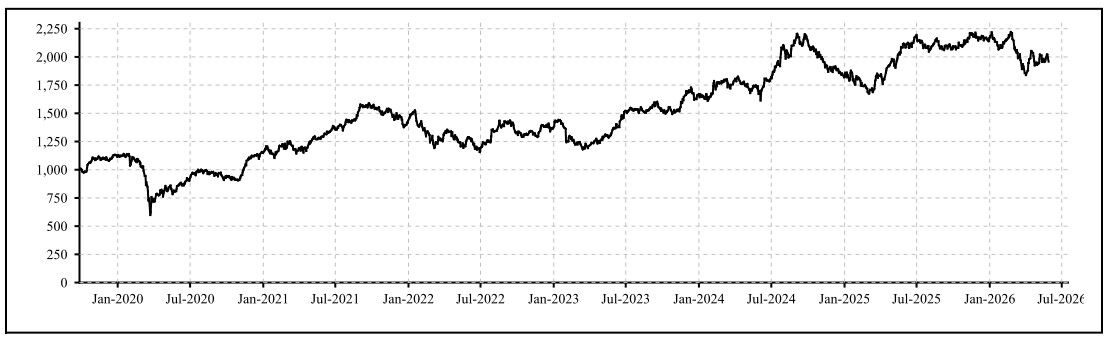
Source: NSE Indexogram
The above chart shows the performance of the Nifty Insurance Index over the past years.
Selection Criteria for the Nifty Insurance Index
The following are the selection criteria for the stocks included in the Nifty Insurance Index.
- The Nifty Insurance Index has a base date of September 27, 2019, and a base value of 1000.
- Stocks included in the Nifty Total Market Index at the time of review are eligible for inclusion in the index.
- Stocks belonging to the eligible basic industries within the Insurance sector are eligible for inclusion at the time of review.
- The weight of each stock in the index is based on free float market capitalisation.
- The Index is reconstituted semi-annually and rebalanced quarterly.
- The weight of each stock in the index is capped at 20%.
Benefits of Investing in the Nifty Insurance Index
The following are the benefits of investing in the Nifty Insurance Index.
Diversification
Investing in the Nifty Insurance Index provides exposure to multiple companies, helping diversify your investment across different stocks, reducing the risk of overreliance on a few stocks.
Potential Long-Term Growth
According to the India Brand Equity Foundation (IBEF), the insurance sector in India has experienced robust growth with the domestic market increasing at a CAGR of 17% over the past two decades. The insurance sector is expected to grow further, with premium growth increasing by 6.9% over 2026–2030, outpacing China, the US, and Western European markets, as per Swiss Re Group.
Capital Appreciation
The insurance sector has experienced significant growth over the past years and is expected to expand further, potentially leading to capital appreciation.
Risks of Investing in the Nifty Insurance Index
The following are the risks of investing in the Nifty Insurance Index.
Sector Concentration
Investing in the Nifty Insurance Index exposes investors to high sector concentration risk. If the insurance industry faces a downturn, both the index and your investment value may decline.
Regulatory Risk
The insurance sector is regulated by the Insurance Regulatory and Development Authority of India (IRDAI). Any changes in regulations set by the authority regarding capital requirements, insurance products, or surrender values can significantly impact the company's profitability.
Similarly, changes in tax exemptions offered on life or health insurance can also influence the demand for insurance products and their sales.
Economic Conditions
Insurance companies are highly sensitive to changes in interest rates, as these directly impact their investment portfolios and the value of their long-term liabilities. Unfavourable economic conditions such as high inflation, economic slowdown, and reduction in disposable income can lower the demand for insurance products.
High Competition
The insurance industry is highly competitive, leading to price wars and high-cost customer acquisition costs, which could shrink the profits of the companies. In case of persistent poor profits, the company’s stock price may fall.

The Nifty Insurance Index is a sectoral Index that aims to track the performance of the insurance companies within the Nifty Total Market Index. The stocks included in the index are selected based on the eligibility criteria set by the NSE Indices Ltd, which is responsible for managing, maintaining, and rebalancing the index.
To make an informed investment decision, investors must weigh the benefits and risks of investing in the Nifty Insurance Index.
FAQs
What is the Nifty Insurance Index?
The Nifty Insurance Index is a sectoral index that measures the performance of the top companies' stocks in the Insurance sector included in the Nifty Total Market Index.
When was the Nifty Insurance Index launched?
The Nifty Insurance Index was launched by NSE Indices Ltd. on June 15, 2026.
How are stocks selected for the Nifty Insurance Index?
The stocks are selected for the Nifty Insurance Index from the Nifty Total Market Index based on the eligibility criteria set by NSE Indices Ltd.
When is the Nifty Insurance Index reconstituted and rebalanced?
The Nifty Insurance Index is reconstituted semi-annually and rebalanced quarterly by NSE Indices Ltd.
About Author
Mariyam Sara
Sub-Editor

holds an MBA in Finance and is a true Finance Fanatic. She writes extensively on all things finance whether it’s stock trading, personal finance, or insurance, chances are she’s covered it. When she’s not writing, she’s busy pursuing NISM certifications, experimenting with new baking recipes.
Read more from Mariyam





















Upstox is a leading Indian financial services company that offers online trading and investment services in stocks, commodities, currencies, mutual funds, and more. Founded in 2009 and headquartered in Mumbai, Upstox is backed by prominent investors including Ratan Tata, Tiger Global, and Kalaari Capital. It operates under RKSV Securities and is registered with SEBI, NSE, BSE, and other regulatory bodies, ensuring secure and compliant trading experiences.
Related articles

Share Market
What Is a Market Correction? Meaning, Causes, and Strategy15 min read | Written by Bidita Sen

Share Market
Cyclical vs Defensive Stocks: Differences, Examples and Strategy15 min read | Written by Bidita Sen

Share Market
What is Efficiency Ratio: Meaning, Types, Formula and More12 min read | Written by Sachin Gupta

Share Market
What is a Solvency Ratio: Meaning, Types, Benefits, Limitations and More12 min read | Written by Sachin Gupta
Share Market
Profitability Ratios: Meaning, Formula, Benefits, Limitations and More11 min read | Written by Sachin Gupta


Share Market
A Guide to American Depository Receipts (ADR) for Indian Investors13 min read | Written by Subhasish Mandal