What is Nifty Financial Services Index? A Complete Guide for Investors

Written by Mariyam Sara
Published on May 21, 2026 | 6 min read


Key Takeaways
-
The Nifty Financial Services Index, also known as FINNIFTY, is a sectoral benchmark index that tracks the performance of the top 20 companies listed on the NSE.
-
The constituent companies are selected based on their free float market capitalisation and the eligibility criteria set by NSE Indices Ltd.
-
The Nifty Financial Services index is rebalanced semi-annually to ensure the index accurately represents the performance of the financial services sector.
-
You can invest in the FINNIFTY index by directly buying the individual stocks included in the index or via index funds and ETFs.
-
Investing in the Nifty Financial Services index offers several key benefits, including broad exposure to multiple financial segments, portfolio diversification, a proxy for India's economic growth, strong FPI-linked capital flows, and high market liquidity.
-
Before investing in the Nifty Financial Services index, consider risks such as changes in interest rates, sectoral concentration, strict regulations, shifts in policies, and economic downturns.
Tracking the Nifty Financial Services Index, also known as FINNIFTY, is essential for investors because it acts as a barometer for the Indian financial services sector and reflects the broader investment habits of Indian households.
Let’s explore the Nifty Financial Services index, its constituents, historical performance, and selection criteria.
What Is the Nifty Financial Services Index?
The Nifty Financial Services Index, also known as FINNIFTY, is a sectoral benchmark index that tracks the performance of the top 20 financial service companies listed on the NSE. These companies include banks, financial institutions, housing finance, insurance companies, and other financial services firms.
The constituent companies for the FINNIFTY index are selected based on their market capitalisation and other eligibility criteria set by the NSE Indices Ltd. The index is widely used as a benchmark for fund portfolios and for launching index funds, ETFs, and other financial sector-related investment products.
Constituents of Nifty Financial Services Index
The following are the top 10 prominent companies included in the FINNIFTY index as per their weightage as of May 2026.
| Company's Name | Weight (%) |
|---|---|
| HDFC Bank Ltd. | 18.30 |
| ICICI Bank Ltd. | 13.49 |
| Axis Bank Ltd. | 10.02 |
| State Bank of India | 9.89 |
| Kotak Mahindra Bank Ltd. | 9.25 |
| Bajaj Finance Ltd. | 8.22 |
| [BSE Ltd.](https://upstox.com/stocks/bse-limited-share-price/ | 4.88 |
| Shriram Finance Ltd. | 4.30 |
| Bajaj Finserv Ltd. | 3.31 |
| SBI Life Insurance Company Ltd. | 2.68 |
The constituents of the FINNIFTY index and their weightage are rebalanced semi-annually, so stay updated with the current index constituents by visiting Upstox Finservice Chart.
Historical Performance of Nifty Financial Services Index
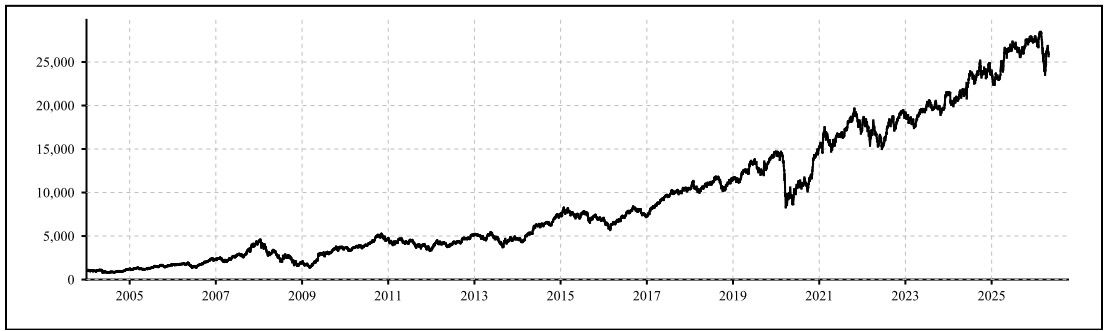
According to NSE data, the Nifty Financial Services index has delivered a 5-year CAGR 11.49% return and has a 1.10 Beta in relation to Nifty 50, meaning the index is more volatile than the broader market.
Historically, the FINNIFTY index had slow yet steady growth with sharp interim corrections during periods such as the 2008-09 global financial crisis and the 2020 COVID-19 pandemic.
Source: NSE Indexogram
How Do You Invest in the Nifty Financial Services Index?
You can invest in the Nifty Financial Services index in the following ways.
Direct Investment
You can directly purchase individual stocks included in the FINNIFTY index and adjust your allocation according to the recent rebalancing. However, this approach requires high manual efforts, and investing in only a few stocks increases your risk through over-dependence.
Index Funds
Index funds track the Nifty Financial Services index and allow investors to passively invest in the index. You can choose to invest via SIPs (Systematic Investment Plans) or a single lumpsum payment.
Exchange Traded Funds
ETFs replicate the index and are listed on stock market exchanges, allowing investors to trade their ETF units quickly and smoothly.
Selection Criteria for Nifty Financial Services Index
The constituent companies included in the Nifty Financial Services Index are selected based on the following eligibility criteria.
- Nifty 500 constituents within the Financial Services segment, such as banks, financial institutions, housing finance, and other financial services, etc., are considered eligible.
- Within the eligible universe, the weights of each subsector based on average free float market capitalisation are calculated.
- The weightage of the 20 companies selected from each sub-sector should closely match the weightage of the sub-sector as explained earlier.
- Companies available for trading in the NSE F&O segments will be given preference within each sub-sector.
- Companies will be included if the average free-float market capitalisation is 1.5 times the average free-float market capitalisation of the smallest index constituent.
- Weightage of each stock in the index is calculated based on its free-float market capitalization such that the top 3 stocks' weights are capped at 19%, 14%, and 10%, respectively. For stocks other than the Top 3 stocks, individual weights will be lower than those of higher-weighted index constituents.
- Non-F&O stocks' individual weightage is capped at 4.5%. The total weight of all non-F&O stocks is capped at 10%.
Benefits of Investing in the Nifty Financial Services Index
The following are the benefits of investing in the Nifty Financial Services index.
Broad Exposure
The index offers exposure to various financial segments such as insurance, asset management, and payment service providers. Diversifying your investments across sectors, reducing concentration risk, and mitigating the impact of sector-specific risks.
Long-term Capital Appreciation
Historically, the index delivered slow yet steady annual returns and outperformed the broader market during growth cycles, as the index has a 1.10 beta in relation to the Nifty 50.
High Liquidity
One of the eligibility criteria for the companies is that they should be actively traded and available for trading in the F & O segment, with higher weightage assigned to F&O stocks. This ensures high liquidity, allowing investors to enter and exit positions seamlessly.
Financialisation Proxy
The combination of rising household savings moving into the financial markets and a significant influx of Foreign Portfolio Investments (FPIs) could drive up the index and generate strong returns for investors.
Risks of Investing in the Nifty Financial Services Index
The following are the risks associated with investing in the Nifty Financial Service Index.
Bank Dominated Index
Heavier weights are given to banks in the index, so if the banking sector faces a downturn, the entire index is negatively impacted
Sectoral Concentration
Since the index focuses on the financial services segment, it could lead to sectoral concentration: if the sector faces downturns driven by regulatory changes or economic slowdowns, the index would decline.
Changes in Interest Rates
Because the index assigns a higher weight to banks, changes in interest rates and RBI policies could impact demand for loans and, consequently, their profitability.
Economic Downturns
The financial service sector is considered the backbone of the economy. During market downturns or recessions, businesses borrow less, more borrowers default on their loans, and demand for financial products like insurance decreases. These factors can negatively impact the profitability of the companies within the index and lead to a fall in the index value.

The Nifty Financial Services index is a sectoral index that tracks the performance of the top 20 companies listed on the NSE. These companies are selected based on the eligibility criteria set by the NSE Indices Ltd. Investors can invest in the FINNIFTY index by directly purchasing the individual stocks in the index or via index funds and ETFs.
Before investing, investors should understand how the index works and consider all the risks associated with investing in the Nifty Financial Services index to make informed investment decisions.
FAQs
What is the Nifty Financial Services Index?
The Nifty Financial Services index, also known as FINNIFTY, is a sectoral benchmark index that tracks the performance of the top 20 companies listed on the NSE.
How many stocks are there in the Nifty Financial Services Index?
There are 20 stocks in the Nifty Financial Services index (FINNIFTY).
How is the Nifty Financial Services Index calculated?
The Nifty Financial Services index value is derived using the free float market capitalisation method, where the index value reflects the total free float market value of all the stocks in the index relative to a base market capitalisation value.
Who manages the Nifty Financial Services Index?
The NSE Indices Ltd manages and rebalances the Nifty Financial Services Index (FINNIFTY).
How can I invest in the Nifty Financial Services Index?
You can directly invest in the individual stocks included in the Nifty Financial Services index or via index funds or ETFs.
How often is the Nifty Financial Services Index rebalanced?
The Nifty Financial Services index is rebalanced semi-annually to ensure the index accurately reflects the performance of the Financial Services segment.
About Author
Mariyam Sara
Sub-Editor

holds an MBA in Finance and is a true Finance Fanatic. She writes extensively on all things finance whether it’s stock trading, personal finance, or insurance, chances are she’s covered it. When she’s not writing, she’s busy pursuing NISM certifications, experimenting with new baking recipes.
Read more from Mariyam





















Upstox is a leading Indian financial services company that offers online trading and investment services in stocks, commodities, currencies, mutual funds, and more. Founded in 2009 and headquartered in Mumbai, Upstox is backed by prominent investors including Ratan Tata, Tiger Global, and Kalaari Capital. It operates under RKSV Securities and is registered with SEBI, NSE, BSE, and other regulatory bodies, ensuring secure and compliant trading experiences.
Related articles

Share Market
Cyclical vs Defensive Stocks: Differences, Examples and Strategy15 min read | Written by Bidita Sen

Share Market
What is Efficiency Ratio: Meaning, Types, Formula and More12 min read | Written by Sachin Gupta

Share Market
What is a Solvency Ratio: Meaning, Types, Benefits, Limitations and More12 min read | Written by Sachin Gupta
Share Market
Profitability Ratios: Meaning, Formula, Benefits, Limitations and More11 min read | Written by Sachin Gupta

Share Market
A Guide to American Depository Receipts (ADR) for Indian Investors13 min read | Written by Subhasish Mandal


Share Market
Nifty500 Ahimsa Index: Selection, Weighting & Ethical Framework17 min read | Written by Bidita Sen