How to Invest in the NIFTY 50?

Written by Mariyam Sara
Published on April 28, 2026 | 5 min read


Key Takeaways
-
You can invest in NIFTY 50 by directly investing in the 50 companies, NIFTY 50 index funds, and NIFTY 50 ETFs.
-
To invest in NIFTY 50, you need to have a Demat and Trading account with a SEBI-registered broker, a Bank account, and a valid PAN card.
-
NIFTY 50 offers high growth potential, diversification, stability, and liquidity to investors.
-
Beginners and investors seeking passive and low-risk investments can invest in the NIFTY 50 index funds or ETFs.
The Ministry of Finance reported that the NIFTY 50 delivered gains of approximately 11.1% during April to December 2025. This means that if you had invested in the NIFTY 50 index in April 2025, your investment would have increased by around 11%.
The Nifty 50 is a benchmark index of the NSE (National Stock Exchange of India Ltd) and consists of the top 50 companies having large market capitalisation with a good track record of financial performance. Here’s a complete guide on how to invest in NIFTY 50, the advantages, and risks of investing in it.
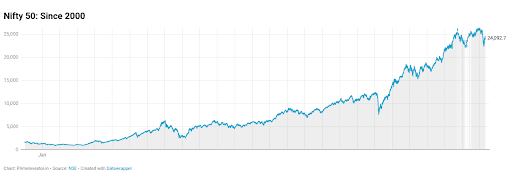
NIFTY 50 Historical Performance
How to Invest in NIFTY 50?
Investing in NIFTY 50 offers investors exposure to fundamentally strong companies across various sectors. Here’s how you can invest in NIFTY 50:
Direct Investments
You can gain direct exposure to the NIFTY 50 by purchasing shares of all 50 constituent companies in their respective proportions. However, this requires significant capital, and you will need to manually rebalance your portfolio to match the index, which is revised semi-annually.
NSE 50 Index Funds
You can invest in Index funds designed to track the performance of the NIFTY 50 and aim to mimic its return. These funds allow you to invest in NIFTY 50 Index funds via a lump sum or SIP mode of investment.
NSE ETFs
ETFs (Exchange Traded Funds) are investment funds that track the NIFTY 50 index, which represents the 50 largest and financially strongest companies on the NSE. These ETFs are traded on the stock exchange, allowing you to buy and sell NIFTY 50 ETFs like regular stocks.
Requirement for Investing in NIFTY 50
To invest in NIFTY 50, you need to have the following.
- Demat Account
To invest in NIFTY 50, you need to open a Demat Account with a SEBI-registered broker such as Upstox. Before opening an account, find out the Annual Maintenance Charges (AMC) and other fees to choose a broker that suits your investment needs and affordability.
- Trading Account
A Trading Account facilitates the transaction of buying and selling securities and is linked to your bank account. Most brokers offer a 2-in-1 Demat account, which combines the features of a demat and a trading account into a single platform.
- PAN Card
You must have a valid and active Permanent Account Number (PAN) card as mandated by SEBI regulations.
- Bank Account
Your Demat and Trading Accounts will be linked to your bank account. When you purchase a security, the purchase price will be debited from your bank account, and the shares will be transferred and stored in your Demat Account.
Why You Should Invest in NIFTY 50
NIFTY 50 includes the top 50 fundamentally strong companies with large market capitalisation across various sectors, offering exposure to blue-chip stocks. Here’s why you should consider investing in NIFTY 50.
Stability
The NIFTY 50 index consists of blue-chip companies across various sectors such as Banking, IT, Automobile, Pharma, and Energy. These companies are considered market leaders and offer stability, especially during an economic downturn.
Investment Diversification
Since the NIFTY 50 index includes companies across multiple sectors, you gain exposure to various industries and lower your risk of concentrating in a single sector.
Long-term Growth
The NIFTY 50 index has shown consistent growth over the past few years and can offer significant returns in the long run.
Suitable for Beginners
Beginners can invest in NIFTY 50 index funds or ETFs, as they track the index, requiring less active management and research.
Highly Liquid
NIFTY 50 consists of highly liquid companies, having high trading volume, making them easy to trade in the market.
Low Cost
NIFTY 50 Index funds or ETFs have a lower expense ratio as these funds simply track the index and are passively managed.
Risk Involved in Investing in NIFTY 50?
Though investing in NIFTY 50 Index funds and ETFs can offer high growth potential in the long term, there are a few risks you must consider before investing.
Market Volatility
The performance of NIFTY 50 is directly linked to the performance of the Indian equity market. In times of economic downturns, geopolitical issues, and policy changes can pull down the NIFTY 50 index.
Concentration Risk
Sectors such as IT, Financial Services, and Energy make up a significant portion of the NIFTY 50 index. If these heavyweight sectors underperform, the entire NIFTY 50 index may decline even if other stocks perform well.
Tracking Error of Funds
Avoid investing in NIFTY 50 Index funds and ETFs with higher tracking error to ensure your returns keep pace with those of the NIFTY 50 index.
Interest Rate Risk
If the RBI (Reserve Bank of India) increases the benchmark interest rate, equity investors may move their capital to relatively safer, low-risk debt instruments such as bonds and Fixed Deposits (FDs).

Investing in the NIFTY 50 can offer high growth potential and help build wealth over time. If you want to invest in NIFTY 50, you can directly purchase the shares of companies included in the index in the same proportion or opt for NIFTY 50 index funds and ETFs. Before investing in the NIFTY 50, ensure you have an active demat and trading account and understand all associated risks.
FAQs
What is the NIFTY 50, and how can you invest in it?
NIFTY 50 is an index consisting of top-tier companies listed on NSE. These companies have large market capitalisation, high liquidity, and a good track record of financial performance. You can invest in NIFTY 50 via Index funds, ETFs, or directly investing in the companies included.
How can beginners invest in the NIFTY 50?
Yes, beginners are recommended to invest in the NIFTY 50 index as it consists of financially strong companies that are less susceptible to market volatility, offering stability.
Can you invest directly in the NIFTY 50?
You cannot directly invest in the NIFTY 50 index; however, you can invest in the companies included in the index or NIFTY 50 index funds or ETFs.
Is investing in the NIFTY 50 safe for beginners?
Yes, the NIFTY 50 is safe to invest in as it is strictly regulated by SEBI, dedicated to protecting the interests of the investors. Since the companies included in the index are usually large-cap companies, which are less volatile than mid and small-cap companies.
Which is better for investing in the NIFTY 50 Index funds: SIP or lump sum?
Investing in the NIFTY 50 index funds via SIP is a better option as it allows you to buy more units at the fixed SIP amount when the prices are down. This averages the cost over time and reduces the impact of volatility.
How long should you stay invested in the NIFTY 50?
It is recommended to stay invested in the NIFTY 50 index for the long term to build wealth and earn capital appreciation.
What are the risks of investing in the NIFTY 50?
Market volatility, concentration risk, high tracking error of index funds and ETFs, along with changes in interest rates, are some of the risks associated with investing in the NIFTY 50 funds.
About Author
Mariyam Sara
Sub-Editor

holds an MBA in Finance and is a true Finance Fanatic. She writes extensively on all things finance whether it’s stock trading, personal finance, or insurance, chances are she’s covered it. When she’s not writing, she’s busy pursuing NISM certifications, experimenting with new baking recipes.
Read more from Mariyam













Upstox is a leading Indian financial services company that offers online trading and investment services in stocks, commodities, currencies, mutual funds, and more. Founded in 2009 and headquartered in Mumbai, Upstox is backed by prominent investors including Ratan Tata, Tiger Global, and Kalaari Capital. It operates under RKSV Securities and is registered with SEBI, NSE, BSE, and other regulatory bodies, ensuring secure and compliant trading experiences.
Related articles

Share Market
What Is a Market Correction? Meaning, Causes, and Strategy15 min read | Written by Bidita Sen

Share Market
Cyclical vs Defensive Stocks: Differences, Examples and Strategy15 min read | Written by Bidita Sen

Share Market
What is Efficiency Ratio: Meaning, Types, Formula and More12 min read | Written by Sachin Gupta

Share Market
What is a Solvency Ratio: Meaning, Types, Benefits, Limitations and More12 min read | Written by Sachin Gupta
Share Market
Profitability Ratios: Meaning, Formula, Benefits, Limitations and More11 min read | Written by Sachin Gupta

Share Market
A Guide to American Depository Receipts (ADR) for Indian Investors13 min read | Written by Subhasish Mandal