How the Global Memory Chip Shortage is Impacting Tech Stocks in India in 2026

Written by Mariyam Sara
Published on April 16, 2026 | 9 min read

Summary
Initially, the global memory chip shortage was driven by pandemic-related supply chain disruptions in early 2020, which persisted in 2026 due to unprecedented demand from the AI industry. The demand and supply imbalance hit tech companies hard as microchip prices surged, lowering their net profits and compelling them to transfer the cost to the end user.
Key Takeaways
-
The current global memory chip shortage is an extension of the pandemic-driven supply chain disruption, causing a demand-supply imbalance. This abnormal demand further intensified due to the expansion of AI infrastructure.
-
DRAM and NAND/SSD prices surged significantly in recent months, and the reduced availability of these components increased the input cost for device manufacturing companies.
-
Memory is one of the main features of most smartphones, and an increase in memory chips would push up smartphone prices in India.
-
Following the memory chip shortage, Indian tech stocks plummeted by 24% due to increased FII outflows, but rupee depreciation and increased company valuations gained investors' confidence, rebounding IT stocks.
Global memory chip shortage refers to the demand for memory chips exceeding supply and the global capabilities to produce them. Indian IT stocks, considered must-haves for smart investors, experienced a significant dip driven by semiconductor shortages and substantial FII outflows.
Global tech companies are facing memory chip shortages, as major memory chip manufacturers shifted from conventional DRAM and NAND towards high-bandwidth (HBM) and high-capacity DDR5 memory used in AI data centres.
Compared to smartphones and computers, AI servers and enterprise environments require significant memory per system, propelling the demand for memory chips higher than the global manufacturing capacity and supply, resulting in a shortage and price surges.
Let’s understand what’s causing the global memory chip shortage, how it impacts the Indian tech stocks, and whether it makes them risky or attractive.
What Is Causing the Global Memory Chip Shortage?
In early 2020, the semiconductor industry experienced a significant memory chip shortage, which was exacerbated by late 2025 developments in AI infrastructure, propelling demand beyond the global supply.
AI data centres require far more memory per system compared to regular customer devices such as smartphones and computers, resulting in memory manufacturers shifting from DRAM to High Bandwidth Memory (HBM) used in AI data centres. This led to a global memory supply crunch and surging DRAM prices.
The limited supply and excessive demand pressure the profit margins of companies producing budget-friendly electronics and the weakened rupee has made memory chips more expensive.
Why Tech Stocks are Falling in India?
Tech stocks experienced a bitter start in 2026, with Foreign Institutional Investors (FIIs) withdrawing capital from the IT sector due to slow growth and fear of AI disrupting the traditional IT services, dragging the IT sector down by 24% from mid-February to early April. The global memory chip shortage started in 2020 and persisted into 2026, making it a structural and long-term theme impacting tech companies, which added to IT investors’ woes.
FIIs feared that AI tools would replace the traditional IT services, reducing the profit margin of Indian tech companies. With concerns of a potential recession looming over the US economy, FIIs were cautious about the tech spending of US clients, which makes up a major proportion of Indian IT companies' revenue.
The weakening Indian rupee and the stronger dollar made safer, higher-yielding US Treasury bonds more attractive to FII, leading to capital outflows. To get an overview of IT stock performance, you can check the NIFTY IT which includes top Indian tech companies with large market capitalisation.
NIFTY IT Performance
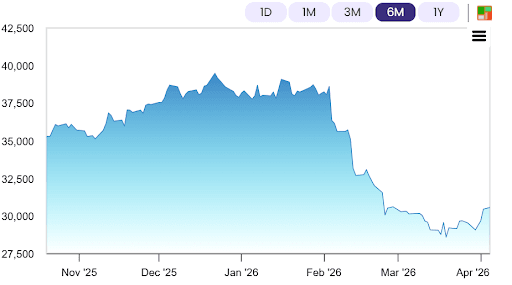
Source: NSE
NIFTY IT showed signs of recovery in mid-April as FII selling eased and the rupee weakened, boosting returns for Indian IT companies.
DRAM microchip shortage is bound to increase the cost of production for smartphone and laptop manufacturers, which would be transferred to the end customer.The effect of the shortage is already hitting the markets with DRAM chips, earlier selling for ₹5,000 are now being sold for ₹15,000.
Indian Tech Stocks Benefiting From the Global Memory Chip Shortage
Though the memory chip shortage has shaken the entire tech industry in India, there are certain companies that benefit from this shortage. Indian companies specialising in manufacturing electronic and chip design may benefit by fulfilling the supply deficit.
The following are Indian tech stocks benefiting from the global memory chip shortage:
HCL Technologies
HCL Technologies specialises in chip design, embedded systems, and VLSI (Very Large Scale Integration) services, supporting the development of electronic systems essential for smartphones, automotive, and high-performance computers.
CG Power and Industrial Solutions Ltd
CG Power and Industrial Solutions Ltd partnered with Renesas and Stars Microelectronics to establish India’s first Outsourced Semiconductor Assembly and Test (OSAT) facility. This facility would be dedicated to chip assembly, testing and packaging, while also catering to advanced and legacy packages used in industries such as automotive, consumer, and industrial.
Dixon Technologies Ltd
Dixon Technologies Ltd is a leading Electronic Manufacturing Services (EMS) provider, engaged in designing, manufacturing, testing and repairing electronic products for Original Equipment Manufacturers (OEMs).
Dixon Ltd is a top Indian contract manufacturer and a major beneficiary of the Indian government’s Production Linked Incentive (PLI) schemes to expand domestic production and reduce import reliance.
Micron Technology
In February 2026, Micron Technology set up and inaugurated India's first semiconductor assembly and test facility to advance semiconductor manufacturing capabilities in India.
Micron Technology's new facility began production and is dedicated for converting advanced DRAM and NAND wafers from Micron’s global manufacturing network into finished memory and storage products. This facility serves domestic and international customers by fulfilling the global demand for memory and storage driven by AI infrastructural development.
Vedanta Ltd
Vedanta Ltd is building a major semiconductor fabrication and display fab unit in the Dholera Special Investment Region (SIR) in Gujarat, India. This project is designed to become India’s first semiconductor fab facility to reduce import dependency and fulfil domestic demand for semiconductors.
India’s Semiconductor Revolution
The global microchip shortage highlighted the need for self-reliance in producing microchips. To capitalise on the global shortage, reduce import dependency and position India as a major player in the semiconductor industry, the government introduced India Semiconductor Mission 2.0 in February 2026.
The Union Budget 2026-27 allocated ₹1,000 crore for the India Semiconductor Mission 2.0, focusing on producing semiconductor equipment and materials, designing full-stack Indian semiconductor intellectual property and fortifying both domestic and global supply chains.
The mission is expected to design and manufacture chips required for nearly 70-75% of domestic applications by 2029. The next phase of this mission will focus on increasing manufacturing to achieve 3-nanometre and 2-nanometre technology nodes and become one of the top semiconductor nations globally.
What The Global Memory Chip Shortage Means for Indian Investors
The global memory chip shortage is not a short-term factor but a long-term structural bottleneck that increases the input costs of electronics-producing tech companies, pressuring their profit margin. On the flip side, this shortage has presented India with an opportunity to lead the global semiconductor industry by producing semiconductors and memory chips domestically to meet domestic and global demands.
Seasoned investors are tracking companies setting up semiconductor plants in India to fulfil the supply chain gap and export semiconductors and memory chips to foreign countries, leveraging the weakening rupee. This would make memory chips cheaper for domestic companies and increase the export revenue.
However, investors must consider the production capacity and building stage of these plants before investing in companies.

The global microchip shortage is disrupting the supply chain and driving up the costs of smartphones and PCs due to high demand and low supply of DRAM and NAND chips. The fear of AI replacing traditional IT services, the microchip shortage and increased FIIs outflows, and plummeting tech stocks.
While tech stocks are significantly impacted by the microchip shortage, some tech companies, supported by the government, are setting up facilities to fill in the supply chain gaps and making India aatma-nirbhar for semiconductor and microchip production.
FAQs
1. What is causing the global memory chip shortage?
The global memory chip shortage is driven by significant growth in AI and cloud computing infrastructure. Since a major portion of the microchips is produced by a limited number of global suppliers, which caused many memory manufacturers to shift from DRAM and NAND chips used in smartphones and PCs to high-bandwidth memory (HBM) used in AI servers.
This translates to less production of consumer-centric DRAM and NAND, leading to increased chip prices.
2. Why is AI a major factor behind the global memory chip shortage?
AI systems require far more memory than traditional computing, large data centres are consuming a significant amount of advanced memory, reducing the supply for other industries.
3. How is the global memory chip shortage affecting tech companies in India?
Due to the microchip shortage, Indian tech companies are incurring higher input costs for smartphones, laptops and servers, reducing profit margins and delaying launches.
4. What impact does the memory chip shortage have on Indian consumers?
The memory chip shortage increases prices of smartphones, laptops and gadgets, since prices account for around 20% of a smartphone’s cost, leaving fewer budget-friendly options.
5. Are Tech stocks benefiting from the shortage?
Yes, certain tech companies are setting up semiconductor manufacturing projects, supported by the government, to fulfil domestic demand for memory chips and reduce import dependency.
6. How is India responding to the crisis?
The Indian government introduced the India Semiconductor Mission 2.0, focusing on producing semiconductor equipment and materials domestically, designing full-stack Indian semiconductor intellectual property and committing to meet domestic and global demand.
7. How long will the memory chip shortage last?
Sassine Ghazi, CEO of Synopsys, along with multiple analysts, expect the shortage to continue through 2026 and possibly into 2027, due to sustained AI demand and a slow increase in manufacturing capacity.
About Author
Mariyam Sara
Sub-Editor

holds an MBA in Finance and is a true Finance Fanatic. She writes extensively on all things finance whether it’s stock trading, personal finance, or insurance, chances are she’s covered it. When she’s not writing, she’s busy pursuing NISM certifications, experimenting with new baking recipes.
Read more from Mariyam





















Upstox is a leading Indian financial services company that offers online trading and investment services in stocks, commodities, currencies, mutual funds, and more. Founded in 2009 and headquartered in Mumbai, Upstox is backed by prominent investors including Ratan Tata, Tiger Global, and Kalaari Capital. It operates under RKSV Securities and is registered with SEBI, NSE, BSE, and other regulatory bodies, ensuring secure and compliant trading experiences.
Related articles

Share Market
What Is a Market Correction? Meaning, Causes, and Strategy15 min read | Written by Bidita Sen

Share Market
Cyclical vs Defensive Stocks: Differences, Examples and Strategy15 min read | Written by Bidita Sen

Share Market
What is Efficiency Ratio: Meaning, Types, Formula and More12 min read | Written by Sachin Gupta

Share Market
What is a Solvency Ratio: Meaning, Types, Benefits, Limitations and More12 min read | Written by Sachin Gupta
Share Market
Profitability Ratios: Meaning, Formula, Benefits, Limitations and More11 min read | Written by Sachin Gupta


Share Market
A Guide to American Depository Receipts (ADR) for Indian Investors13 min read | Written by Subhasish Mandal