Short Term FD vs Long Term FD – Interest Rate & Benefits

Written by Pradnya Surana
Published on November 27, 2025 | 3 min read
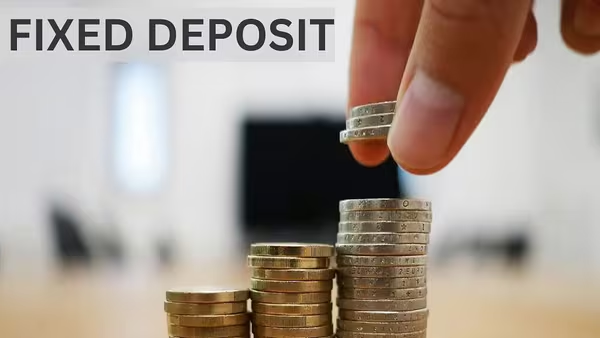

Fixed Deposits (FDs) are one of the most popular and trusted options for saving and investing in India. They give guaranteed returns, are easy to understand and operate.
Today, one can open an FD just with a few clicks from the comfort of home. When you start an FD with any bank or financial institution, you are essentially lending them money for a predetermined duration. The banks or financial institutions then give you interest at a pre-determined rate on the money deposited.
What is a Short-term FD?
A short-term FD usually has a tenure between 7 days to 12 months. It is best for investors who want to park their money for a short duration without taking any risk. Generally, depositors here anticipate the need for the money in post few weeks or months, but want to earn better returns than parking money in savings accounts. Also, when the duration of investment is less than a year, one would not want to invest this in equity markets, which can be volatile. The interest rates in short-term FD are lower than long-term FD, but are guaranteed.
Benefits of Short-term FD
High liquidity
Your money is not locked for long. You can break the FD quickly if you need funds.
Less interest rate risk
If interest rates rise in the future, you can reinvest at higher rates after maturity.
Good for short goals
Can be used for travel plans, small purchases, bill payments, or building an emergency fund.
Low penalty for premature withdrawal
Since the tenure is short, penalties usually have a smaller impact.
What is a Long-term FD?
A Long-term FD has a tenure of 1 year to 10 years. Investors who want stable, long-term growth often choose this option. Interest rates in long-term FD are higher than short-term ones. Here again, interest rates are locked for the entire deposit tenure irrespective of tenure.
Benefits of Long-term FD
Higher Interest Rates
Banks and financial institutions usually offer better interest rates for longer periods.
Stable and Predictable Income
For those who want steady, guaranteed returns without market risk, consider investing here.
Good for Long-Term Goals
Helpful for long-term goals such as child education, marriage expenses, retirement savings or wealth building. Basically, a part of your savings and investments that you would not want to risk to market volatility.
Compounding Benefit
If you choose interest reinvestment, the power of compounding can significantly grow your money.
Short-term FD vs Long-term FD – Interest Rates
Interest rates are the most important factor when comparing short and long-term FDs. As mentioned, interest rates for long-term FD are higher than short-term ones. Why? Because banks reward investors who keep their money locked for longer periods.
However, interest rate trends can change based on the economy. Sometimes, banks may offer similar rates for both. It is advisable to keep a check on FD interest rates from time to time.
Taxation on Short-term and Long-term FDs
Tax rules are the same for both types of FDs
- Interest earned is added to your total income
- Tax is charged as per your income tax slab
- TDS is deducted if the interest exceeds ₹40,000 (₹ 50,000 for senior citizens)
- You can submit Form 15G/15H (as per your eligibility) to avoid TDS.
Which One Should You Choose?
Choosing between short-term and long-term FD depends on your financial needs and goals and risk appetite.
Choose a short-term FD if you anticipate the need for money in a few weeks. It will earn better interest than sitting idle in your savings account. Choose a long-term FD if you intend to save for a particular goal, where you do not want to risk capital loss. You can also save your emergency funds in a long-term FD, which, in case you need to break it, will incur only a small interest penalty.

Both short-term and long-term FDs are safe, reliable and give guaranteed returns. If you want flexibility and quick access to funds, choose a short-term FD. If you want higher interest and long-term growth, choose a long-term FD. Understanding your financial needs should be the primary determinant in selecting FD tenure. A balanced approach, investing in both short and long-term FDs, can also help you enjoy safety, liquidity and guaranteed returns.
About Author
Pradnya Surana
Sub-Editor
is an engineering and management graduate with 12 years of experience in India’s leading banks. With a natural flair for writing and a passion for all things finance, she reinvented herself as a financial writer. Her work reflects her ability to view the industry from both sides of the table, the financial service provider and the consumer. Experience in fast paced consumer facing roles adds depth, clarity and relevance to her writing.
Read more from Pradnya


















Upstox is a leading Indian financial services company that offers online trading and investment services in stocks, commodities, currencies, mutual funds, and more. Founded in 2009 and headquartered in Mumbai, Upstox is backed by prominent investors including Ratan Tata, Tiger Global, and Kalaari Capital. It operates under RKSV Securities and is registered with SEBI, NSE, BSE, and other regulatory bodies, ensuring secure and compliant trading experiences.
Related articles




Online Trading
What Are High-Yield NCDs? A Beginner’s Guide to Safer Fixed-Income Investing3 min read | Written by Mariyam Sara

Online Trading
Understanding the Put-Call Ratio: A Key Indicator for Market Sentiment and Trading Strategies5 min read | Written by Dev Sethia

Online Trading
Is Forex Trading Legal in India? All You Need to Know About Legalities and Penalties6 min read | Written by Dev Sethia
Online Trading
Understanding Profit After Tax (PAT): What It Means for Investors and Businesses5 min read | Written by Dev Sethia