What Is a Broker and How Brokerage Charges Work?

Written by Pradnya Surana
Published on November 27, 2025 | 3 min read

Stockbroker and Brokerage – The Essentials in Stock Market Investing
When you want to buy or sell any shares, you cannot simply walk into the stock exchange to execute this transaction. For this, you need an intermediary who does these transactions for you.
The intermediary who carries out the stocks and securities transaction is known as a ‘stockbroker’. Here, we will understand in detail the role of a stockbroker, the brokerage and the charges involved in the stock market transactions.
Who is a Stockbroker?
A stockbroker is a licensed individual or a firm authorised by the Securities and Exchange Board of India (SEBI) to facilitate buying and selling stocks and other securities on a stock exchange. They also provide a trading platform, like a website or a mobile app or both, for you to trade. So, essentially, stockbrokers are the bridge between you and exchanges.
The Evolution of Stockbrokers
In earlier times, stockbrokers operated through a physical office where clients would visit or call to place orders. The cumbersome paperwork involved, limited financial literacy and overall perception of stock trading being equal to gambling limited the number of retail investors.
Today, the improved financial literacy and the digital investment platforms provided by the stockbrokers have propelled lakhs of retail investors into the Indian stock market. Almost all stockbrokers have a digital platform where the entire process of buying and selling shares is paperless and does not require a visit to the broker's office. Even the account opening process is digital. The stockbrokers work under strict guidelines of SEBI and stock exchanges. This adds to investors' trust.
Types of Stockbrokers
In India, there are two types of stockbrokers, namely,

Full-service brokers
Provide investment advisory services and fees are higher

Discount brokers
Provide basic trading services, without advisory and charge less fees
Both these categories of brokers suit different investor categories.
Full service brokers
These brokers, apart from providing a platform for transactions, also offer a vast array of services like research reports, investment advice, portfolio management and personalised support. These brokers usually charge a certain percentage of trade value as brokerage. Eg- ICICI Securities, Nuvama Wealth Management
Discount brokers
Upstox is a discount broker. For discount brokers, their focus is mainly on the execution of trades through modern-day digital platforms. Discount brokers don’t get into advisory and portfolio management. They usually charge zero or minimal brokerage and flat fees for most of their services.
Understanding Brokerage Charges
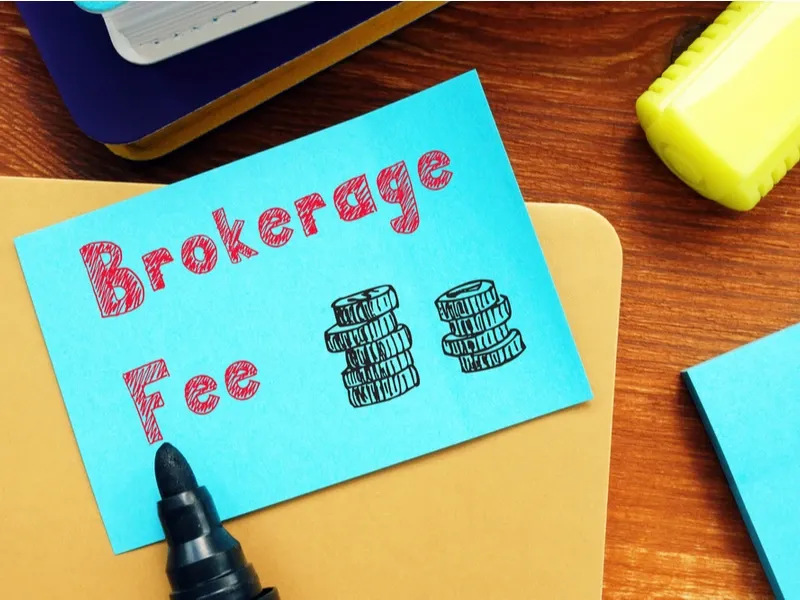
Brokerage is what a broker charges for providing services. A stockbroker charges certain fees to facilitate the securities transaction. Let’s understand them for each type of broker,
Full-service broker
These brokers usually charge a certain percentage of the trade value as a brokerage fee. This rate differs from broker to broker and also the value of the trade. There is a certain rate for one range. Like for the value of trade between ₹10,000 to ₹1lakh, there might be a certain per cent brokerage. For ₹1 lakh to ₹10 lakh, the rate may differ and so on. The brokerage usually ranges from 0.25% - 0.75%
Discount broker
These brokers charge a flat fee per trade, say, irrespective of transaction value. Upstox charges a flat ₹20 as a brokerage on delivery trades (where you buy for long-term investing) and intraday trades. These brokers are highly beneficial for high-trade values.
Additional Charges Over Brokerage
Brokerage isn’t the only charge in stock market transactions. There are certain other fixed and variable costs associated. Let's learn about them,
Securities Transaction Tax (STT)
This is levied by the government on all stock market transactions. For equity delivery trades, it's 0.1% on both buy and sell sides.
Exchange Transaction Charges
These are fees collected by NSE and BSE for using their platforms, calculated at around 0.00297% of the transaction value.

IPFT (Investor Protection Fund Trust) charges
These are charges for NSE trades, the rate being ₹10 per crore of turnover and ₹50 per crore of premium value.

GST (Goods and Services Tax)
This applies at 18% to brokerage, transaction and IFPT charges.

SEBI Charges
It charges ₹10 per crore of turnover to fund the regulatory body's operations.

Stamp Duty
It varies from state to state but is charged at around 0.015% for the buy transactions of delivery trading.

Depository Charges
These are fees for maintaining your demat account. They range from ₹300 to ₹750 annually.
When combined, these charges can add up to approximately 0.5% to 0.7% of your transaction value. These all charges (whichever applicable) plus your brokerage charge, are the total charges that you pay for stock market transactions. As discussed, some of these are fixed charges and some vary.
Brokerage varies depending on the type of broker you have opted for.

Understanding brokers' service and brokerage charges, along with other charges, is of utmost importance. You must pay these charges irrespective of whether you make a profit or a loss. If your trade is making a profit, these charges will claim a certain percentage of it and if you are making a loss, these charges will create a further dent in the capital.
About Author
Pradnya Surana
Sub-Editor
is an engineering and management graduate with 12 years of experience in India’s leading banks. With a natural flair for writing and a passion for all things finance, she reinvented herself as a financial writer. Her work reflects her ability to view the industry from both sides of the table, the financial service provider and the consumer. Experience in fast paced consumer facing roles adds depth, clarity and relevance to her writing.
Read more from Pradnya














Upstox is a leading Indian financial services company that offers online trading and investment services in stocks, commodities, currencies, mutual funds, and more. Founded in 2009 and headquartered in Mumbai, Upstox is backed by prominent investors including Ratan Tata, Tiger Global, and Kalaari Capital. It operates under RKSV Securities and is registered with SEBI, NSE, BSE, and other regulatory bodies, ensuring secure and compliant trading experiences.
Related articles

Share Market
India's LPG Crisis Is the Wake-Up Call. Renewables Are the Answer6 min read | Written by Pradnya Surana
Share Market
What is the Difference Between Small Gain & Capital Gain?4 min read | Written by Dev Sethia

Share Market
Types of Stocks: Large Cap, Mid Cap, Small Cap Explained5 min read | Written by Pradnya Surana



Share Market
How Dividends Help You Earn Passive Income From the Stock Market3 min read | Written by Pradnya Surana