What Is the Nifty Telecommunications Index? A Complete Guide for Investors

Written by Mariyam Sara
Published on June 23, 2026 | 5 min read

Key Takeaways
-
The Nifty Telecommunications Index is a sectoral benchmark that tracks the performance of the top 13 listed companies in the telecommunications sector.
-
Stocks included in the Nifty Total Market index at the time of review are eligible for the Nifty Telecommunications Index. The weight of each constituent company is based on its free-float market capitalisation.
-
The Nifty Telecommunications Index is reviewed semi-annually and rebalanced quarterly.
-
Investing in the Nifty Telecommunications index offers various benefits such as diversification, exposure to top companies, risk management, and high growth potential.
-
However, before investing in the Nifty Telecommunications Index, investors must consider risks such as sector concentration, regulatory constraints, and the rapid pace of technological change.
The Nifty Telecommunications index was launched in June 2026 by NSE Indices Limited, the index services subsidiary of the National Stock Exchange. This index tracks the top 13 companies in the telecommunications sector and acts as a barometer for the Indian telecommunications industry.
Let’s explore what the Nifty telecommunications index is, how it works, along with its selection criteria and constituents.
What is the Nifty Telecommunication Index?
The Nifty Telecommunications index is a sectoral benchmark index that tracks the performance of leading telecommunication companies within the Nifty Total Market Index. Introduced in June 2026, the index is designed to give an accurate and detailed measure of the telecommunication sector’s performance. The index is calculated using free-float market capitalisation methodology.
The companies included in the Nifty Telecommunication Index are selected from the Nifty Total Market Index, subject to additional eligibility criteria.
How Does the Nifty Telecommunication Index Work?
The Nifty Telecommunications Index is a sectoral index built to track the performance of telecommunication stocks within the Nifty Total Market Index. Its constituents are selected based on the eligibility criteria established by NSE Indices Limited and are assigned weights according to their free-float market capitalisation.
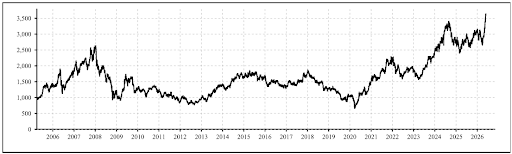
The Nifty Telecommunications Index can be used as a benchmark for fund portfolios and as the basis for launching index funds, ETFs, and other telecommunications-related investment products. The index has a base date of April 01, 2005, and a base value of 1000.
Constituents of the Nifty Telecommunication Index
As of May 2026, the Nifty Telecommunications index comprises the following top 13 prominent companies, ranked according to their respective weightage:
| Company Name | Weight (%) |
|---|---|
| Vodafone Idea Ltd. | 20.29 |
| Indus Towers Ltd. | 17.56 |
| Bharti Airtel Ltd. | 16.80 |
| Tata Communications Ltd. | 12.94 |
| HFCL Ltd. | 10.33 |
| Sterlite Technologies Ltd. | 8.02 |
| Bharti Hexacom Ltd. | 6.31 |
| Tejas Networks Ltd. | 2.40 |
| ITI Ltd. | 1.62 |
| Railtel Corporation Of India Ltd. | 1.54 |
Selection Criteria for the Nifty Telecommunication Index
The constituent companies for the Nifty Telecommunications index are selected based on the following eligibility criteria set by the NSE Indices Ltd.
- Stocks included in the Nifty Total Market index at the time of review are eligible for inclusion in the Nifty Telecommunications index.
- Stocks belonging to basic industries within the Telecommunications sector can be eligible to be included in the index at the time of review.
- The weight of each stock in the index is based on free float market capitalisation.
- The Nifty Telecommunications Index is reconstituted semi-annually and rebalanced quarterly.
- The individual stock weights are capped at 23%, and the weight of the top 3 stocks is capped at 62%.
Nifty Telecommunication Index Historical Performance
Though the Nifty Telecommunications Index was introduced in June 2026, NSE calculated the CAGR of the index based on the constituent companies' past performance. Over the past 5 years, the index delivered a total return of 17.71%, which is significantly higher than the Nifty 50’s return of roughly 9.87%, as per NSE Indexogram May 29, 2026.
The Nifty Telecommunications index has a Beta of 1.11 relative to the Nifty 50, indicating that this specific sector experiences higher volatility relative to the broader market.
Source: NSE Indexogram
Benefits of Investing in the Nifty Telecommunication Index
The following are the benefits of investing in the Nifty Telecommunication Index.
Diversification
Investing in the Nifty Telecommunication Index provides exposure to various companies within the telecommunication sector, rather than just a few individual stocks.
Exposure to Top Companies
Investors gain access and exposure to top companies within the sector, selected based on strict eligibility criteria.
High-Growth Potential
By investing in the Nifty Telecommunications Index, investors can benefit from large-scale nationwide 5G infrastructure upgrades, high consumer demand for internet services, and the expansion of segments such as Cloud, IoT, and fintech.
Risk-Management
The Nifty Telecommunications Index is rebalanced quarterly and reconstituted semi-annually to ensure it accurately reflects the performance of the telecommunication sector. The weight of a single stock is capped at 25% to avoid over-concentration, thereby helping to reduce risk.
Risks of Investing in the Nifty Telecommunication Index
The following are the risks associated with investing in the Nifty Telecommunication Index.
Concentration Risk
Investing in the Nifty Telecommunications Index may expose investors to concentration risk because the index tracks companies solely within the Telecommunications sector. Any sector-specific downturns could significantly impact the performance of the index and, consequently, an investor’s portfolio.
Regulatory Constraints
The telecommunications sector is under the strict regulatory oversight of the Telecom Regulatory Authority of India (TRAI). Any unfavourable policy shifts, spectrum pricing changes, or changes in tariff mandates would impact the profitability of these companies and their stock prices.
High Competition
The telecommunication industry is highly competitive, which leads to price wars between companies, compelling them to offer services at lower prices to attract customers. This could pressure the profit margins of the companies.
Rapid Technological Advancements
To maintain a competitive edge and develop innovative services, companies must constantly invest in and rapidly adopt new technologies. This often results in substantial capital expenditure and higher operating costs.

The Nifty Telecommunications Index is a sectoral benchmark that tracks the performance of the top listed companies belonging to the telecommunications sector. These companies are selected from the Nifty Total Market Index and weighted using the free-float market capitalisation methodology.
FAQs
What is the Nifty Telecommunication Index?
The Nifty Telecommunications Index is a sectoral benchmark that tracks the performance of the top listed companies belonging to the telecommunication sector listed on the National Stock Exchange (NSE).
How many stocks are there in the Nifty Telecommunication Index?
As of May, 2026, there are 13 stocks in the Nifty Telecommunication index. The index is reconstituted semi-annually and rebalanced quarterly.
How is the stock’s weight calculated in the Nifty Telecommunication Index?
In the Nifty Telecommunication Index, the weight of each stock is calculated using the free-float market capitalisation methodology.
Who manages the Nifty Telecommunication Index?
The NSE Indices Ltd manages and rebalances the Nifty Telecommunications Index.
How often is the Nifty Telecommunication Index rebalanced?
The Nifty Telecommunication Index is rebalanced quarterly and reconstituted semi-annually.
About Author
Mariyam Sara
Sub-Editor

holds an MBA in Finance and is a true Finance Fanatic. She writes extensively on all things finance whether it’s stock trading, personal finance, or insurance, chances are she’s covered it. When she’s not writing, she’s busy pursuing NISM certifications, experimenting with new baking recipes.
Read more from Mariyam
















Upstox is a leading Indian financial services company that offers online trading and investment services in stocks, commodities, currencies, mutual funds, and more. Founded in 2009 and headquartered in Mumbai, Upstox is backed by prominent investors including Ratan Tata, Tiger Global, and Kalaari Capital. It operates under RKSV Securities and is registered with SEBI, NSE, BSE, and other regulatory bodies, ensuring secure and compliant trading experiences.
Related articles

Share Market
What Is a Market Correction? Meaning, Causes, and Strategy15 min read | Written by Bidita Sen

Share Market
Cyclical vs Defensive Stocks: Differences, Examples and Strategy15 min read | Written by Bidita Sen

Share Market
What is Efficiency Ratio: Meaning, Types, Formula and More12 min read | Written by Sachin Gupta

Share Market
What is a Solvency Ratio: Meaning, Types, Benefits, Limitations and More12 min read | Written by Sachin Gupta
Share Market
Profitability Ratios: Meaning, Formula, Benefits, Limitations and More11 min read | Written by Sachin Gupta


Share Market
A Guide to American Depository Receipts (ADR) for Indian Investors13 min read | Written by Subhasish Mandal