What Is the Nifty Smallcap Index? Full Beginner’s Guide to Small-Cap Investing in India

Written by Mariyam Sara
Published on May 14, 2026 | 7 min read


Key Takeaways
-
The Nifty Smallcap indices serve as benchmarks for different sets of small-cap companies listed on the NSE.
-
There are different Nifty Smallcap indices, such as the Nifty Smallcap 50, Nifty Smallcap 100, and Nifty Smallcap 250, which are designed to track small-cap stocks based on the number of constituent companies included in the index.
-
You can invest in the Nifty Smallcap indices via direct investment, index funds, and ETFs.
-
Investing in the Nifty Smallcap indices may offer high-growth potential and long-term capital appreciation, but with higher risk.
-
Before investing in the Nifty Smallcap index, investors should consider risks such as high volatility, low liquidity, and a lack of financial transparency to make informed financial decisions.
The Nifty Smallcap index includes companies with low market capitalisation and high growth potential listed on the NSE. Investors track Nifty Smallcap indices to gauge the performance of small-cap companies listed on the NSE, as these benchmarks reflect different sections of India’s small-cap universe. The companies included in the indices are ranked between 251 and 500, by market capitalisation.
Let’s understand what the Nifty Smallcap index is, how it works, and whether it is the right investment for you.
What Is the Nifty Smallcap Index?
The Nifty Smallcap index is a benchmark that tracks the performance of small-cap companies listed on the NSE. Small-cap companies generally refer to firms ranked 250 onwards as per market capitalisation.
There are different Nifty Smallcap indices based on the number of constituents:
- Nifty Smallcap 250 Index
The Nifty Smallcap 250 index includes 250 companies from various sectors such as financial services, IT, healthcare, and manufacturing. It consists of companies ranked 251st to 500th based on market capitalisation.
- Nifty Smallcap 100 Index
The Nifty Smallcap 100 index tracks the performance of the top 100 companies with small market capitalisation and acts as a benchmark for the small-cap segment. It consists of companies ranked 251st to 350th based on market capitalisation.
- Nifty Smallcap 50 Index
The Nifty Smallcap 50 index represents the top 50 companies selected based on average daily turnover from the top 100 companies selected based on full market capitalisation in the Nifty Smallcap 250 index.
How Does the Nifty Smallcap Index Work?
The Nifty Smallcap Index uses the free-float method to determine the weight of each company based on its freely traded shares rather than its total market capitalisation. The indices include companies across various sectors, and are maintained by NSE Indices Ltd and are periodically rebalanced semi-annually to ensure it reflects true market performance and liquidity. The Indices constituents are changed based on index methodology, eligibility, market capitalisation ranking, liquidity and periodic rebalancing.
How to Invest in the Nifty Smallcap Index?
The Nifty Smallcap index is suitable for investors with high risk tolerance, aiming for long-term gain. You can invest in the Nifty Smallcap index through the following options.
Direct Investment
You can directly invest in the individual stocks of companies included in the Nifty Smallcap indices. However, this may increase risks such as high volatility, low liquidity, and potential business failure.
Index Funds
If you seek passive investments, you can opt for Nifty Smallcap index funds. These funds are mutual funds that replicate the index, offer SIPs (Systematic Investment Plans), and have a low expense ratio.
Exchange Traded Funds (ETFs)
Nifty Smallcap ETFs are passive investments that are listed on the stock exchanges and can be easily traded, offering high liquidity. However, liquidity may vary across ETFs due to factors such as trading volume, underlying liquidity and market makers.
Benefits of Investing in the Nifty Smallcap Index
From May 2016 to April 2026, the Nifty Smallcap 250 index has grown multifold from 4,250 to 16,731 with sharp interim corrections in 2020 and 2025.
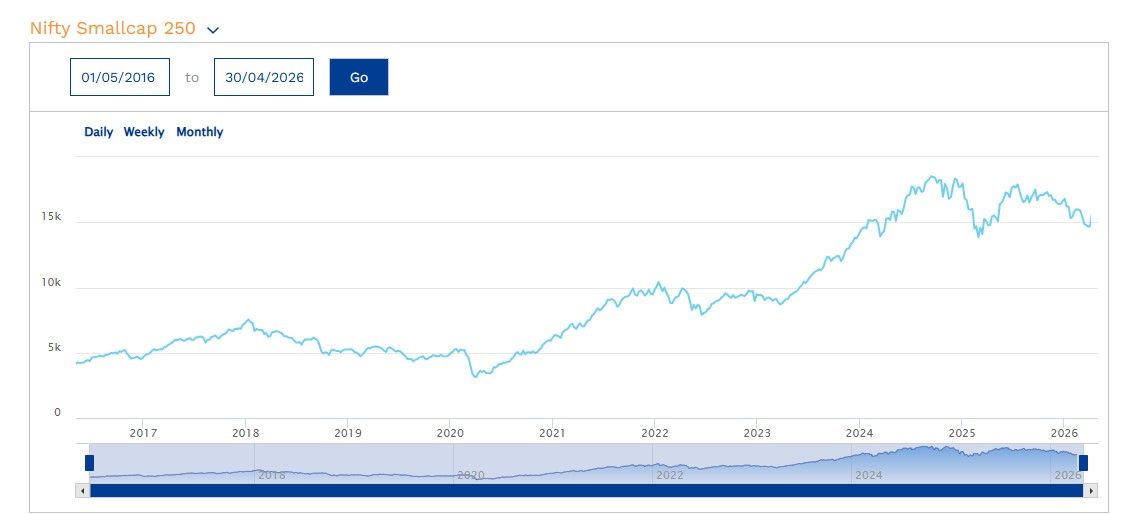
Source: NSE
The following are the benefits of investing in the Nifty Smallcap Index.
High Growth Potential
The Nifty Smallcap index offers access to small and emerging companies with high growth potential of becoming mid or large-cap giants in the future.
Diversification
When you invest in a Nifty Smallcap index, your money is spread across various companies and sectors, ensuring your overall portfolio isn’t significantly impacted if one sector faces a downturn.
Potential Outperformance in Bull Market
Due to their volatility, small-cap stocks may outperform large-caps during bull markets, though this is never guaranteed.
Risks of Investing in the Nifty Smallcap Index
Though Nifty Smallcap indices can offer high growth potential, they carry certain risks that could impact your returns. The following are the risks you must consider before investing in the Nifty Smallcap index.
High Volatility
Small-cap stocks are highly volatile, experiencing sudden and dramatic price swings, and are hit harder during market corrections.
Tracking Error in Index Funds & ETFs
If you choose to invest in Nifty Smallcap index funds or ETFs, check the fund’s tracking error. If the tracking error is high, the returns may slightly vary from those of the index. Other factors, such as expense ratio, liquidity and cash holdings, can also decrease your total return value.
Financial Risk
Some small-cap companies are more sensitive to economic downturns, rising interest rates, and inflation, which could reduce their profit margins and increase reliance on debt.
Susceptible to Market Manipulations
Due to low liquidity, small-cap stocks are prime targets for pump-and-dump schemes, where fraudsters inflate prices through misinformation and artificial demand before dumping shares at the peak. These scams severely damage unsuspecting investors and their portfolios.
Should a Beginner Invest in the Nifty Smallcap Index?
The Nifty Smallcap index is ideal for investors with a high-risk appetite who are seeking long-term capital appreciation will gain from this index. While small-cap stocks offer significant growth potential, they are highly volatile and often have lower liquidity.
Hence, it is recommended for beginners to gain limited exposure to the Nifty Smallcap index to diversify their portfolio.

Nifty Smallcap 250 represents companies ranked 251st to 500th by market capitalisation within the Nifty 500 universe and are selected using the free-float market capitalisation method.
The Nifty Smallcap index offers high growth potential but also carries risks such as high volatility, low liquidity, sensitivity to market manipulation, and financial risk. Beginners are advised to start investing with a small amount to limit potential losses.
FAQs
What is the Nifty Smallcap Index?
The Nifty Smallcap index is a benchmark index that tracks the performance of small-cap companies listed on the NSE. The constituents of the index are reviewed semi-annually and can be replaced if they fail to meet the criteria.
What is the difference between the Nifty Smallcap 50, 100, and 200 indices?
The Nifty Smallcap 50, 100, and 200 indices are different in terms of their composition, market size, and volatility. They track the top 50, 100, and 250 small-cap companies ranked by market capitalisation, respectively, and carry different levels of risk.
How is the Nifty Smallcap Index calculated?
The Nifty Smallcap index is calculated by using the free-float market capitalisation method to ensure the index reflects the true performance of the smallcap segment.
What are small-cap stocks in India?
Small-cap stocks are emerging companies with low market capitalisation and high growth potential. These companies are ranked 250 and below based on market capitalisation.
What are the benefits of investing in the Nifty Smallcap Index?
Investing in the Nifty Smallcap index offers investors benefits such as high growth potential, low entry cost, diversification, and outperformance during bull markets.
What are the risks of investing in the Nifty Smallcap Index?
Investing in the Nifty Smallcap index is considered risky since it invests in small-cap stocks that carry risks such as high volatility, financial risk, and low liquidity, which makes them susceptible to Pump and Dump scams.
Can beginners invest in the Nifty Smallcap Index?
Beginners are recommended to invest in the Nifty Smallcap index with caution, as small-cap stocks carry significant risk. They must start investing with a small amount to limit potential loss.
About Author
Mariyam Sara
Sub-Editor

holds an MBA in Finance and is a true Finance Fanatic. She writes extensively on all things finance whether it’s stock trading, personal finance, or insurance, chances are she’s covered it. When she’s not writing, she’s busy pursuing NISM certifications, experimenting with new baking recipes.
Read more from Mariyam




















Upstox is a leading Indian financial services company that offers online trading and investment services in stocks, commodities, currencies, mutual funds, and more. Founded in 2009 and headquartered in Mumbai, Upstox is backed by prominent investors including Ratan Tata, Tiger Global, and Kalaari Capital. It operates under RKSV Securities and is registered with SEBI, NSE, BSE, and other regulatory bodies, ensuring secure and compliant trading experiences.
Related articles

Share Market
What Is a Market Correction? Meaning, Causes, and Strategy15 min read | Written by Bidita Sen

Share Market
Cyclical vs Defensive Stocks: Differences, Examples and Strategy15 min read | Written by Bidita Sen

Share Market
What is Efficiency Ratio: Meaning, Types, Formula and More12 min read | Written by Sachin Gupta

Share Market
What is a Solvency Ratio: Meaning, Types, Benefits, Limitations and More12 min read | Written by Sachin Gupta
Share Market
Profitability Ratios: Meaning, Formula, Benefits, Limitations and More11 min read | Written by Sachin Gupta

Share Market
A Guide to American Depository Receipts (ADR) for Indian Investors13 min read | Written by Subhasish Mandal