
Market News
Why Trent soared, but DMart sank after robust Q2 business updates: Explained

5 min read | Updated on October 06, 2026, 16:42 IST


SUMMARY
DMart shares hit a 52-week low after reporting 18% YoY growth in revenue for Q2FY27, while Trent shares jumped nearly 12.9% after posting 21% growth. This divergence in the share price reaction should prompt investors to look at their valuations and earnings growth.
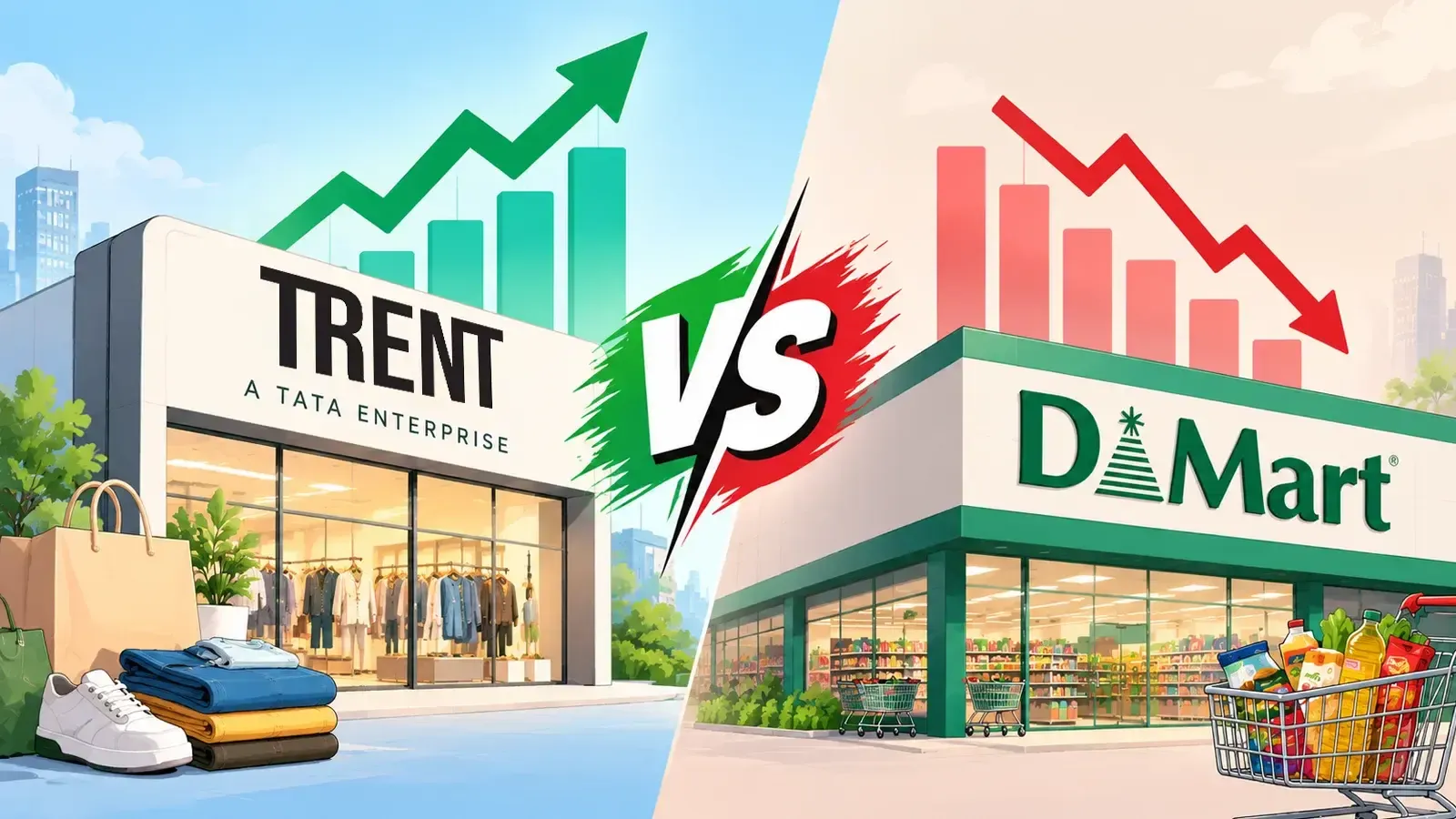
DMart shares trade nearly 40% away from its record high level, while Trent shares trade ~50% away from the record high levels. Image: Shutterstock.
The Q2 earnings season is around the corner, with big companies scheduled to announce their results for the September quarter, starting this week. A few companies have already started announcing their business updates for the quarter. Shares of consumer-focused companies are particularly in the limelight after their Q2 business updates, as they give a clearer idea of what the upcoming earnings will look like.
In this context, shares of Trent were among the top gainers on Tuesday after the company announced robust earnings growth for the quarter ended September 2026. In addition, shares of Nykaa, Honasa Consumer and V-Mart Retail also saw a strong positive reaction to their robust earnings growth for the quarter.
However, shares of Avenue Supermart (DMart) plunged over 6.4%, displaying an opposite reaction, despite posting a robust Q2 business update. However, Nykaa and Honasa Consumer may not be exactly comparable to DMart, as they are e-retailers focusing on the beauty and fashion care segment.
However, Trent, VMart and DMart follow a similar brick-and-mortar-first business model. While Trent and VMart’s shares saw strong gains post the business updates, DMart’s shares were pulled down by 4%, which warrants investors’ attention.
Let us understand what led to the divergent reaction in the share prices.
Q2 business updates
Avenue Supermarts, which operates a retail supermarket chain under the brand DMart, posted revenue of ₹19,206 crore for the quarter ended September 2026, up 18.3% YoY. The company posted ₹18,795 crore in the previous quarter and ₹16,360 crore in the same period last year. The company’s total store count for the quarter stood at 518 stores, up from 500 in FY26. Despite strong double-digit growth, the shares fell 6.45% on Monday and made a fresh 52-week low of ₹3,521 apiece on the NSE on Tuesday.
The Tata Group-owned fashion and apparel retail company, Trent Ltd, posted a 21% YoY increase in revenue at ₹5,788 crore vs ₹4,724 crore in the same period last year. Meanwhile, the company also announced strong store additions for its key brands Westside and Zudio. Westside added 10 stores and Zudio added 17 stores during the quarter. During the quarter, the company achieved an important milestone of opening its 1,000th Zudio store and now owns more than 1,342 stores across all its lifestyle brands.
Following the robust business updates, shares of Trent Ltd jumped as much as 12.9% on Tuesday, hitting an intraday high of ₹2,909 apiece on the NSE.
Valuation discrepancy
The primary reason behind the divergence in the reactions lies in valuations. Trent and DMart trade at a very high price-to-earnings ratio of 83x and 76x on TTM earnings, despite a decent fall from record-high levels. Trent shares are trading nearly 50% lower from their record-high level of ₹5,563 apiece, and DMart shares are trading nearly 40% lower from their record-high price of ₹5,900 apiece.
However, while comparing the price-to-earnings growth (PEG) ratio, Trent shares look fairly u as compared to DMart, securing greater interest from investors. Trent’s PEG ratio stands at 1.19x as compared to DMart's 9.7x. Meaning, in DMart’s case, for every 1% of earnings growth, investors are paying 9.7x more. Whereas, in Trent’s case, investors are getting a fair deal for paying a similar premium rate at which the company’s earnings are growing.
Expected growth
Similarly, on the expected earnings growth parameter, analysts at global brokerage houses like Goldman Sachs, JP Morgan Chase, and Jefferies have divided opinions. Consensus estimates indicate 15% profitability growth for DMart in FY27, considering it manages to defend and grow its EBITDA margin at 8%. Similarly, Trent’s profitability is also expected to grow by 14%, led by its asset-light and high-margin apparel business.
Return on equity (RoE)
In addition, Trent also offers a high RoE of 27% as compared to 13% for Avenue Supermart. This means that for every rupee of shareholders’ equity invested, Trent delivers a 27% return, and DMart delivers a 13%. The low RoE for DMart stems from its lower single-digit operating margins and asset-heavy business model. DMart owns 85% of its stores, as compared to Trent, which runs on a lease and franchise model, keeping the balance sheet light. Additionally, 57% of the revenue comes from the food segment, which is inherently a low-operating-margin business. Meanwhile, 27% of its revenue comes from the apparel business, which is relatively a high-margin business and drives the majority of the revenue for Trent.
| Parameters | DMart | Trent |
|---|---|---|
| 3-year net profit CAGR | 8% | 71% |
| 3-year share price CAGR | -2% | 23% |
| Price-to-earnings | 76.6x | 83x |
| PEG | 9 | 1.19 |
| RoE | 13% | 28% |
Source: Screener.in
Bottomline
Considering DMart’s premium valuations, investors expect more growth to justify the current valuations. Trent’s strong growth in new store additions, high-margin, asset-light model, and a decent share price correction from a record-high level make it a more permissible contender for growth. Though a single-day share price reaction may not necessarily paint a true picture of a stock, it provides an opportunity to look at stocks through a different lens.
Related News
About The Author
Next Story

