
Market News
Paytm, SBI, YES, ICICI Bank shares rally after govt introduces 0.4% MDR on merchant UPI payments

5 min read | Updated on September 16, 2026, 11:49 IST

SUMMARY
The government on Tuesday introduced a 0.4% fee on transfers worth more than ₹2,000 made to merchants through the platform from October 15, while explicitly ring-fencing everyday person-to-person transactions as well as small payments from any charge.
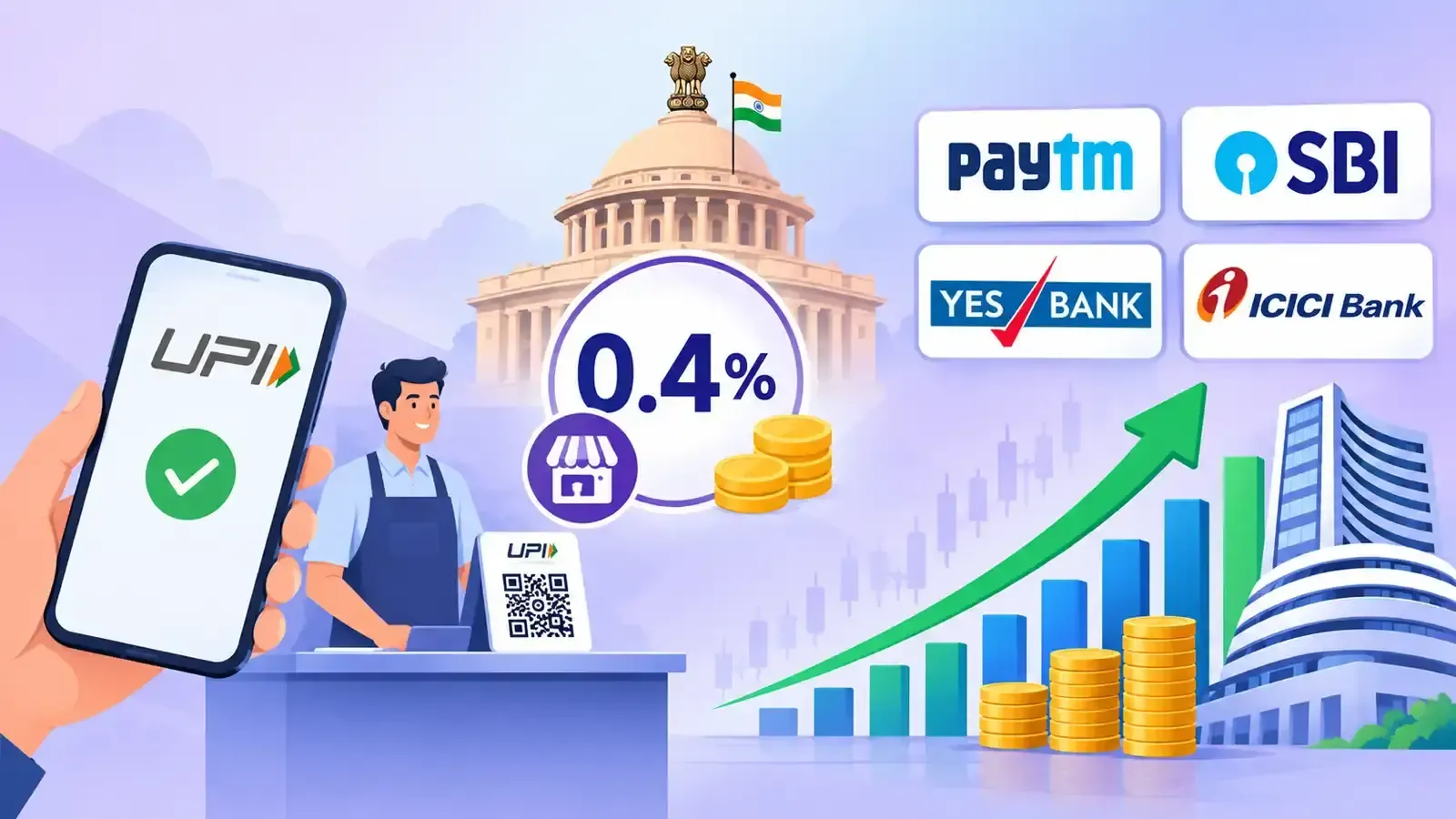
"Charges will apply only to person-to-merchant (P2M) transactions exceeding ₹2,000," the finance ministry said in a statement.
Shares of payment and banking companies such as Paytm, YES Bank, SBI, Bank of Baroda, Mobikwik, among others, were trading in the green on Wednesday, September 16, after the National Payments Corporation of India (NPCI) on Tuesday introduced a 0.4% fee on UPI payments of more than ₹2,000 made to merchants, effective October 15.
However, the new charge will apply only to person-to-merchant (P2M) transactions above ₹2,000, while everyday person-to-person (P2P) transactions and small payments will continue to remain free.
"Customers will not be required to pay any charge when making such payments through UPI," the finance ministry said in a statement, adding, "MDR is a charge within the merchant payment ecosystem. It is not a charge on customers making UPI payments."
Also, individuals will continue to have "unlimited free usage, with no monthly quotas, volume restrictions or tiered caps on free UPI transactions", it said.
"Charges will apply only to person-to-merchant (P2M) transactions exceeding ₹2,000," the finance ministry said in a statement. "A nominal merchant discount rate of 0.4% will be levied on P2M transactions above ₹2,000. This commission will be shared amongst the payment ecosystem partners, including banks and app providers."
How shares were faring
At 9:28 am, shares of One 97 Communications, the parent company of Paytm, traded 1.24% higher at ₹1,751.40 apiece on the NSE. The stock hit a 52-week high of ₹1,855.50 during the session, up 7.25% from its previous close of ₹1,730.
Among banking stocks, YES Bank shares were up 3.34% at ₹23.84 apiece on the NSE. State Bank of India (SBI) shares gained over 1% to ₹979, while Bank of Baroda (BoB) shares were up 0.24% at ₹233.25.
Key points
-
From October 15, a 0.4% Merchant Discount Rate (MDR) will be levied on person-to-merchant (P2M) transactions above ₹2,000 through UPI (Unified Payments Interface), capped at ₹300 for payments of ₹75,000 and above.
-
Essential and thin-margin sectors -- railways, telecom, insurance, fuel and agricultural inputs -- will pay a flat MDR of ₹5 per transaction above ₹2,000, intended to keep costs predictable for critical services; these categories account for nearly 17% of P2M transaction volume but roughly 46% of P2M transaction value.
-
The same flat-fee treatment extends to government utility bill collection (electricity, water, piped gas) and educational fee payments such as school tuition and university fees above ₹2,000, both similarly exempted below that threshold.
-
Payments into mutual funds, securities and through stockbrokers and dealers will attract a lighter 0.02% MDR, capped at ₹300 -- a rate designed to keep the cost of investing low and encourage retail participation in formal financial markets.
-
Person-to-person (P2P) transfers -- which make up 37% of UPI's transaction volume and 70% of its transaction value -- will continue to attract zero charges, irrespective of size. Small-value transactions up to ₹2,000, which the government said account for more than 95% of total P2M volume, remain untouched.
Top beneficiaries
Analysts have termed the reintroduction of Merchant Discount Rate (MDR) on eligible UPI transactions as a positive development for the payments ecosystem, with Paytm, Pine Labs, One Mobikwik and YES Bank emerging as some of the biggest potential beneficiaries. The estimates vary across analysts, but the common view is that the new MDR framework could create a significant revenue pool for banks and payment players.
CITI
CITI estimates that the new MDR framework could create an incremental ecosystem revenue pool of around ₹16,000–17,000 crore annually. It expects roughly 60% of the pool to accrue to the banking system, 25% to UPI app providers and 15% to non-bank payment aggregators.
The investment bank sees YES Bank as a standout beneficiary, given its outsized share of UPI beneficiary volumes. It estimates the potential impact at around 5–10% of pre-provision operating profit (PPOP) and 6–12% of profit before tax (PBT). This is followed by Bank of Baroda, Punjab National Bank and IndusInd Bank, with an estimated 2% PBT impact, while Axis Bank, SBI and Federal Bank could see a 1–2% PBT impact.
CITI views the move as a structurally positive and long-awaited monetisation event for UPI-heavy banks and third-party application providers (TPAPs).
Goldman Sachs
Goldman Sachs said the announced UPI MDR could drive a material earnings upgrade for payment companies. It sees 40–70% potential upside to its FY28 EBITDA estimates for Paytm, noting that the announced 40-basis-point MDR is higher than the 20–30 bps it had previously expected.
Based on NPCI data, Goldman Sachs estimates that around 50% of the overall UPI transaction value could accrue to the 40-bps MDR category, implying a potential industry revenue pool of around ₹20,600 crore. In a high-end scenario, the investment bank estimates an incremental ₹1,400 crore EBITDA for Paytm in FY28.
JPMorgan
JPMorgan also sees the reinstatement of UPI MDR as positive for the economics of the payments ecosystem, with issuer banks emerging as key beneficiaries. The brokerage estimates the total maximum revenue pool from the initiative at around ₹17,000 crore.
Of this, JPMorgan estimates around ₹11,700 crore could accrue to banks through the issuer and acquirer pool, equivalent to about 2.1% of FY26 net profit for listed commercial banks. It estimates around ₹1,700 crore for payer platform service providers (PSPs) and ₹3,400 crore for third-party application providers (TPAPs).
JPMorgan expects the benefit to be uneven across banks, with the potential revenue opportunity relatively higher for mid-tier banks such as YES Bank, given their exposure to the UPI ecosystem.
Related News

About The Author
Next Story

