
Upstox Originals
What India's new closing price mechanism means for your money

6 min read | Updated on August 07, 2026, 16:36 IST


SUMMARY
Every fund you hold, every index you track, and every F&O trade you settle depends on one number: the day's closing price. SEBI changed how that number gets decided on 3 August, and a full week of data now shows a system that wobbled, adjusted, and is gradually settling into a routine. Here's what actually happened, and what it means if you hold an index fund, an ETF, or an arbitrage fund.
SEBI changed the method of calucalting closing prices of certain stocks in early August. | Image: Shutterstock
Every time you tried to calculate the gains you made on your investment, the number you most relied on is the closing price. But how many of us truly understand how it is calculated and the wider impact this one number has on the entire market? It quietly does a lot of work, and from August 3, 2026, for many Indian stocks, the way it gets calculated changed completely.
The table below shows the impact of this one number.
| Where you'll see it | Why it matters to you |
|---|---|
| Mutual fund / ETF | The day-end value (NAV) of any fund you hold is calculated using that day's closing prices. |
| Nifty50 and Sensex | Closing prices of both indices are built from the closing prices of their member stocks. |
| F&O expiry | If you trade options or futures that expire that day, your final settlement uses the closing price. |
| Loan or margin against shares | Brokers and banks value pledged shares at the closing price to work out how much you can borrow. |
Source: NSE India and SEBI framework documents, August 2026.
Until August 2, the closing price was calculated by taking the average price of every trade in the last 30 minutes.
From August 3, for stocks that have futures and options contracts, trading now stops at 3:15 pm, and the final 15 minutes run as a live auction instead: buyers and sellers submit orders, and the exchange finds the one price at which most shares can actually change hands.
That single matched price becomes the closing price, not an average of scattered trades, but one real, agreed-upon price. Other stocks, and most F&O contracts themselves, are untouched for now. To understand this in more detail, please read this article: What is a Closing Auction Session
Four sessions, four different endings
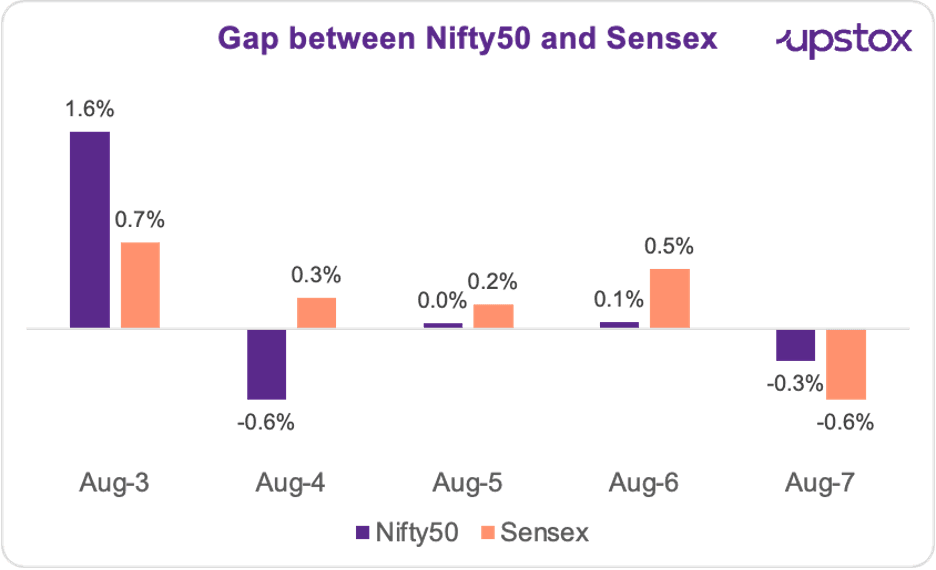
The chart below shows how Nifty and Sensex behaved over the first four days. It's worth reading closely, because the swings weren't random.
Source: Closing levels as reported by NSE and BSE.
Monday's jump was due to about a dozen heavyweight Nifty50 stocks settling unusually high in the auction, nothing to do with any actual news. Wednesday's calm arrived once traders spotted they could profit from small price gaps between the cash and futures markets, and rushed in to close them, which is a sign of the market adjusting, not breaking.
Thursday's wobble came back for a specific, ordinary reason: it was a weekly expiry day for Sensex options, which pulled far more trading activity into BSE stocks than NSE ones. Three different causes, three different-looking wobbles, none of them a sign the system had failed.
One more useful comparison: the NSE has run a similar auction each morning, before the market opens, for over a decade. So, a rough first week for a new mechanism is normal. It's what India's own market history would predict.
How does this affect retail investors?
Index funds or ETFs that track the Nifty50 or Sensex are required to match the index as closely as possible. Previously, the fund manager had to guess where the 30-minute average would land and trade towards a moving target, which is hard to do perfectly.
Now, the fund manager can place its order directly into the same auction everyone else uses, and get the exact same closing price. Fewer guesses should mean your fund's return drifts less from the index it's meant to copy, over time.
There's one exception worth flagging. Some funds, called arbitrage funds, make small, steady profits by buying a stock and selling its futures contract at almost the same moment, pocketing a tiny, safe gap between the two prices.
That gap just got harder to predict: the stock's price is now set by the new 3:15–3:30 pm auction, but its futures contract still closes the old way, ten minutes later. Invesco Mutual Fund flagged this directly in a report this week, saying the wider, less predictable gap is squeezing arbitrage fund returns even as it helps ordinary index funds. If you hold an arbitrage fund, this isn't a red flag, just something worth keeping an eye on over the next few months.
India is neither early nor late to this idea
Closing auctions aren't an Indian invention. SEBI said that it studied the NYSE, LSE and Tokyo Stock Exchange while designing this system, and the table below shows why: these auctions are the global default, and they all took years, not days, to settle.
| Exchange | Closing mechanism | In use since |
|---|---|---|
| NYSE (USA) | Closing auction | Volumes tracked since 2010 |
| Nasdaq (USA) | Closing cross auction | Long-established |
| London Stock Exchange | Closing auction | Long-established |
| Tokyo Stock Exchange | 5-minute closing auction added to a lengthened trading day | 5-minute closing auction added to a lengthened trading day. November 2024 |
Source: ScienceDirect (Closing auctions: Nasdaq versus NYSE, 2022), NYSE Data Insights
NYSE's closing auction volume roughly doubled between 2010 and 2018. Even Tokyo, one of the world's most established exchanges, only added a closing auction in November 2024. A bumpy first week here looks less like a warning sign and more like the ordinary cost of joining a system every major market eventually adopts.
What is worth watching from here
Most stocks, the ones without F&O contracts, still run on the old method. The real test won't be an ordinary Tuesday. It will be the first monthly F&O expiry under the new rules, and the first big index rebalancing, when far more money moves through the auction at once than it has so far.
For now, the closing price of your favourite stock or fund is decided differently than it was a week ago. Nothing about it demands action from you today, but it's worth knowing why the number on your app might occasionally look a little strange near the end of the day.
About The Author
Next Story

