
Upstox Originals
Flush with NRI dollars, banks now face a costlier puzzle

6 min read | Updated on October 12, 2026, 15:17 IST


SUMMARY
For the past four years, Indian banks have had a problem: they've been lending more than they've collected in deposits. Then this summer, NRIs poured $133 billion into dollar deposits with Indian banks, and suddenly the banks had more money than they could lend. But here is the catch: this money is expensive, and right now there aren't enough good borrowers to lend it all out at a decent profit. So, can banks actually make money on it?

Between 16 and 31 August 2026, deposits rose by ₹9.5 trillion. | Image: Shutterstock
Imagine you had so much money that you had no idea how and where to spend it? Sounds like the story of some movie - but this is similar to the situation Indian banks are facing right now. On the face of it, it sounds like a good problem to have. No one wants a bank that is cash-starved. Better one that has excess money, correct? But is it really so simple?
What happens if a bank raises money at ~6.65% but can lend it at only around 8–9%? So, what are we really talking about?
For the past 4 years, Indian banks lent faster than they collected in deposits. But something changed in August.
Between 16 and 31 August 2026, deposits rose by ₹9.5 trillion while loans grew by ₹3.8 trillion. As per the RBI, deposit growth was the fastest in 15 years. The source was one scheme: the RBI’s special window for Foreign Currency Non-Resident (FCNR) deposits. Read more in detail about them here.
So, is the deposit problem solved?
The funding problem, yes, for now. The mismatch behind it, only partly. At the peak in May 2026, banks were lending about ₹114 for every ₹100 of fresh deposits, according to the RBI. Earlier this year, loans were growing more than 5% faster than deposits. So how did banks keep lending money they did not have all these years? They borrowed. They borrowed from the market, chased big-ticket “bulk” deposits from companies, and paid extra for them. All of this was costly.
By mid-September, thanks to the FCNR money, that gap had shrunk to ~1%. And since this money is locked in for 3 to 5 years, banks don't have to worry about it leaving soon. You can see it in the chart below: deposit growth has nearly caught up with loan growth.
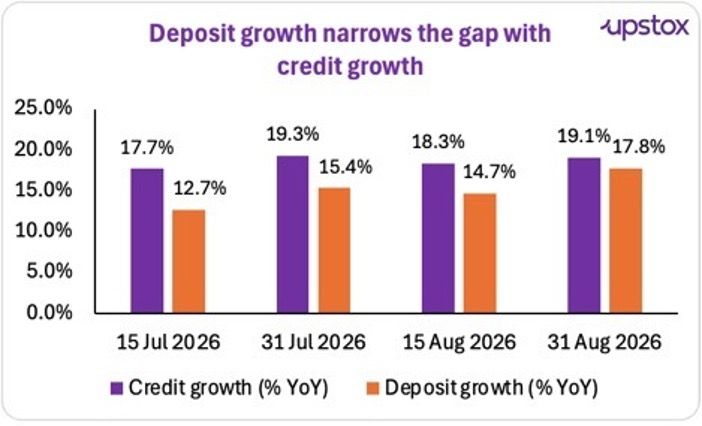
Source: RBI
But where did all this new money go? In the second half of August, banks lent out only 63% of their fresh deposits, down from 92% just two weeks earlier. What happened to the remaining 37%? There were simply not enough borrowers. So banks parked it with the RBI. The problem? These deposits earn less than what the bank borrowed them for.
Two more things to keep in mind. This money came in once; it will not keep coming at this pace. And some banks simply used it to replace older, costlier deposits. So the problem is eased, not solved. Loans are still growing faster than deposits.
So, how expensive is this money?
More than what banks pay their regular depositors.
Banks are paying NRIs around 6.5% on these dollar deposits. The RBI covers the currency risk only on the principal, so banks have to cover the interest part themselves. Add that, and the money costs them about 6.65%.
Compare that with what banks pay at home. In July, a fresh rupee fixed deposit cost banks 5.90% on average. HDFC Bank’s overall cost of funds was just 4.4%. In short, the FCNR money costs banks a lot more than their regular deposits do.
So, what can banks do with it?
Now the real question: what can banks earn on it?
| Where the money can go | Rate (%) | What it means at a 6.65% cost |
|---|---|---|
| Parked with the RBI overnight | 5.00 | Loses money every day it sits there |
| Lent to other banks overnight | 5.02 | Loses money every day it sits there |
| 10-year government bond | 7.17 | Barely positive |
| Fresh loans to customers (average) | 7.98–9.09 | Profitable, but less than what existing loans earn |
Source: RBI, Investing.com, as of September 2026; 10-year yields are as of 29 September 2026
Leaving the money parked loses money every day, so banks need to put it to work. They have four choices, and none of them is great.
-
Option 1: Repay old, expensive borrowings. Bank of India and Indian Bank are already doing this. Safe, but it does not grow the business.
-
Option 2: Lend to companies. Loan demand is strongest here right now. But big companies negotiate hard, and with every bank flush with cash, corporate loan rates are set to come down. More loans, but less profit on each.
-
Option 3: Lend to individuals. Personal loans and credit cards earn the most. But growth there is slowing, and bankers themselves are warning against lending carelessly to individuals. The most profitable door is the one banks are most nervous about.
-
Option 4: Buy the bonds the RBI is selling. As the table shows, this barely covers the cost. Safe, but very little profit.
So, can banks make money on this?
Yes, but slowly, and not all banks equally.
Think of it this way. Say a bank lends this money at ~8%, roughly what public sector banks earn on fresh loans today. After paying ~6.65% for it, the bank keeps about 1.35%. On its regular business, a large bank like HDFC Bank keeps over 3%. So every loan made with this money adds to profit, but it also pulls the bank’s average profit margin down.
Money that is not lent out and is parked with the RBI now earns 5.25% after the rate hike. That still means a loss of about 1.40 percentage points a year.
Rating agency ICRA put it simply in September: putting this money to work will take time, all banks will be chasing the same good borrowers, and profit margins will take a hit.
Which banks will come out ahead? Those with strong retail businesses can afford to wait for the right borrowers. Those that raised dollars just to fill a funding gap cannot. What should you watch? Three things: the RBI’s rate decision on 7 October (if rates fall, this fixed-cost money hurts banks more), the September-quarter results from mid-October (watch what banks earn on their loans, not just the headline profit), and how fast the ₹10 trillion surplus shrinks. The money came in a matter of weeks. Making money on it will take much longer.
About The Author
Next Story

