
Upstox Originals
Same industry, different stories: What Ola Electric and Ather Energy teach investors

7 min read | Updated on August 11, 2026, 11:57 IST


SUMMARY
Two pioneers (Ola Electric and Ather Energy) helped build India's EV two-wheeler market, but their shares have taken very different directions. Their story reveals why market share and revenue only tell part of the story, and what often matters long before it appears in the numbers.
Stock list
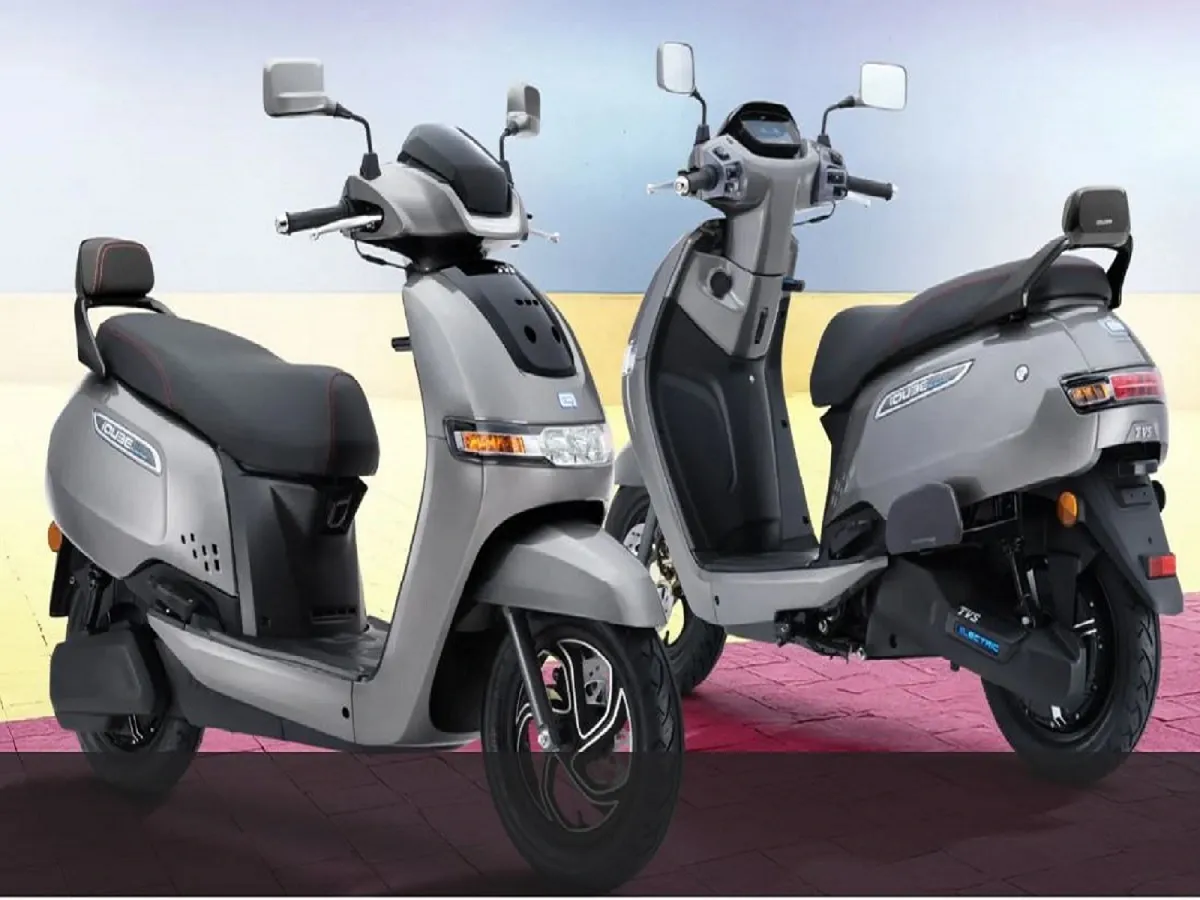
TVS Motor Company has introduced its flagship electric scooter iQube equipped with enhanced features at ₹1.03 lakh (ex-showroom Delhi).
Two companies. Similar products. A market with unprecedented opportunity. Yet, both of them are faring very differently in the market right now. We are talking of Ola Electric and Ather Energy, both pioneers in the Indian electric two-wheeler (2W) space. They not only helped create a market but also boosted adoption. Yet, the price performance of both the companies tell us a diametrically opposite story.
When Ola Electric listed in August 2024, the stock jumped 92% in 10 sessions on that same excitement. Ather Energy listed nine months later, in May 2025, at ₹321 a share, and rose just 1.6% on debut. While Ola definitely had early momentum, Ather has managed to clinch the pole position.
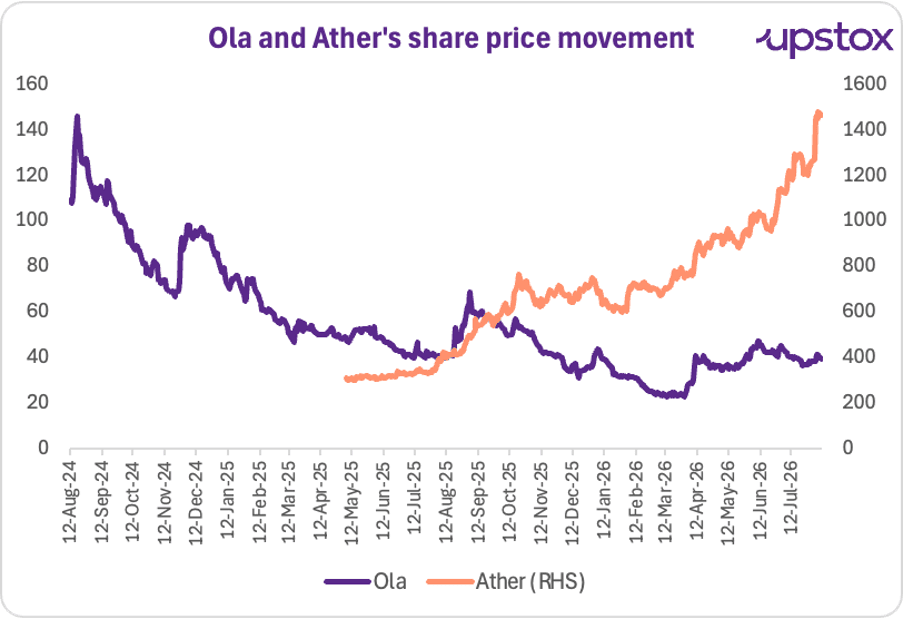
Source:Investing.in; Price till 10th August 2026
This is in no way to say that a winner has been declared. The story is long from over. But this story carries important lessons for investors about how to look at businesses beyond just numbers.
So, let's dive in!
Pioneers in the industry
Since 2021, India has made huge strides in the world of electric vehicles, especially electric two-wheelers. Roughly 2 crore electric two-wheelers have been sold since 2021, marking a genuine shift in consumer preference.
Ola Electric and Ather Energy both bet on that shift early. Ather built one of the first credible Indian-made smart scooters back in 2018, when the category barely existed. Ola did something arguably harder: it convinced ordinary Indian buyers, not just early adopters, that an electric scooter could be their only vehicle. It scaled faster than anyone in the category ever had, building the country's largest electric two-wheeler customer base.
So, where did things start to diverge?
Product innovation
Ola moved fast and wide: the S1, S1 Air and S1 X variants, followed by a line of electric motorcycles under the Roadster brand, all launched within a few years of each other, alongside an ambitious in-house push into battery cells and motors. That pace came with early quality lapses.
Ather moved narrower and slower: the 450 series for performance buyers, the Rizta for families, with a new EL-platform scooter due only this August, its first meaningfully new line in two years. The Rizta, a family-oriented scooter launched in 2024, crossed two lakh units sold by December 2025 and grew deliveries 81% YoY in the June 2026 quarter.
Alongside its scooters, Ather also built out Ather Grid, its own public charging network, now with over 4,300 charging points, an infrastructure bet that supports the vehicles it sells rather than expanding the vehicle range itself.
Neither approach is inherently right; one optimised for speed and breadth, the other for depth and reliability, and the market has so far rewarded the latter more than the former.
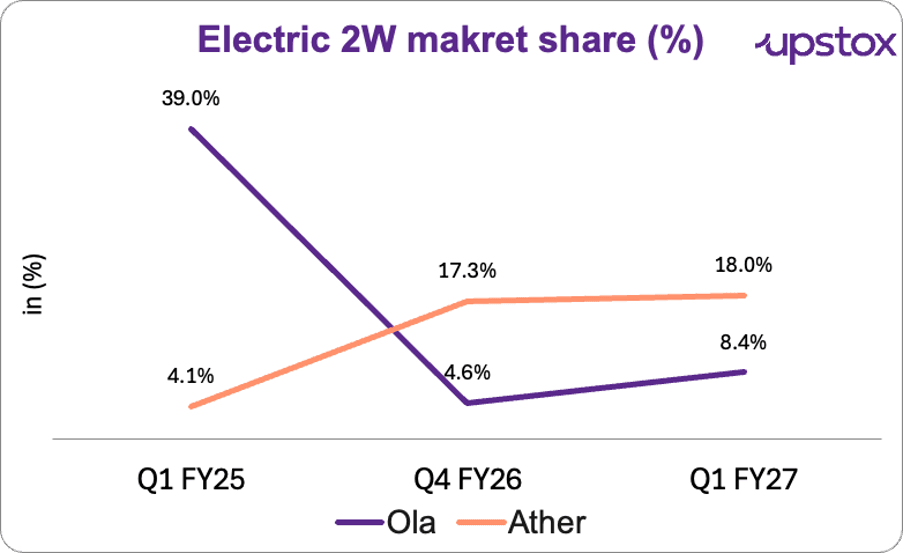
Source: Outlook Business (April 2026, citing Vahan and company data)
After-sales experience: Mixed results
Ola built its first five years around company-owned stores and an online-first buying experience. It worked, until volumes outran the ability to service them. Between September 2023 and August 2024 alone, India's National Consumer Helpline logged 10,644 complaints against the company, with certain media articles reporting the figure had climbed to over 80,000 complaints a month at one stage.
Ola has cited a survey showing over 90% overall customer satisfaction. However, the damage was done.
Ather was not spared complaints either; its customers were airing hardware and software grievances on social media through late 2024.
According to one Ather executive, the company treats a new service centre as part of opening a new store, not a decision made afterwards. Its dealers are required to open both together. Its service network nearly doubled within a single financial year, from 277 centres to around 548. Growth was slower. It was also matched, quarter for quarter, by the infrastructure needed to support it.
Neither company is free of blemishes. But with products that are essential to people’s daily lives, word of mouth still remains a critical feedback mechanism. News reports of scooters catching fire and poor after-sales service tend to be sticky and are difficult to shake off.
The scoreboard: What it looks like in the numbers
The most recent quarter adds one more data point to a pattern that was already years in the making. Ather's June-quarter (Q1 FY27) results showed revenue up 89% YoY and its first-ever positive EBITDA.
Meanwhile, Ola's Q1 FY27 revenue fell 45% year-on-year, though deliveries and market share both improved sharply from the previous quarter. One good quarter does not undo three years of service debt, just as one bad quarter would not have undone three years of it being built up.
| Metric (Q1 FY27, quarter ended 30 June 2026) | Ola Electric | Ather Energy |
|---|---|---|
| Revenue from operations | ₹455 cr (-45% YoY) | ₹1,217 cr (+89% YoY) |
| EBITDA | Negative, loss narrowing | Positive for the first time |
Source: Company reports
What this actually teaches investors and businesses
Deliveries, revenue and market share tell you what already happened. Looking at just these numbers is superficial analysis. These numbers say nothing about whether the momentum can persist.
Complaint volumes, warranty claims and regulator notices rarely show up in a results presentation, but they tend to move first, while the worst of its stock and market-share damage shows up later.
Share prices often catch up to operational reality with a lag, not in real time, which is precisely why judging a growth stock only on its most recent quarter can be misleading in either direction.
Takeaway for businesses
For a business, the takeaway is more specific than 'customer service matters'. It's that distribution and service capacity need to be built as one decision, not two.
Scaling sales ahead of the ability to support what has already been sold is not a minor operational gap; in a category where the product needs regular maintenance and carries real safety implications, it becomes a liability that does not show up on a balance sheet until it eventually shows up in both the complaint count and the sales figure.
What happens next, and what's still unproven
Ather needs its new EL-platform scooter, due on 29 August 2026, and its upcoming Maharashtra factory to scale without diluting the premium experience its stock price now assumes; the stock also trades at a price-to-book ratio near 98, a reminder that a strong operating story and a fairly priced stock are not automatically the same thing. Ola needs its new dealer network and cost discipline to hold for several quarters in a row, while its pending regulatory matters work their way to a close.
Both companies are still selling into a market that is underpenetrated; electric two-wheelers crossed 10% of new registrations for the first time only in June 2026. There is room for both to keep growing. Whether investors reward that growth the way Ather's stock has been rewarded, or the way Ola's was punished, may come down to a metric neither company puts on its investor call: how quickly a customer's problem gets fixed.
About The Author
Next Story

