
Upstox Originals
Parag Parikh Flexi Cap Fund: Is short-term underperformance just a phase?
6 min read | Updated on August 18, 2026, 13:16 IST


SUMMARY
For more than a decade, Parag Parikh Flexi Cap Fund built its reputation on doing things differently; focusing on value, staying patient and avoiding short-term market noise. That approach worked remarkably well for years. But now, after a prolonged spell of underperformance, investors are asking a difficult question: Is this simply a bad phase for a good strategy, or a sign that its edge is fading?

PPFAS build more than ₹1.4 lakh crore in assets. | Image: Shutterstock
Some mutual funds become popular because of the returns they deliver. Others stand out for the way they invest. Parag Parikh Flexi Cap Fund has managed to build its reputation on both.
For years, the fund has followed a distinctive approach: buying quality businesses at sensible valuations, holding cash when opportunities are scarce and investing overseas alongside its Indian holdings.
The strategy has helped PPFAS build more than ₹1.4 lakh crore in assets, making PPFCF the largest actively managed mutual fund in India.
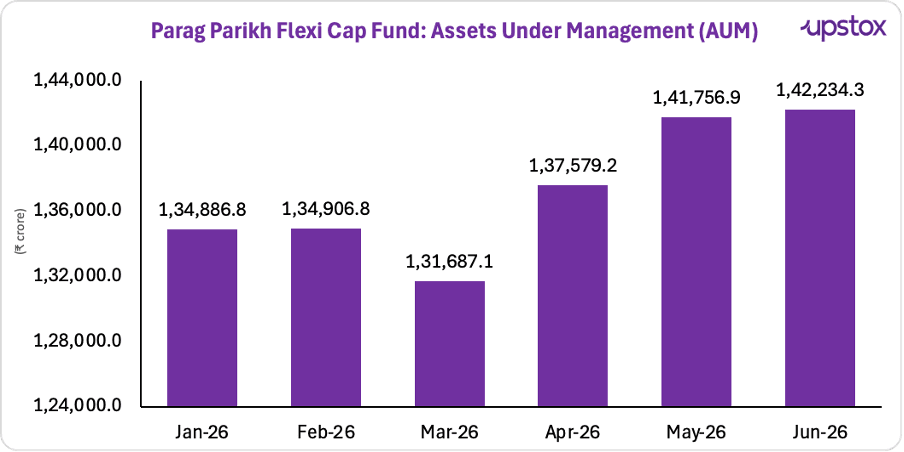
Source: PPFAS monthly factsheets
Why is everyone suddenly talking about it?
Because the fund has recently gone through a period of relative underperformance, trailing its benchmark and several category peers. And when a fund with this much investor trust starts looking different from the rest of the category, it naturally raises questions.
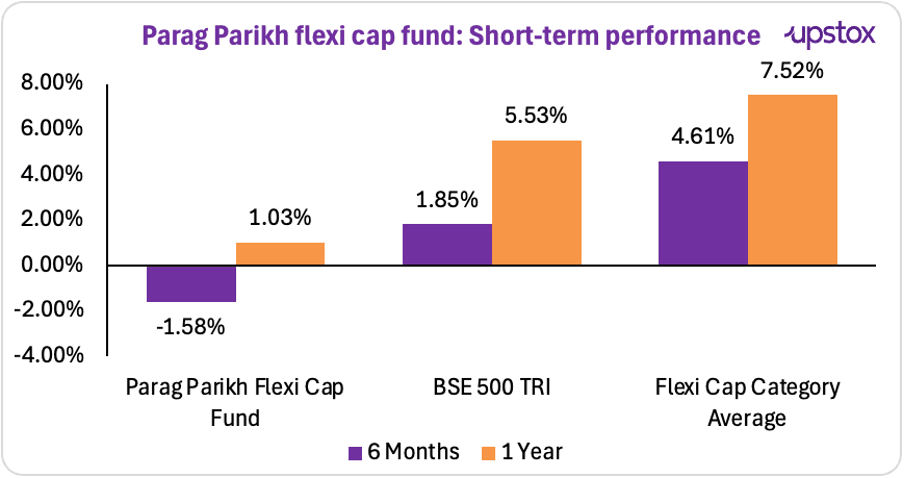
Source: PPFAS data; *Data as on 6 Aug, 2026
First, why did Parag Parikh Flexi Cap Fund become a benchmark for active investing? Back in 2013, when Parag Parikh Flexi Cap Fund was launched, its approach was a little different. The fund wasn't built around chasing whatever was doing well in the market. Instead, it focused on businesses that looked reasonably valued and took a long-term view on them.
That approach stayed fairly consistent over the years. Even as market favourites changed, PPFAS largely stuck to its investment philosophy.
And eventually, that consistency became a big part of what the fund was known for. It also became one of the earliest Indian mutual funds to meaningfully invest overseas, giving investors exposure to global technology leaders such as Alphabet, Meta Platforms, Microsoft and Amazon.
Equally importantly, the fund was never uncomfortable holding cash when attractive opportunities were limited; a decision that often drew criticism during bull markets but helped preserve capital during corrections.
A decade of long-term outperformance
The current discussion around PPFCF is largely centred on its recent one-year returns. Yet that tells only part of the story.
While the fund has struggled over the past year, its longer-term record remains significantly stronger. For most of its existence, the fund has consistently outperformed both its benchmark and the average flexi-cap fund over longer investment horizons.
| Time Period | Parag Parikh Flexi Cap Fund | BSE 500 TRI | Flexi Cap Category Average |
|---|---|---|---|
| 3 Years (CAGR) | 14.72% | 12.73% | 14.43% |
| 5 Years (CAGR) | 13.59% | 12.17% | 13.09% |
| 7 Years (CAGR) | 20.49% | 16.20% | 16.27% |
| 10 Years (CAGR) | 17.49% | 13.68% | 13.89% |
Source: Value Research, as on 6 Aug 2026
Has the fund's investment philosophy stopped working?
Not necessarily.
The recent underperformance appears to be the result of multiple factors coming together rather than a single investment mistake.
Holding cash became a headwind instead of a cushion
One of PPFAS’s defining traits has been its willingness to hold cash when attractive investment opportunities are limited.
But this strategy can cut both ways. When markets rise, cash doesn’t participate in the rally, turning the fund’s cautious positioning into a drag on returns.
During the first half of 2026, PPFAS held around 14%–23% of its portfolio in cash, arbitrage and debt. This allocation fell from 23.1% in January to 14.5% in June, but the money parked outside equities still meant missing part of the market rally.
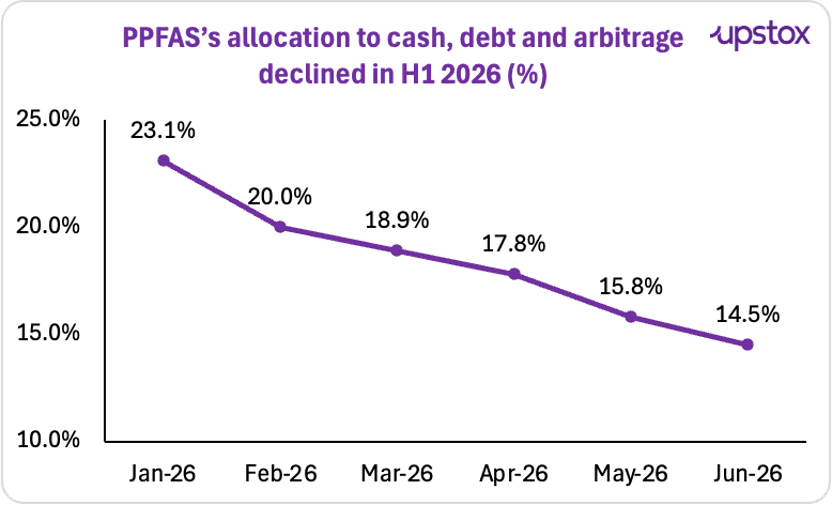
Source: PPFAS
As markets kept climbing, every percentage point held outside equities translated into a drag relative to funds that stayed almost fully invested.
Ironically, one of the fund's biggest strengths during falling markets became one of its biggest disadvantages during a rising one.
Regulatory limits reduced one of the fund's biggest advantages
For years, PPFCF stood out for its overseas investments, with positions in global technology leaders such as Alphabet, Amazon, Meta Platforms and Microsoft.
However, industry-wide limits on overseas mutual fund investments restricted the fund's ability to add to these positions, leaving less room to deploy fresh capital overseas. International equities still account for around 10.6% of the portfolio, but the restriction has limited one of the fund's long-standing advantages; and one of its better-performing segments.
Value investing went out of favour
Perhaps the biggest reason behind the recent underperformance has less to do with stock selection and more with market leadership.
PPFAS has always followed a value-oriented philosophy. Instead of chasing expensive stocks simply because they're rising, it looks for reasonably priced businesses with a margin of safety. The numbers reflect this: the portfolio trades at a P/E of about 17x, versus nearly 27x for the category.
That discipline has historically served investors well. But markets don't always reward value.
In 2026, investors increasingly favoured momentum, earnings upgrades and higher-risk segments. Mid- and small-caps outpaced large-caps, while the rally largely bypassed the reasonably priced large-caps PPFAS favours.
| Segment (1-year to 6 Aug 2026) | Price Return |
|---|---|
| Nifty 100 (large-cap) | +2.39% |
| Nifty Midcap 150 | +10.49% |
| Nifty Smallcap 250 | +9.47% |
Source: NSE Indices
For a fund that refuses to compromise on valuations, keeping pace with such a rally becomes difficult. In many ways, PPFCF underperformed because it continued doing exactly what it has always done.
What are the fund managers saying?
The fund house maintains that its investment philosophy remains unchanged. CIO Rajeev Thakkar has said the fund’s elevated cash position reflects a lack of sufficiently attractive opportunities at prevailing valuations, rather than an attempt to time the market. The fund has continued to deploy capital selectively when it finds opportunities, including several thousand crore in a single month.
Haven't investors seen this movie before?
This isn’t the first time a well-known value-oriented strategy has gone through a prolonged period of underperformance.
In the late 2010s, HDFC’s flagship equity funds, managed by Prashant Jain, went through an extended phase when value investing was out of favour, while markets increasingly rewarded growth and momentum stocks. The funds stayed anchored to valuations and long-term fundamentals, widening the performance gap with peers.
Mr. Jain stuck to his investment philosophy instead of chasing the market trend. He also spent considerable time engaging with investors and distributors, explaining the portfolio rationale and acknowledging the weak performance. Eventually, market leadership shifted and value stocks recovered.
The broader lesson isn’t that one style is better than another, but that investment styles move in cycles. Momentum, growth and value can each lead for years before market leadership changes.
The comparison with PPFCF isn’t perfect. Market conditions, portfolio construction and mandates differ, and past cycles offer no guarantee about what happens next. A potential turnaround can also take years to materialise, and its timing is impossible to predict.
For investors, the key takeaway is that even established strategies can go through difficult phases; making it important to understand the reasons behind underperformance, not just track the numbers.
About The Author
Next Story

