
Upstox Originals
Is the Nifty IT Index finding its feet again?

7 min read | Updated on August 04, 2026, 14:58 IST


SUMMARY
The sharp recovery in Indian IT stocks has sparked hopes that the sector's worst phase is over. But are investors betting on stronger fundamentals or getting ahead of the recovery?
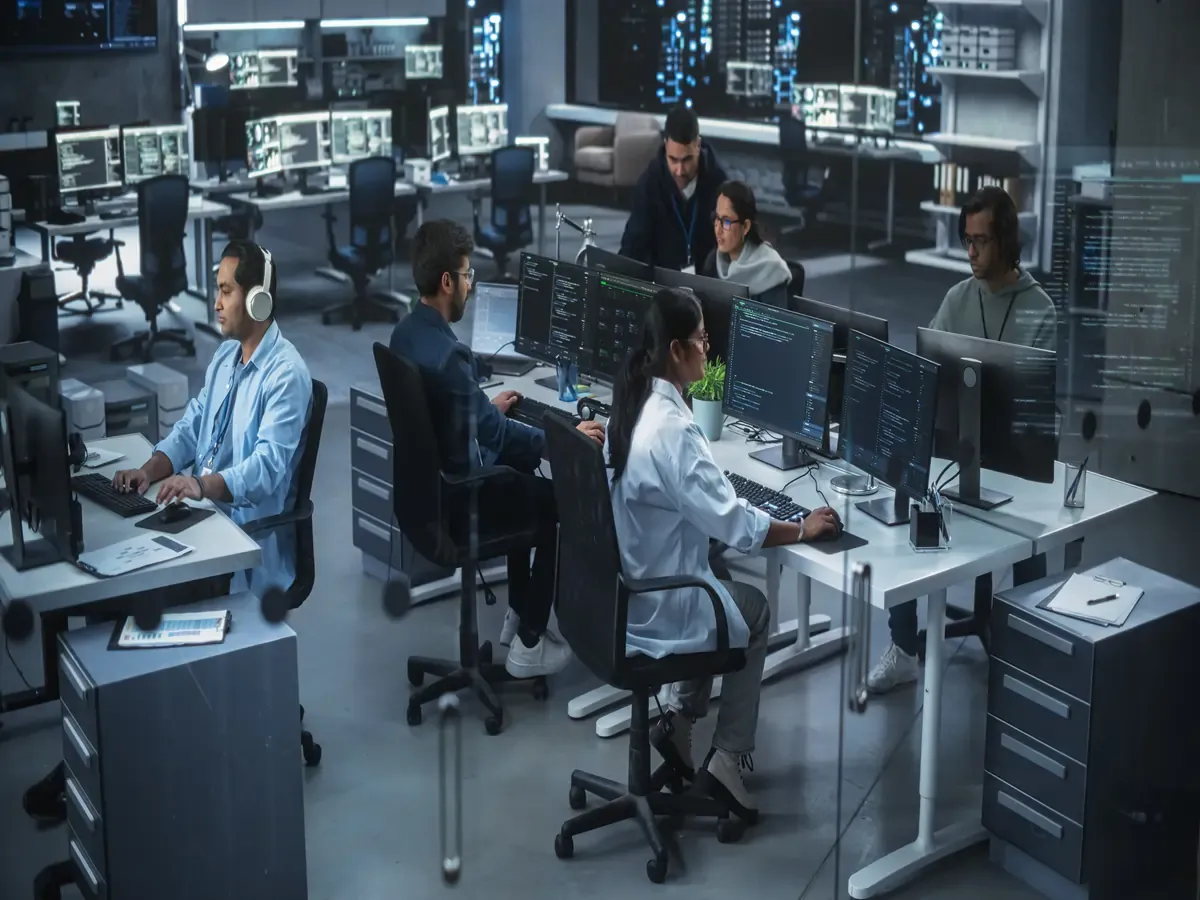
In July alone, the Nifty IT index jumped 18.4%. | Image: Shutterstock
Who doesnt like a comeback story? And in this case, we are talking about one of the quickest and unexpected comeback in the Indian markets. India’s IT stocks have staged an impressive return in just this past month.
In July alone, the Nifty IT index jumped 18.4%, its best monthly performance in six years and second only to the 22.5% rally in June 2020. The rebound looks even more impressive from the bottom. From its 52-week low of 25,699.10 on 1 July, the index climbed more than 21% to end the month back above the 31,000 mark.
Here's how the Nifty IT index went from record highs to one of its steepest corrections, and then staged a sharp recovery:
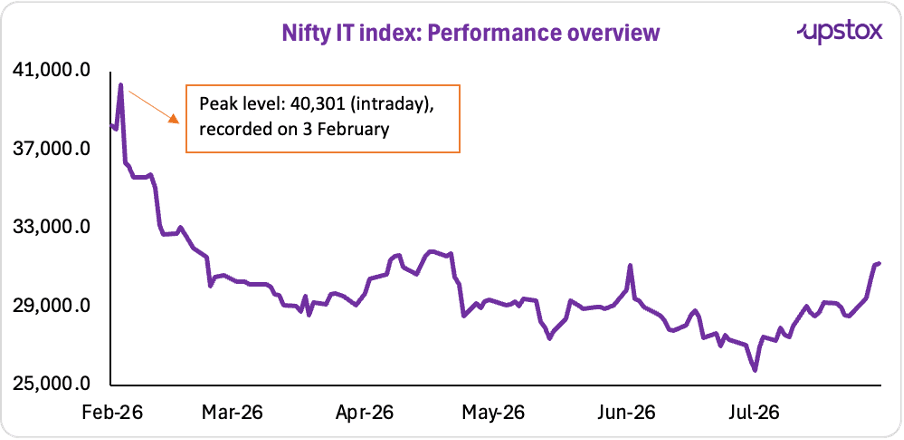
Source: NSE, Data till 30 July
What actually powered the rebound?
A reverse AI trade?
For most of 2026, one trade ran the whole show: AI hardware. Everyone piled into chipmakers; US, South Korea, Taiwan, Japan; bidding semiconductor stocks up to eye-watering valuations. In July, that trade finally cracked. Money rotated out of expensive chip names and into the boring-but-profitable corner of tech: cash-generating software companies. Indian IT; cheap and cash-rich; turned out to be one of the biggest winners of the reshuffle.
The split-screen says it all. While Indian IT was ripping higher, the Philadelphia Semiconductor Index dropped 20.7% and South Korea's chip-heavy KOSPI fell 20.6% over the month as investors bailed on semis. Same broad sector, opposite directions.
The big banks noticed too. HSBC upgraded Indian equities to "Neutral" from "Underweight," and UBS bumped its call to "Attractive" from "Neutral." Goldman Sachs and Bernstein both flagged a setup for a stronger second half for the Nifty 50. When the suits turn optimistic all at once, it usually means something.
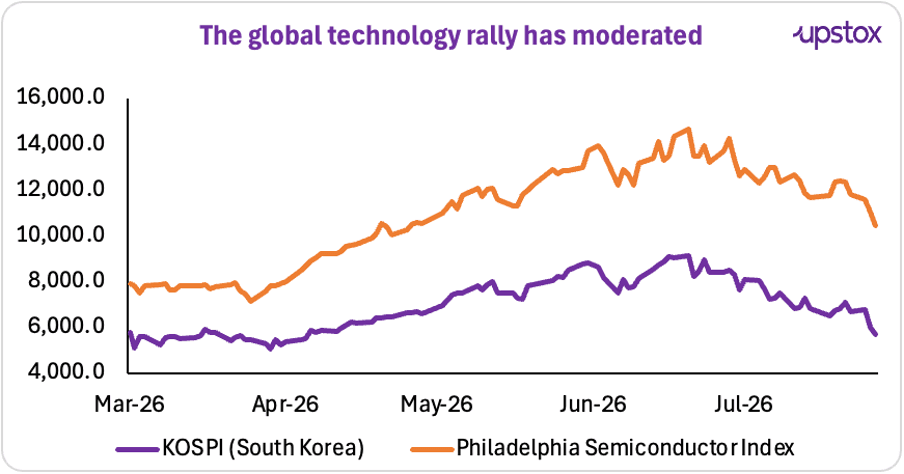
Source: ICE Data Indices and Korea Exchange (KRX); Data till 30 July
Are foreign investors actually coming back?
Kind of, cautiously. The Nifty IT Index also got a lift from improving foreign investor sentiment. Foreign portfolio investors (FPIs) had been dumping Indian stocks for months. In July, they flipped to net buyers for the first time since February, putting in ₹15,412 crore. Keep it in perspective, though. FPIs yanked nearly $29 billion out of Indian equities in just the first half of 2026.
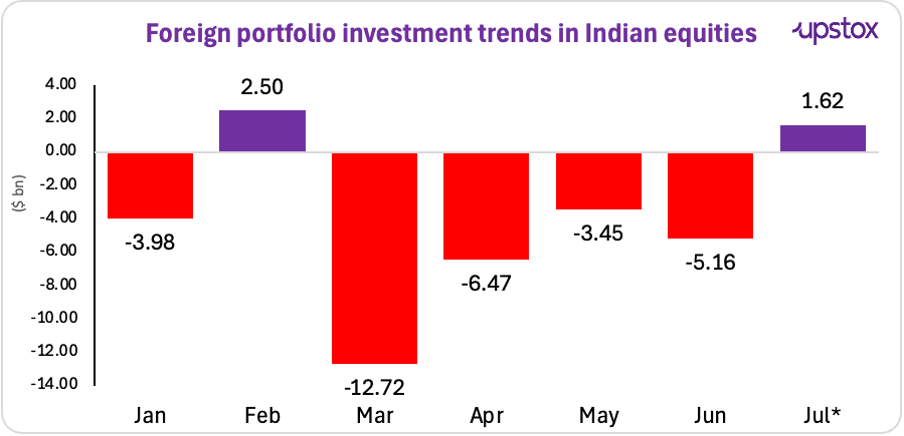
Source: NSDL; Data till 30 July
Did the earnings justify the optimism?
The June-quarter (Q1 FY27) earnings, reported through July, gave investors tangible reasons to turn optimistic, though the picture was more nuanced than the headline numbers suggested. At first glance, the earnings looked encouraging, with four of the five companies reporting double-digit revenue growth in rupee terms. But a significant part of that strength came from currency translation.
| Company (Q1 FY27) | Revenue (₹ crore) | Growth (YoY, reported) | Deal Wins / Total Contract Value (TCV) |
|---|---|---|---|
| TCS | 72,275 | 13.9% | $9.5 bn TCV |
| Infosys | 48,211 | 14.0% | $3.6 bn Large Deal TCV (61% net new) |
| HCLTech | 34,579 | 14.4% | $2.4 bn TCV (record quarterly bookings) |
| Wipro | 24,479 | 10.6% | $3.37 bn Total Bookings |
| Tech Mahindra | 15,712 | 2.7% | $1.078 bn Deal Wins (TCV) |
Source: Company Filings
The table tells the honest story. TCS posted 13.9% year-on-year rupee revenue growth, but sequential constant-currency growth (basically, the growth left over once you strip out the currency swing) was a measly 0.4%. Across the sector, real constant-currency growth was around 2.8%, even as rupee revenue jumped ~14% on a softer currency. Translation: take away the weak rupee, and the actual demand recovery looks thin.
Is AI India's IT growth engine, or its existential threat?
This is the debate the sector's entire re-rating hinges on, and it deserves both sides.
Do the global cues, US spending, the Fed, the rupee; favour India from here?
Since the US pays most of Indian IT's bills, the sector basically lives and dies by American budgets. And the signals right now are mixed.
The lazy assumption is that a dovish Fed (one leaning toward cutting rates) rides in to save the day; lower US rates, looser client tech budgets, everyone wins. In 2026, that script is flipped. The Fed held rates on 29 July in a split 9-3 vote, with three members actually pushing for a hike, not a cut, because inflation won't quit (PCE running above 4%). Under new Chair Kevin Warsh, markets have gone from pricing in cuts to bracing for possible hikes later this year. So the rate-cut tailwind everyone was counting on isn't just missing, a hike would actively squeeze the exact valuations that just rallied.
The demand signals aren't screaming confidence either. Accenture, the global bellwether everyone watches, trimmed its full-year revenue guidance. The weak rupee is a genuine margin booster for Indian exporters, but it cuts both ways: a softening dollar can blur the revenue outlook on discretionary projects. And the old headaches haven't gone anywhere, H-1B visa costs, GCCs competing on home turf.
So is the worst over for Indian IT?
The strongest argument for the bulls is price. After the crash, TCS traded near 18x earnings, well below its 25-28x historical band, with the sector throwing off attractive free-cash-flow yields. Cheapness plus returning flows is a potent short-term mix.
But cheap can stay cheap if growth doesn't return, the textbook value trap. The scars are fresh: foreign investors pulled a record $8.5 billion out of Indian IT in 2025, nearly half of all foreign exits from Indian equities that year. One month of FPI buying reverses a sliver of that, not the thesis behind it. And the chart is nearing a wall, analysts flag stiff resistance around 31,800-32,000, where the 200-day moving average meets prior price resistance; it needs a decisive close above to confirm a trend.
A durable turn needs four things to align: constant-currency growth accelerating beyond low single digits, AI net-new revenue visibly outrunning legacy deflation, a real pickup in US discretionary spending, and FPIs staying buyers rather than renting the trade.
About The Author
Next Story

