
Upstox Originals
How India is turning concerts into a tourism business

9 min read | Updated on September 30, 2026, 18:32 IST


SUMMARY
India’s concert economy is turning live entertainment into a tourism and consumption engine. As fans travel across cities for global and domestic artists, hotels, airlines, restaurants, and local businesses are benefiting from the spending ripple effect. And that could change how India thinks about both live entertainment and tourism: not as separate industries, but as two sides of the same consumer experience

In 2025, nearly 5.6 lakh Indians travelled cross-city purely to attend a concert, up 18% year-on-year, as per BookMyShow's Throwback report.
When one thinks of Ahmedabad, the usual image that comes to mind is of the serene Sabarmati Ashram, or its thriving textile hub, or maybe even the vibrant food. Few would have been likely to envision it as a destination where 222,000+ fans jam to Coldplay’s iconic hits.
Yet, that’s exactly what happened. With two shows at the Narendra Modi Stadium in 2025, Chris Martin and his British rock band created an impact that any tourism board would be delighted with. They made hotel rooms that usually cost ₹15,000 a night sell for six times that price, filled the airport with more travellers in three days than it had ever handled (despite 3-4x spike in airfare cost), and generated an estimated ₹641 crore in economic impact.
Put together, this phenomenon has been described as the ‘concert economy’. It's a term Prime Minister Modi used in his Independence Day address this year, and one that's changing how the stakeholders, including government and businesses, think about live entertainment.
The multiplier effect
Here’s a data point to understand this better. For every ₹100 an attendee spent on their Coldplay ticket, they went on to spend another ₹585 around it on hotels, flights, food, shopping and more, according to an EY-Parthenon and BookMyShow report. The ticket price, in other words, became a fraction of the total spend it triggered.
It may be tempting to treat Ahmedabad as a one-off, but the numbers suggest that it is actually becoming the template.
In 2024, Diljit Dosanjh's Dil-Luminati tour was attended by roughly 3.2 lakh fans across 13 cities and it generated an estimated ₹943 crore in economic impact. Then, in mid-2026, when American rapper Post Malone did his first-ever India show in Guwahati, the multiplier was sharper still: for every ₹100 spent on a ticket, attendees spent roughly ₹899 around it.
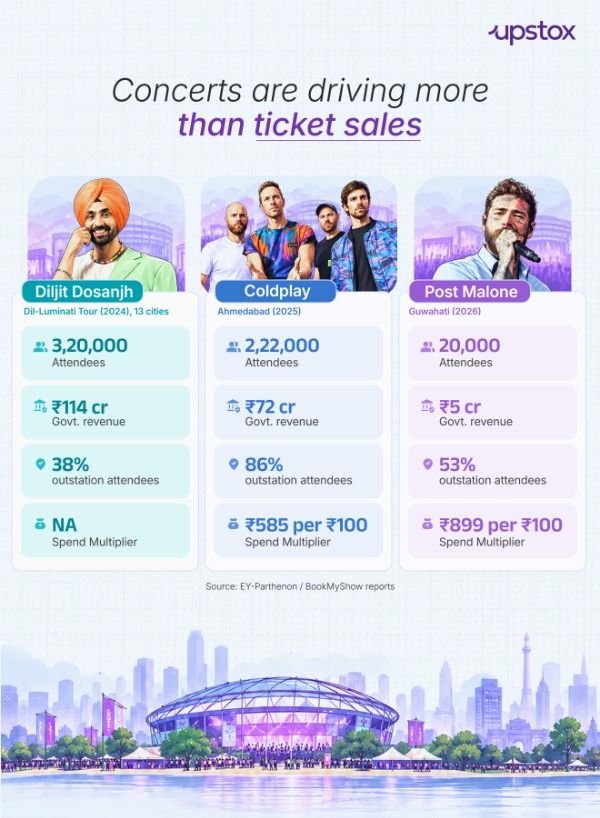
Note that Guwahati, a much smaller city, hosting a comparatively smaller show, actually produced a higher spend multiplier than Ahmedabad. This means, a concert economy doesn’t need to be limited to the big metro cities. It simply needs the infrastructure to host artists and the fans flocking to watch them perform.
Not surprisingly, in 2025, nearly 5.6 lakh Indians travelled cross-city purely to attend a concert, up 18% year-on-year, as per BookMyShow's Throwback report. And these included fans travelling not just to Mumbai and Delhi, but also to Indore, Vadodara, Shillong, Rajkot and Visakhapatnam. Each of those trips have led to ancillary spends, turning entertainment into actual economic impact.
Old habit, new stage
This might be a good time to remember that India has been monetising mass gatherings around a single unmissable moment for centuries. Take, for instance, the Maha Kumbh Mela. Every 12 years, millions of people travel to Prayagraj and an entire local economy scales up to absorb them. The scale is obviously in a different league. Kumbh is measured in hundreds of millions of people, concerts in hundreds of thousands. But the underlying economics are identical: hotels fill up, transport costs rise, food and retail businesses see a spending spike. It’s just that the trend of travelling to a destination for a specific event is now being engineered around commercial entertainment too.
Who's betting on, and benefitting from, this trend
India's concert economy is a mega-ecosystem comprising innumerable local businesses, state and central governments, and the artists themselves. But connecting these diverse stakeholders are two key players: BookMyShow and District.
BookMyShow is the OG. It has been around for about two decades. Apart from selling tickets (for movies, concerts, plays, matches, and more), the company has also invested in producing and promoting tours like Coldplay's and Post Malone's. This means it earns off sponsorships, Food & Beverage commissions and the full show, not just a transaction fee. It also owns major festival IPs like Lollapalooza, Bandland and Sunburn, and its agreements with tourism departments in Assam, Gujarat, Telangana and Delhi suggest that it’s positioning itself as the default partner for state governments trying to build their own "concert economies."
The comparatively newer entrant, District (formerly known as ‘Paytm Insider’ before it was acquired by Eternal in 2024), is also looking to tap into this opportunity. So, in addition to ticketing and dining-out bookings, it is building a portfolio of exclusive artist tie-ups as well as flagship IPs like Zomato Feeding India Concert and Zomaland.
Another interesting player in this space is Saregama, the 120-year-old music label better known for owning a major chunk of Bollywood's music catalogue. The company has four revenue streams: music, video (films and web series), artist management and live events, creating an interconnected ecosystem with a compounding effect. Case in point being UN40, its two-day fest in March 2026, which had 25+ performers, many from its own artist roster.
By creating a diversified portfolio of live events, including "Carvaan Live" Bollywood concerts and high-production "bhajan clubbing" arena, Saregama is aggressively expanding to capture a larger share of the wallet. Events business brought in ₹16 crore in Q1FY27, up 214% year-on-year. That’s a small slice of its overall ₹263 crore in quarterly revenue, but by far its fastest-growing one.
To be sure, it is harder to pin down the exact financial impact. Mostly because none of these companies report ‘concerts’ as a standalone line item. At Saregama, ‘Live Events’ bundles in concerts, devotional shows and comedy nights together. Meanwhile, BookMyShow is unlisted, so its latest numbers are not available, while Eternal doesn't break District's revenue down further. It's one number covering everything from a movie ticket to a concert pass to a Sunday dinner booking.
With that caveat in place, the numbers are still striking. BookMyShow's FY25 revenue rose 30% year-on-year to ₹1,869 crore, while profit after tax jumped 76% to ₹192 crore. Live Events made up ₹756 crore of its revenue, up 66% on the back of an expanded slate of music festivals and stand-up comedy shows. Meanwhile, Eternal’s "Going-out" segment (District) generated ₹318 crore in revenue in Q1FY27, up 54% year-on-year, though losses also widened 27% to ₹61 crore. It’s a small part of Eternal's overall ₹20,211 crore in quarterly revenue, but the company is confident enough in the trajectory to be targeting a $3 billion NOV (Net Order Value) business with a 5% adjusted EBITDA margin by FY30.
The government is leaning in
Besides companies being bullish on the potential of the growth of this segment, the government too is enthusiastic. It has started treating live entertainment as economic infrastructure.
In the Economic Survey 2026, the government classified the concert economy under the broader "orange economy" i.e., activity driven by creativity, culture and intellectual property, where value comes from ideas and experiences rather than physical goods. It notes that live concerts are "high-multiplier, services-intensive" activities that generate value well beyond ticket sales by supporting tourism, employment and urban services – precisely what has been observed on ground.
As per latest available estimates, organised live events are among the fastest growing segments in the Media & Entertainment industry, valued at ₹145 billion in 2025. A government press release notes that it is projected to grow at 10% to ₹196 billion by 2028.
It is important to note here that achieving this growth is not going to be easy. India's supply side hasn't caught up with the demand it's creating. The country has less than 10 purpose-built concert venues that can host more than 10,000 people, and organisers routinely need sign-off from different government agencies just to stage one large show.
But, recognising the potential of this sector, the government wants to solve these bottlenecks. A critical step in this direction is the setting up of the Live Events Development Cell (LEDC) in July 2025. It aims to function as a single-window facilitation mechanism, bringing together representatives from Central ministries, state governments, industry bodies and other stakeholders. LEDC is working towards strengthening infrastructure, simplifying regulatory processes, and promoting ease of doing business. It has also launched an online system for live event permissions to facilitate a single digital workflow that covers everything, from application, coordination, and approvals, to payments, inspections, and escalation of delays.
Through these measures, the government’s aim is to ‘position the concert economy as one of the key drivers of national growth and make India a global hub for live events by 2030 and generate 15-20 additional million jobs in this sector’.
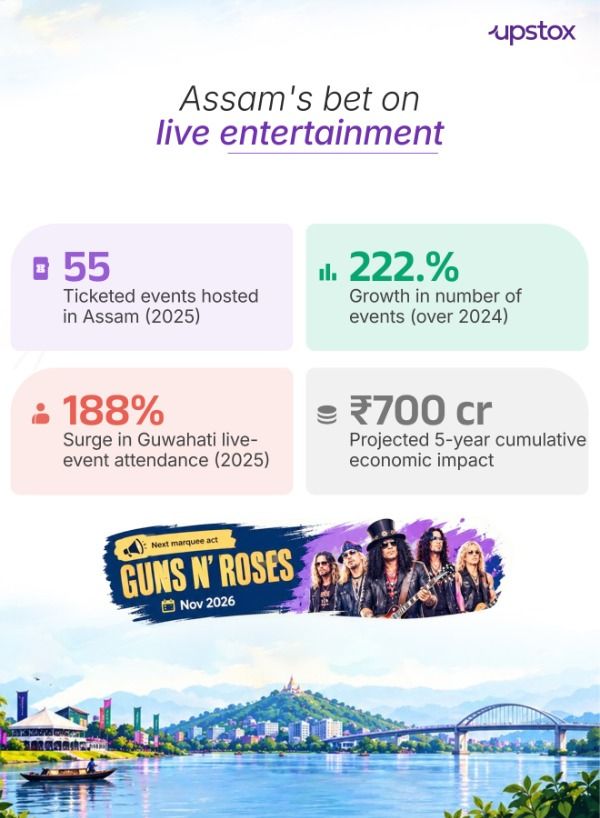
The impact is already being felt in some regions. Assam is the clearest example of what "government as enabler" looks like on the ground. After Post Malone's Guwahati show, BookMyShow and EY-Parthenon partnered with the state's tourism board to publish a blueprint projecting a cumulative ₹700 crore economic opportunity for Assam over the next five years through a sustained pipeline of concerts.
We must acknowledge that the transformation won’t happen overnight. Building more world-class arenas and rewiring a decades-old permission system takes time. But implementing these initiatives will go a long way in fuelling the growth of this nascent, albeit rapidly scaling, industry.
For now, what's undeniable is that a concert is now a legitimate reason to travel to a destination. Businesses, artists, and the government have identified the opportunity presented by India’s rising disposable incomes and a young, experience-hungry demographic. And the fans are turning this opportunity into reality. They're the ones filling the flights, the hotel rooms, and the stadiums – grooving to music under, quite literally, a sky full of stars.
About The Author
Next Story

