
Upstox Originals
High sugar, hidden salt: How deceptive labeling fuels India’s obesity burden

5 min read | Updated on September 16, 2026, 16:10 IST


SUMMARY
FSSAI’s crackdown and proposed front-of-package warning labels aim to expose hidden sugars, fat and sodium content in packaged food items. While brands continue to resist, global evidence shows mandatory red warnings are crucial to enable food reformulation and safeguard public health.
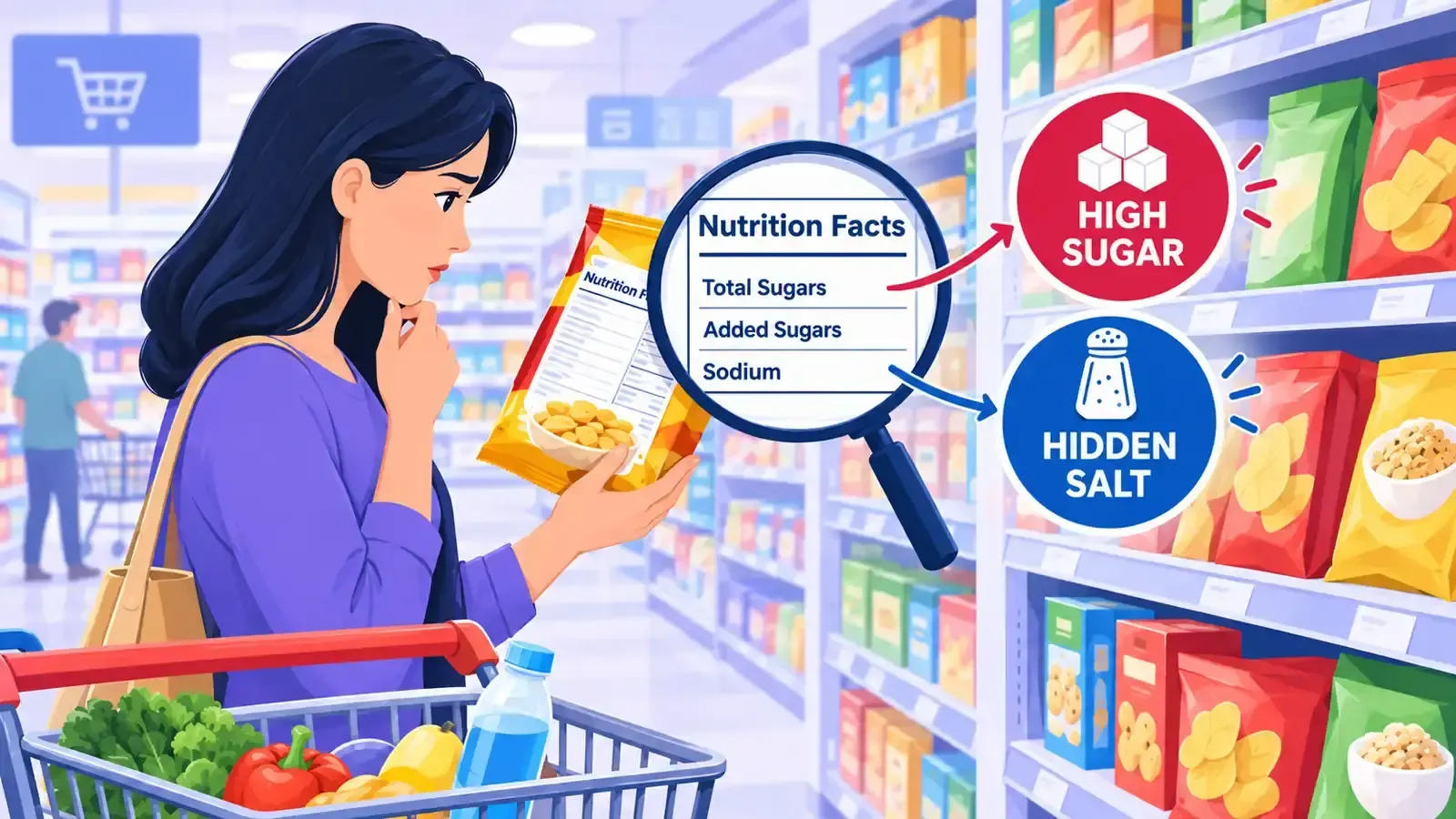
FSSAI has issued a proposal to make red hexagonal warning symbols mandatory for foods high in sugar, salt or fats on the front of packages | Image: Upstox
When you wolf down a packet of chips that claims to be ‘baked’ and not ‘fried’, do you know the oil content could have been replaced with high sodium, starch and chemical emulsifiers to get the right texture? This means your baked chips are not quite as healthy as they claim to be. Similarly, a product claiming to be made with whole wheat should be looked upon with skepticism. Refined flour is most likely the primary ingredient with a small fraction of whole wheat added to qualify for the claim. These hidden half-truths on packaged foods have finally come under the scanner of the Food Safety and Standards Authority of India (FSSAI).
The story of deceptive health claims
It all started in April 2023 when a social media influencer published a video analysing the high sugar content in Mondelez’s Bournvita. The video challenged its long-standing claims as a growth and health supplement for children. In April 2024, the Commerce Ministry backed by FSSAI definitions, directed all e-commerce platforms to remove drinks like Bournvita, Horlicks and Complan from the ‘Health Drinks’ category. It clarified that Indian food laws recognise no category called ‘Health Drink’. Thereafter, FSSAI stopped companies from using health buzzwords like ‘100% pure’ or ‘health drink’ if they did not meet the stringent regulatory criteria.
The crackdown on misleading claims has reached its peak. FSSAI has issued 150 notices to major food companies like Nestle, PepsiCo and Mondelez over misleading claims, ambiguous serving sizes and use of sugar substitutes. Public health activists have petitioned the Supreme Court over delayed warning labels on packaged foods.
FSSAI has issued a proposal to make red hexagonal warning symbols mandatory for foods high in sugar, salt or fats on the front of the packages. But food brands are pushing back, because they fear that almost 80% of their products would end up with warning labels. Instead, they are pushing for ‘Health Star Ratings’.
Potential loopholes in FSSAI’s latest proposal
The first phase of FSSAI's proposal requires a product to exceed thresholds in two or more nutrients of concern (for example, high sugar and high salt) to trigger a warning label. This means a product packed with extreme sugar levels can avoid a warning if it is low in fat and salt. This will enable brands to maintain their health claims. It’s a loophole that will benefit brands in the first phase. For example, a Kellogg's multigrain Chocos box in India, whose label shows it contains 27% added sugar by weight but has fat and salt percentages within the proposal's limits, will potentially escape warnings.
Experts feel that brands have been hiding behind deceptive claims on nutrition labels for far too long, which creates ambiguity for consumers. Speaking to StoryBoard18, brand consultant Lloyd Mathias, said, “For some time, brands have been taking liberties with claims such as ‘energy drinks’, ‘100% pure juice’, ‘boosting immunity’ and similar propositions. This action will sensitise both manufacturers and consumers to the need to pay greater attention to such claims and not take them at face value.”
Will everything become red?
Brands are worried about the new proposed warning labels. Sugar, fat and salt are integral to many traditional products in India. Packaged traditional sweets and namkeens could attract warnings. One key point of contention is that FSSAI is proposing a 100-gram benchmark to decide whether a product needs to have a warning label, instead of going by a single serve. The other big issue for major food companies is thresholds. FSSAI is proposing a red warning if added sugar exceeds 3% of solid products by weight, and fat exceeds 4.2%, stricter than many foreign markets.
Health vs taste: The unending debate
The entire issue boils down to how aware Indian consumers are about the ingredients in packaged foods and their impact on health. According to a study published in the leading medical journal Lancet, India had 180 million adults who were overweight or obese in 2021. This is projected to rise to 450 million by 2050. Packaged foods with their hidden ingredients are just adding to this health burden. Retail sales of packaged foods in India have seen a surge in the last 5 years. According to Ken Research, sales grew from ₹6.15 lakh crore in 2020 to ₹11.76 lakh crore in 2025, growing at an annual rate of over 11%.
India struggles with a massive burden of lifestyle diseases like diabetes and cardiovascular diseases owing to rising obesity. This only underlines the importance of right food choices for Indians. Therefore, the right food labelling could make a huge difference to health.
How food labeling worked in other countries
Globally, researchers say warning labels have benefited public health. Chile's 2016 food labeling law, which puts separate black octagons on a pack for each nutrient that is excessive, resulted in a 23.7% decline in purchases of sugary drinks in the 18 months after it kicked in, according to the journal PLOS Medicine. In fact, Chile was the first country to mandate such labels. Chile’s neighbour Peru also implemented mandatory black octagons. An evaluation study of the impact of advertising warnings commissioned by Peru’s ministry of health and conducted through the National Institute of Health revealed interesting findings. Within the first year of Phase 1 implementation in 2019, 37% of surveyed consumers reported having stopped the purchase of at least one product featuring an octagonal warning label. In fact, Latin America has seen several countries adopt mandatory labeling, which has benefited consumers.
Mandatory warning labels have proved to be more effective than voluntary compliance. In fact, warning labels don’t just change consumer habits, they force food companies to reduce sugar, salt and fat content to avoid red labeling. The next time you flip open a bag of baked chips or reach out for a "multigrain" cereal, look past the promises on the front and choose wisely.
About The Author
Next Story

