
Upstox Originals
Why US tech giants now want to own stakes in their power suppliers

6 min read | Updated on September 18, 2026, 13:49 IST


SUMMARY
Generac shares jumped as much as 45% after Amazon agreed to buy backup generators worth up to $8 billion for its data centres. Only $2.4 billion (or 30%) of that is actually contracted, the rest is maximum spend Amazon may incur. Besides, Amazon also got the right to buy almost 3% of the company. It is the second time in five months that a tech giant has taken a stake in its power supplier just before announcing the order that sends the stock up.

Generac shares jumped as much as 45% after Amazon’s order | Image: Shutterstock
On Wednesday, Generac Holdings (GNRC) shares had an unremarkable day during the trading session. The shares closed at $175.11, flat since a day before. Then came the big announcement.
Amazon had agreed to buy backup power generators for its data centres, in a deal that Generac said could reach $8 billion. The stock rose as much as 45% in after-hours trading. By Thursday it was trading around $226 per share. This move took some market participants by surprise. For the longest time, this company was associated with generators used during storms or power outages. Now, it has become a serious player in the AI data centre boom.
The $8 billion figure is the one every headline carried. It is also the least binding number in the company’s exchange filing.
What Generac has actually contracted is $2.4 billion, not $8 billion
Generac's filing with the US markets regulator contains three different numbers. Only one of them is a firm commitment. Amazon is expected to take delivery of generators worth $2.4 billion across 2027 and 2028, and that is the part both sides have actually agreed. The $8 billion is a limit, not an order. It is the most Amazon could end up spending over the life of the deal.
The difference matters because of where Generac is starting from. Its revenue over the last twelve months was $4.44 billion, and its data centre business was expected to bring in roughly $450 million during 2026. So even the contracted $2.4 billion, spread over two years, is a step change for this company. The headline figure, however, is nearly double its entire annual revenue.
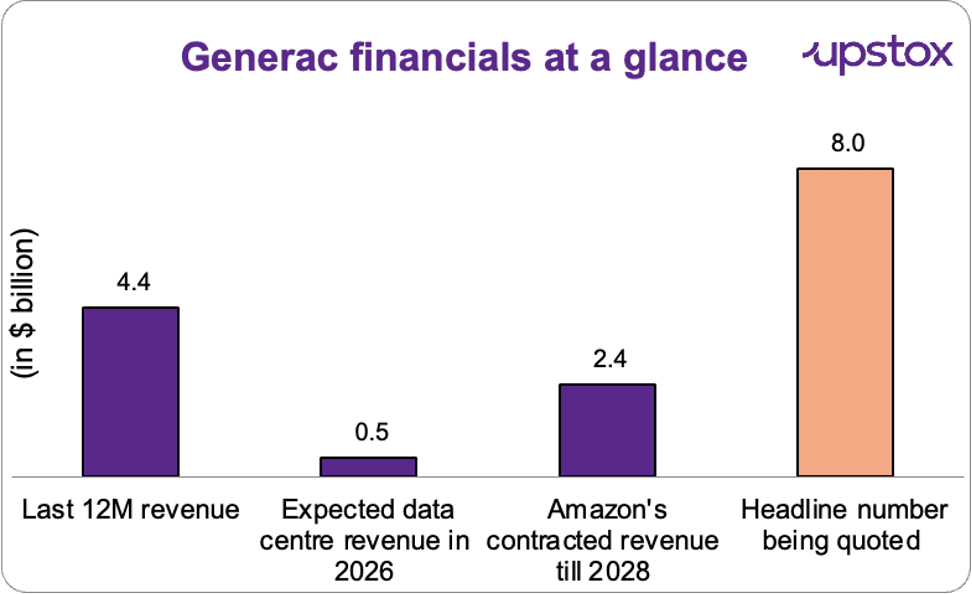
Sources: Generac Holdings Form 8-K filings; CNBC market data
Amazon also got the right to buy Generac shares at a fixed price
The order is only half the deal. Generac also handed Amazon something called a warrant.
A warrant works a bit like a voucher. It lets whoever holds it to buy shares in a company at a price agreed in advance, any time before it expires. If the share price climbs above that agreed price, the voucher is worth money, because the holder can buy at the low fixed price and sell at the higher market price. If the share price stays below it, the voucher is worthless and nobody bothers using it.
Amazon's voucher covers up to 1,693,745 Generac shares at $200.9266 each, and it is valid until September 2033. Amazon does not get all of it at once. Only 307,954 shares are unlocked straight away. The rest unlock slowly, as Amazon actually pays Generac for generators.
Now look at the timing. On Wednesday, Generac shares closed at $175.11. Amazon's agreed price was $200.93, roughly 15% higher than that. At that moment the voucher was useless. Nobody would pay $200.93 for a share they could buy in the open market for $175.11.
Then the deal was made public. The stock jumped. By Thursday it was trading near $226, much higher than $200.93. The voucher went from worthless to valuable, purely because the agreement that created it had been announced.
Generac has roughly 59 million shares in total. Amazon's voucher covers close to 2.9% of the entire company.
Oracle did something in April, and the gain was measurable
This is not new. In April, Bloom Energy issued Oracle a warrant for 3.53 million shares at $113.28, an exercise cost of around $400 million. Four days later the two companies announced an expanded partnership covering up to 2.8 gigawatts of fuel-cell capacity. Bloom shares rose about 15%, to nearly $203, and CNBC calculated Oracle's paper gain over the warrant price at $316 million.
Are companies locking in their electricity commitment?
AI data centres consume enormous amounts of electricity. Getting a new connection from the local power grid can take years, and the companies building these centres do not have years to spare. So they need power generated on site instead. That means generators and fuel cells, and it has turned a small group of equipment makers into a potential bottleneck. Everyone wants the same machines from the same few suppliers. A purchase order on its own does not solve that problem. Any rival can place one too. So the buyers have started offering something extra, which is a stake in the supplier itself.
The logic works for both sides. The supplier gains a customer who is now financially invested in its success and is far less likely to walk away. The buyer gets priority in the queue, plus a share of the gains if the supplier thrives. Somebody does pay for this, though. The supplier's existing shareholders are handing over a piece of their company at a price that was fixed before the good news became public. Amazon's price is locked at $200.93. The shares are now worth more than that.
What can we take from this?
One detail sits slightly awkwardly against all of this. Even after Thursday's jump, Generac was still trading roughly 24% below its 52-week high of $296.44, set on June 25, 2026. The largest customer agreement in the company's history has not yet taken the stock back to where it traded in early summer.
The takeaway is relatively simple. When a supply agreement is announced with a very large number attached, open the company filing and find out how much of it is contracted and how much is a ceiling. Then check whether the customer received shares, and how many.
Both things were disclosed in Generac's case, on the same day, in the same document. Neither was hidden. They just did not fit into a headline, which tends to carry the biggest figure available rather than the most reliable one.
About The Author
Next Story

