
Upstox Originals
Fade to silence: Why FM networks are turning off the transmitter

5 min read | Updated on July 20, 2026, 18:16 IST


SUMMARY
India’s private FM stations are shutting down due to fixed auction fees and plunging ad revenues. To survive against music streaming apps and algorithmic platforms, networks and RJs must transition to multi-platform digital content creators, and host events to diversify revenue streams and ensure survival.
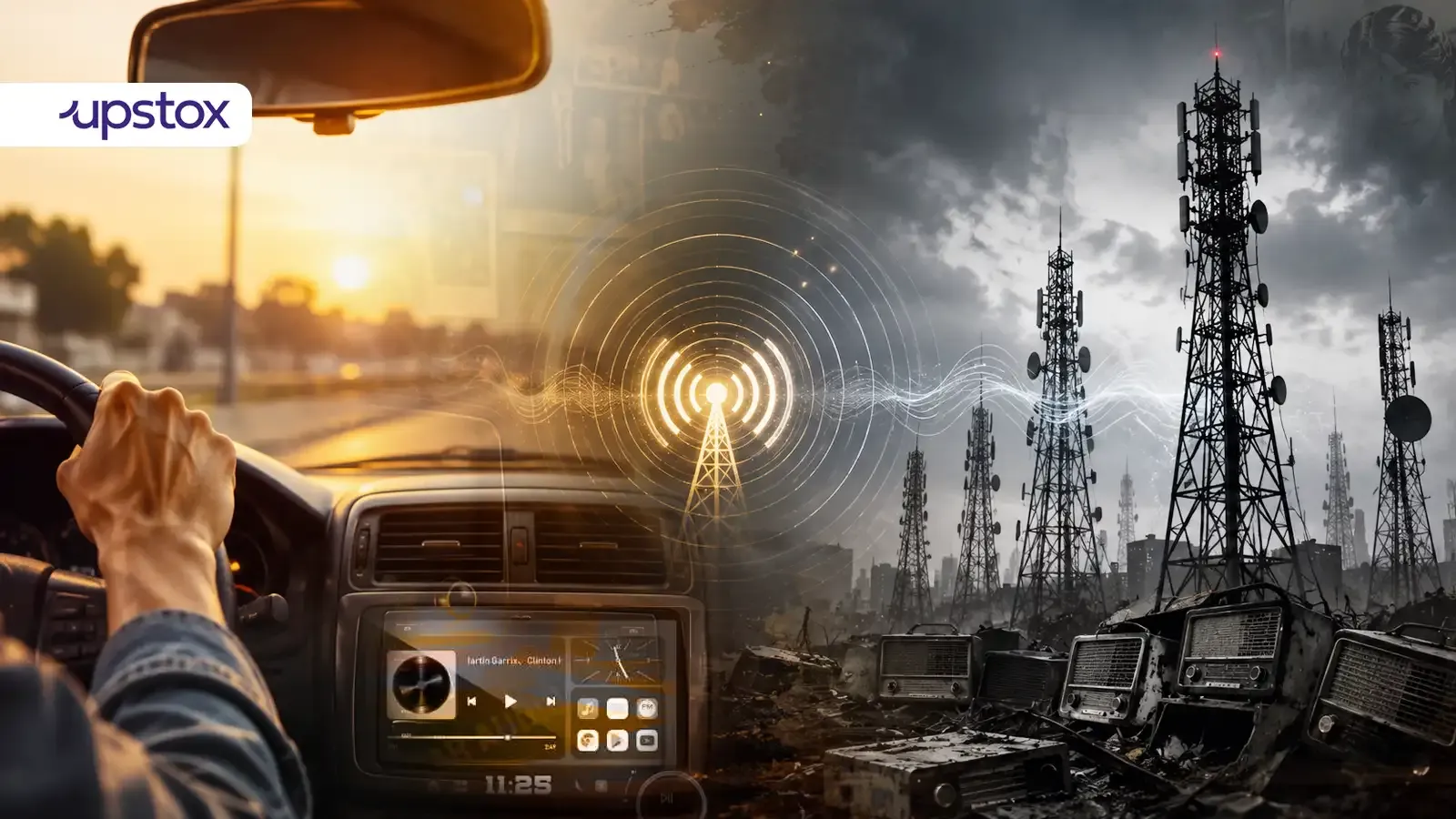
Stations are voluntarily surrendering their spectrum licenses due to regulations, shifting consumer habits, and mounting financial losses | Image: Upstox
The beloved FM radio that became the voice of the younger generation in the 90s and early 2000s is gradually fading into history with the closure of many stations.
Curtains have come down on HT Media’s Radio Nasha in Mumbai, RadioOne in Delhi, Mumbai and Bengaluru, and Fever 91.9 FM in Chennai. Fever FM's core 104.0 MHz network in major northern and regional Hindi-speaking markets remains on air. TVToday shut down Ishq 104.8 FM. Red FM had already surrendered its Magic FM Mumbai licence.
What has caused these radio stations to wind up? This sudden wave of station closures is not a coincidence. It is a voluntary surrender of spectrum licences driven by regulations, changing consumer habits and mounting financial losses.
Here’s what happened. When private FM operators bid for their 15-year Phase III licences years ago, they were banking on the projected double-digit growth in ad revenues. But today, these historical auction prices carry a massive, fixed recurring financial burden. This means they need to pay a non-negotiable fixed bill every year, which is a huge burden.
Does this shutdown of FM networks spell the end of an era of shared cultural moments and a collective sense of belonging for listeners? FM radio is known to anchor communities with local updates, the warm voice of your favourite Radio Jockey, and beloved songs that stay with you through the day..
How did FM radio become such an integral part of our lives?
FM Radio: The pulse of a generation
FM radio burst onto the scene way before the digital wave. FM transmission was first introduced by All India Radio in 1977. Phase I of privatization of FM happened in 1999–2001. On July 3, 2001, Radio City Bengaluru became India’s first 100% private FM station, followed quickly by the Times Group launching Radio Mirchi in Indore. In Phase II in 2005, there was an explosion of private stations across Tier 1 and Tier II cities. FM added zest to urban life and commute culture and Radio Jockeys or RJs became celebrities of sorts.
Phase III in 2015 allowed operators to expand into smaller Tier III towns. It seemed there was no looking back for the medium. But despite geographic expansion, FM channels have been under severe financial stress. The competition has increased manifold. Earlier television was its main competitor, but today the competitors are digital.
The costs of running radio stations
The costs have been mounting for FM stations while ad revenue is down. According to the Association of Radio Operators for India (AROI), radio's share of total Indian advertising spend plummeted from 3.4% in 2015 to just 1.1%. As for the costs, radio stations also have to pay recurring copyright fees for playing Bollywood or regional music. Even if a station has zero advertisers tuning in at a particular time, they still owe the music labels money for every song they play.
Additionally, private players rent space on towers owned by public broadcasters, in this case Prasar Bharati. They have to pay fixed, recurring maintenance and co-location fees.
The fixed costs do not disappear even if ad revenue drops. The budgets allocated to radio earlier are now divided across media. As these annual losses stacked up, the burden became unsustainable for these FM stations.
The shift towards on-demand audio
The above factors notwithstanding, FM radio stations are battling a bigger competitor. On-demand audio like podcasts, audio books and streaming platforms like Spotify, Gaana, JioSaavn, Wynk, and Youtube Music are all competing for the consumer’s ear. And this time, it’s the algorithm that decides what the consumer plays. As tastes change, FM stations need to innovate to get listeners to tune in. On-ground events and digital activations on a large scale can put radio stations in the spotlight. RJs too need to become 360-degrees multimedia content creators and community builders if they want dedicated listeners. Their content needs to be distributed across media.
For example, RJ Naved of Radio Mirchi took the traditional concept of the ‘prank call’ (Mirchi Murga) and changed it into a social satire. He filmed the reactions, posted them on Facebook and Youtube. By doing so, he used his platform to address social prejudices in India through humour. He built a following on digital platforms while maintaining his massive radio listenership.
The radio industry has urged the government to adopt key reforms to save it before more stations shut shop. Firstly, it wants to be allowed to broadcast news and current affairs, it wants GST on radio services to be reduced from 18% to 5%. It wants smartphone manufacturers to unlock FM receivers in devices. It has also asked for a model under which radio companies would pay the government a fixed percentage of their actual earnings as licence fee, instead of paying charges linked to old auction prices.
Survival of the most adaptable
The future belongs to the medium that can adapt itself and survive. There will soon be no concept of a ‘radio only’ company. FM networks will need to rebrand themselves as complete audio entertainment solutions. RJs will turn into podcasters and social media content creators. Local live events and music festivals could help diversify the cash flow. In other words, the future belongs to the networks that can reinvent themselves. While regulatory hurdles cannot be ignored, there is still some hope for the medium that was once a part of our everyday lives.
About The Author
Next Story

