
Upstox Originals
Can one airport save another? Decoding India’s new bundling strategy

10 min read | Updated on July 23, 2026, 18:41 IST


SUMMARY
India has built airports across the country, but not all of them are equally busy. To help smaller airports attract more flights and investment, the government is proposing a new auction model that pairs them with stronger airports. The strategy could create opportunities for airport operators while accelerating regional aviation growth. But its success will depend on whether development reaches every airport in the bundle.
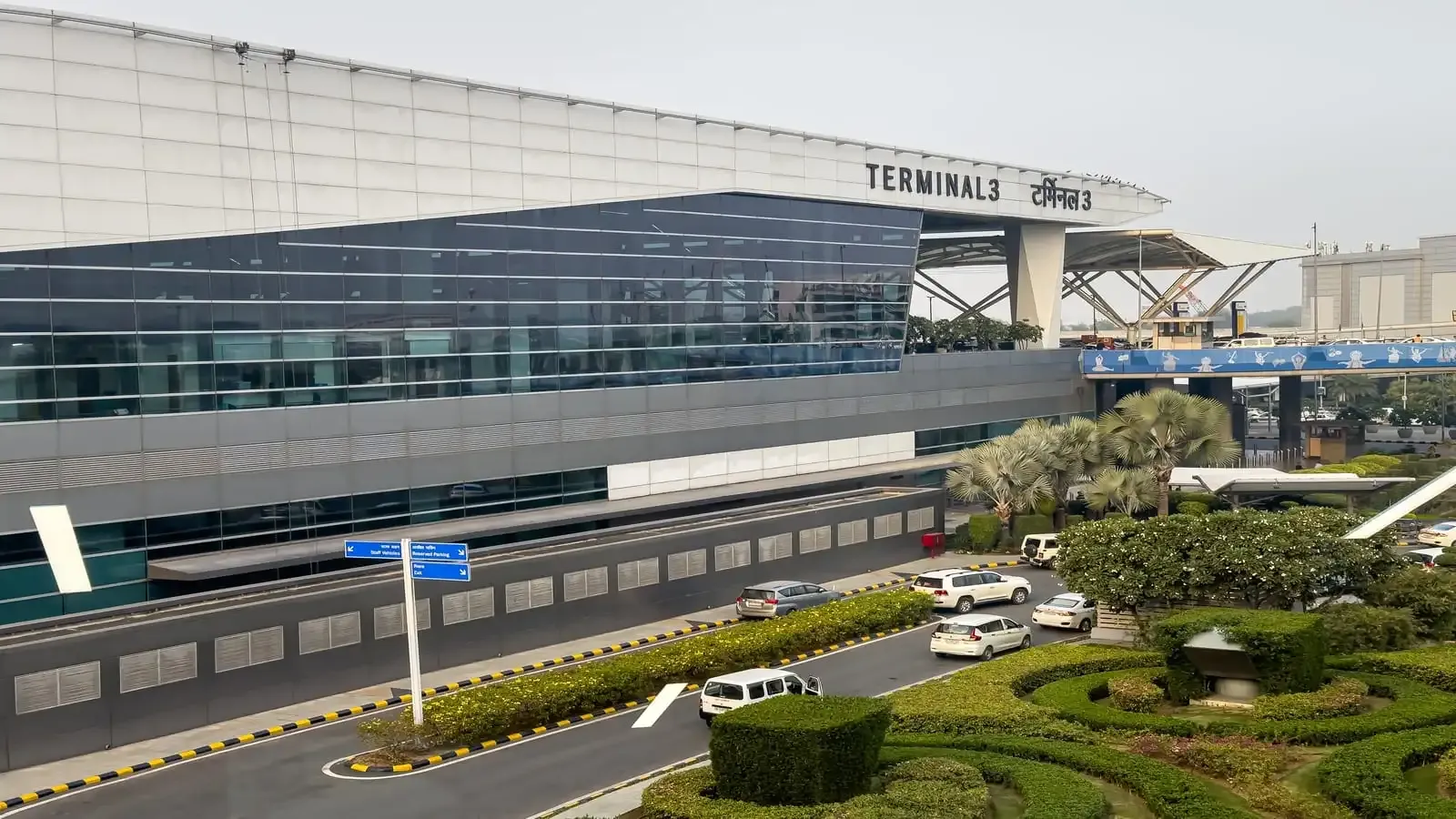
Low-cost airlines now account for more than 80% of domestic revenue passenger kilometres. | Image: Shutterstock
Mumbai has an airport problem—but it is the kind many smaller cities would like to have. Chhatrapati Shivaji Maharaj International Airport handles heavy passenger traffic and has limited room to expand. Navi Mumbai International Airport was therefore developed as a second major gateway for the region, adding capacity as demand continues to grow.
Several smaller Indian airports face the opposite problem. They have runways and terminals, but not enough flights, passengers or commercial activity. For them, building infrastructure is not enough; the bigger challenge is making the airport commercially active.
The government’s proposed airport-bundling plan tries to address this gap. It could place a relatively busy airport and one or more smaller airports in the same package, with a single operator responsible for managing and developing them. The stronger airport could make the bundle financially attractive, while the smaller airport could receive investment and management support.
Bundling could also improve the economics for airport operators. Managing several airports together allows an operator to share technology, procurement, training, maintenance expertise and airline relationships across the network. This creates operating leverage because the operator can expand its business without repeating every cost at each airport.
Experience from the busier airport could also help the operator improve the smaller one. It can apply what it has learned about passenger movement, retail, parking, cargo, route development and terminal management. If the airports serve the same region or travel circuit, the operator may also be able to market them as part of a connected network rather than as separate facilities.
The operator could work with Airports Authority of India (AAI) and airlines to identify routes that are better suited to the smaller airport. Where commercially practical, this could reduce pressure on the busier airport while bringing more flights and passengers to the smaller one. However, such a shift would depend on passenger demand, airline interest, available slots and ground connectivity—it cannot be achieved by the airport operator alone
The proposal could also change how India awards airports. Unlike the 2019 auction, where one bidder won all six airports on offer, the new round may limit how many bundles a single company can win. That could bring more operators into the industry while giving smaller airports a better chance to grow.
What’s going on?
Indian aviation was once centred around Delhi, Mumbai, Bengaluru and Hyderabad. Smaller cities had limited flights, weaker airport infrastructure and fewer passengers. The UDAN scheme began changing this by supporting routes that might not have been commercially viable in their early years.
Launched in 2016, UDAN provides financial support and concessions on airport-related charges for eligible regional flights. As of July 2026, 669 routes had been operationalised across 95 airports, heliports and water aerodromes, benefiting more than 1.66 crore passengers. The government has also approved a modified UDAN programme with an outlay of around ₹29,000 crore over ten years in July-26.
Low-cost airlines now account for more than 80% of domestic revenue passenger kilometres, a measure that combines the number of passengers with the distance travelled.
As a result, the share of non-metro airports in passenger traffic increased from around 32% in FY15 to 40% in FY26. In absolute terms, traffic at these airports rose from 61 million to 167 million during the same period.
Passenger traffic at metro and non-metro airports from FY15 to FY26.
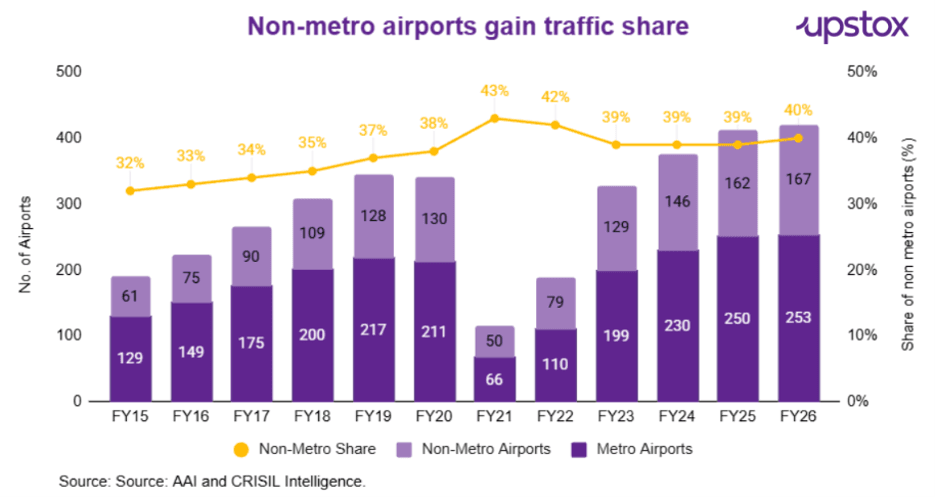
Source: AAI and CRISIL Intelligence.
Airport investment may cross ₹1 lakh crore
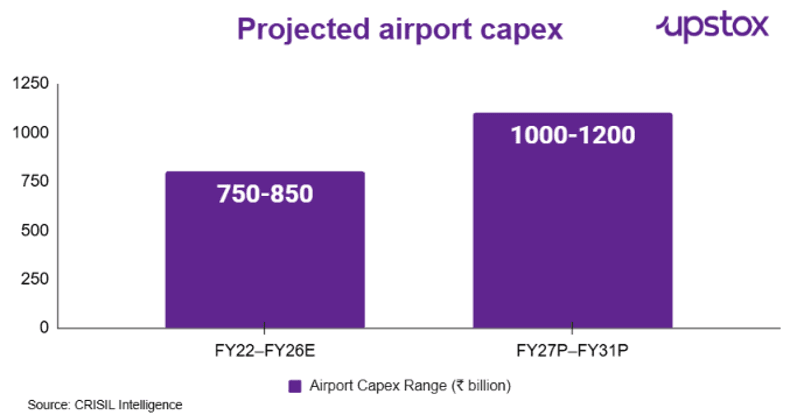
More passengers require larger terminals, better runways, additional aircraft parking, cargo facilities and improved connectivity. CRISIL Intelligence expects airport investment to reach ₹1–1.2 lakh crore between FY27 and FY31, compared with an estimated ₹75,000–85,000 crore between FY22 and FY26.
Airport capital expenditure during FY22–FY31.
The investment pipeline includes further expansion at Jewar and Navi Mumbai airports, the redevelopment of Mumbai Airport’s Terminal 1 and the next phase of expansion at Hyderabad Airport. New terminals and capacity additions are also planned at airports such as Ahmedabad and Mangaluru. This shows that India’s aviation push is not limited to constructing new airports; it also involves expanding and modernising existing ones.
| Airport Category | Airport | Million Passengers Per Annum |
|---|---|---|
| Major Airport | Bhubaneshwar | 3.7 |
| Major Airport | Amritsar | 4.8 |
| Major Airport | Varanasi | 3.9 |
| Major Airport | Raipur | 2.6 |
| Major Airport | Trichy | 1.9 |
| Smaller Airport | Gaya | 0.3 |
| Smaller Airport | Hubballi | 0.3 |
| Smaller Airport | Kushinagar | 0.0 |
| Smaller Airport | Tirupathi | 1.0 |
| Smaller Airport | Kangra | 0.2 |
| Smaller Airport | Aurangabad | 0.7 |
Source: Adani Enterprises
Mega and regional airports solve different problems
Mumbai and Delhi clearly need additional capacity. Navi Mumbai International Airport operates alongside Chhatrapati Shivaji Maharaj International Airport, giving the Mumbai region a second major gateway. Similarly, Noida International Airport at Jewar complements Delhi’s Indira Gandhi International Airport and has an initial capacity of around 12 million passengers annually.
These projects address congestion in India’s largest urban regions. The challenge at many regional airports is different: the infrastructure already exists, but utilisation remains low. Improving connectivity and attracting airlines can often be faster and less expensive than constructing another greenfield airport.
India, therefore, needs both approaches: mega airports to add capacity in congested cities and stronger regional airports to spread aviation growth. Before examining how the proposed bundle model could help, it is important to understand what happened in the previous airport auction.
Problem: What happened in the 2019 auctions?
The previous airport-leasing round provides useful context. In February 2019, Adani Enterprises emerged as the highest bidder for all six airports offered by AAI, Ahmedabad, Jaipur, Lucknow, Mangaluru, Guwahati and Thiruvananthapuram.
The awards were made under the bidding framework set by the government. Adani’s participation demonstrated private-sector interest in airport infrastructure and helped the group build a large aviation portfolio. It later acquired control of Mumbai Airport and continued developing Navi Mumbai International Airport.
At the same time, the outcome led to a wider policy discussion about future auction design. The question was not about the capability of a particular operator. It was whether distributing assets among more companies could encourage competition, bring in new investors and allow the government to compare performance across operators. The proposed limits in the upcoming round should be viewed in this context.
How the bundle plan could work
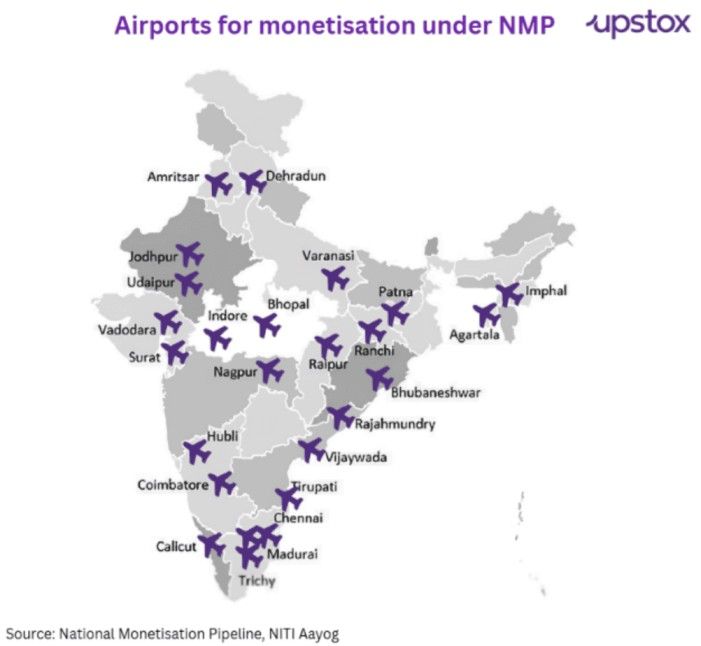
The government has proposed grouping 11 AAI airports into five bundles:
- Amritsar and Kangra
- Varanasi, Kushinagar and Gaya
- Bhubaneswar and Hubli
- Raipur and Aurangabad
- Trichy and Tirupati
The underlying idea is simple. An airport with relatively stronger passenger traffic can make the package commercially attractive. In return, the winning operator must manage and develop the smaller airports included in the same bundle.
For example, Varanasi offers an established religious tourism market. Pairing it with Kushinagar and Gaya could support the broader Buddhist tourism circuit. Amritsar could similarly support Kangra, while Trichy and Tirupati bring together regional, religious and overseas travel demand.
Bundling could prevent operators from selecting only the most established airports. It could also bring private investment, airline relationships and commercial expertise to smaller facilities that may take longer to become independently viable.
A bidder limit could widen participation
The Ministry of Civil Aviation has proposed limiting one bidder to two or three bundles, equivalent to roughly five or six airports. The proposal remains under review and the final tender conditions may change.
If included in the tender, the limit could create space for multiple operators. It may also encourage consortiums that combine airport-management experience with long-term infrastructure capital.
The final structure will matter as much as the bundle list. The government must decide the minimum investment required at each airport, the technical and financial eligibility of bidders, the payment model and the land included with every asset.
Smaller airports will also need separate investment commitments and service standards. Without these safeguards, an operator could focus mainly on the busiest airport in the bundle. The policy will work only if development reaches every airport in the package.
India’s airport-operator landscape
India’s airport network is managed by AAI, private operators, public-private partnerships, state entities and defence organisations. Not every entity below is expected to bid in the upcoming auction, but the table shows the wider operating landscape.
| Category | Operator | Major Indian airports |
|---|---|---|
| State-owned | Airports Authority of India | Chennai, Kolkata, Coimbatore, Varanasi, Bhubaneswar and a large regional network |
| Private and PPP | Adani Airport Holdings | Mumbai, Navi Mumbai, Ahmedabad, Lucknow, Jaipur, Guwahati, Mangaluru and Thiruvananthapuram |
| Private and PPP | GMR Airports | Delhi, Hyderabad, Goa, Nagpur and Bidar; Bhogapuram is under development |
| Private and PPP | Bangalore International Airport Limited | Bengaluru |
| Private and PPP | Cochin International Airport Limited | Kochi |
| International operator | Zurich Airport International through YIAPL | Noida International Airport |
| State and regional JV | Kannur International Airport Limited | Kannur |
| Defence and corporate | Ministry of Defence and HAL | Civil enclaves and airports including Chandigarh, Pune, Ozar and HAL Bengaluru |
Source: News articles
India has several airport operators, but only a few manage multiple large commercial airports. The proposed auction could expand this group by creating opportunities for experienced domestic players, international operators and infrastructure investors.
Where does GMR Airports fit into the opportunity?
GMR is one of India’s established private airport operators. Its current network includes Delhi, Hyderabad, Goa, Nagpur and Bidar, while Bhogapuram Airport is under development. The group also operates international assets and provides technical services outside India.
GMR views the government's consideration of bid caps (limiting a single operator to a maximum of two bundles/four airports) as a deliberate measure to prevent a market monopoly, which levels the playing field against aggressive competitors like the Adani Group
What does this mean for Adani Airports?
For Adani Airports, the proposed rule is both a restriction and an opportunity. Under the new proposal, it could participate, but it may be allowed to win only two or three bundles, depending on the final tender conditions. The limit would apply to every bidder, not only Adani.
If Adani wins a bundle, it could use this experience to improve the smaller airport. Technology, procurement, maintenance, employee training, airline relationships and commercial partnerships could be shared across the airports. This may lower operating costs and help the smaller airport become more efficient.
In summary
India’s next airport auction will test whether the government can balance three goals: attracting private capital, widening competition and making regional airports commercially sustainable. GMR could be one of several potential participants, but the opportunity is larger than any one operator.
Success will not be measured by which company wins the most airports. It will be measured by whether the auction attracts credible bidders, brings investment to every airport in a bundle and helps smaller airports gain more flights and passengers. If that happens, departure boards at regional airports may finally begin to look as active as the terminals built around them.
About The Author
Next Story

