
Upstox Originals
Can India’s wires & cables’ makers keep their margins as competition heats up?

8 min read | Updated on October 06, 2026, 15:52 IST


SUMMARY
India’s wires and cables industry is booming, thanks to a grid upgrade, record renewable additions and strong construction demand. But the party is getting crowded, with UltraTech entering the market in September. As new capacity grows faster than demand, the bigger question is: can incumbents keep their margins intact?
Stock list

In September UltraTech Cement formally launched its own wires and cables brand, Ultravolt. | Image: Shutterstock
India's wires and cables (W&C) makers have just reported some of the best numbers in their history. In the April–June 2026 quarter, market leader Polycab India posted its highest-ever first-quarter revenue and KEI Industries continued to widen its margins. As seen below, these are not numbers of an industry in trouble.
| Metric | Polycab India | KEI Industries |
|---|---|---|
| Revenue from operations (₹ crore) | 8,209.73 | 3,185.34 |
| Revenue growth, YoY (%) | 39 | 23 |
| Net profit (₹ crore) | 766.28 | 274.14 |
| Net profit growth, YoY (%) | 32.8 | 40.1 |
| Domestic W&C revenue growth, YoY (%) | 43 | 29.3 |
| EBITDA margin (%) | 13.8 | 13.0 |
Source: Company fillings; net profit is on a standalone basis for both companies
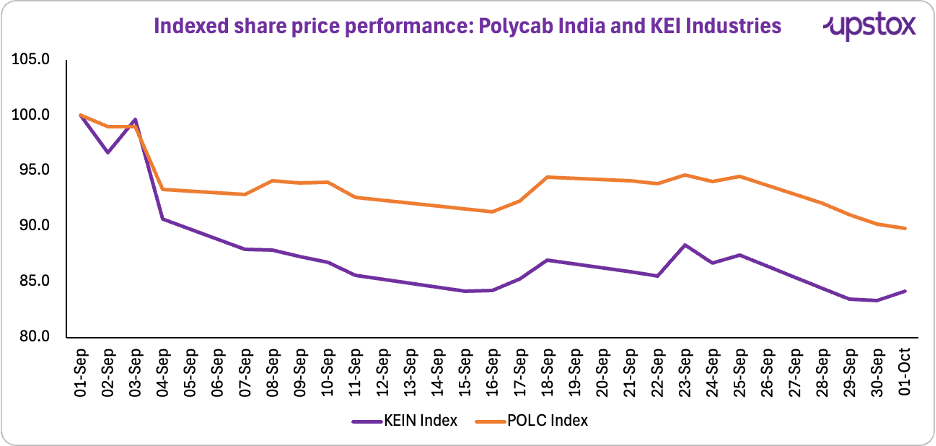
Yet over the past month, their shares have been heading the other way, as the chart below shows:
Source: Investing.com
So, why are share prices falling?
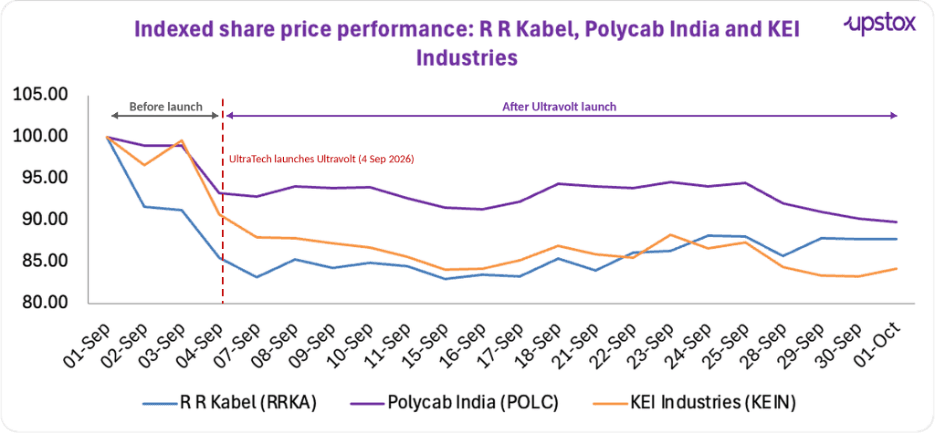
A new competitor walked in. On September 4, 2026, UltraTech Cement, India's largest cement maker, formally launched its own wires and cables brand, Ultravolt. The market did not wait to see how it would sell. KEI fell as much as 9% that day. Polycab, KEI and RR Kabel have kept drifting lower since Ultravolt's launch, and all three now trade 15–24% below their 52-week highs.
Source: Investing.com
Investors were not reacting to weaker demand. They were reacting to the fear that a cash-rich newcomer, with thousands of building-material outlets already selling to homebuilders, could force incumbents to cut prices and give up some of their margins.
So, how big a deal is this?
The threat was announced back in early 2025. UltraTech unveiled its plan in February, and cable stocks slumped up to 15% on each announcement before recovering. September 2026 is when the threat turned real.
UltraTech's plant at Jhagadia in Gujarat began commercial production on September 1, a few months ahead of its own December 2026 deadline. The company is not easing in. It calls Ultravolt the second-largest wires player by capacity at launch, wants to be a top-two player within five years, and plans to sell through more than 5,000 of its UltraTech Building Solutions outlets.
That last point is the real weapon. The person buying cement for a house is often the same person deciding which wires go into its walls.
Why would a cement-maker pour this kind of money into house wires?
Because the demand underneath is real. Two forces are pushing it at the same time: 1) a once-in-a-generation rebuild of the power grid and 2) a construction cycle that now includes data centres, metros and factories.
The grid is being rewired
India is adding renewable capacity faster than ever. FY26 saw a record 55.3 GW of non-fossil capacity, most of it solar. But a solar park in Rajasthan is useless unless its power can reach a factory in Maharashtra, and every gigawatt has to be evacuated, stepped up and transmitted through cable.
That is why the Central Electricity Authority's transmission plan matters so much. It lays out more than ₹9.15 lakh crore of investment by 2032, including over 1.91 lakh circuit km of new lines. The spending shows up directly in order books. KEI's extra-high-voltage (EHV) cable sales jumped nearly 48% in Q1 FY27, and it still has a pending EHV order book of ₹793 crore.
Buildings, factories and server farms
The second engine is closer to home: housing, commercial real estate, railways and a fast-growing data-centre pipeline. At Polycab, wires grew faster than cables in Q1 FY27, and dealer-led sales grew faster than institutional sales. That points to broad, retail-level demand rather than a handful of large contracts.
Put together, industry volumes have compounded at more than 15% a year over the last five years. Crisil expects the market to touch ₹1.2 lakh crore by the end of FY27, up from an estimated ₹90,000 crore in FY25.
But, is there room for everyone?
This is where opinion splits, and both sides have a serious argument.
The case for calm
The market is still fragmented, with an estimated 400 players. Branded companies have steadily taken share from local manufacturers, from 61% of the market in FY14 to 76% in FY25. A deep-pocketed newcomer is likelier to squeeze the unbranded workshop than a Polycab or KEI, which is JM Financial's central view.
Scale matters too. UltraTech's investment amounts to roughly 5% of industry capacity, against the 40%-plus scale at which the Aditya Birla Group went into paints. And wires make up only about a quarter of the overall W&C market, per Crisil. The bigger, approval-heavy cable business is largely out of the newcomers' reach for now.
The case for worry
The bear case is about arithmetic, not panic. Crisil expects organised capacity to grow 20–22% by the end of FY27, once new entrants are counted, against volume growth of about 10%. When supply runs ahead of demand, something usually gives, and it is usually price.
The first casualty may be pricing freedom. Today, W&C makers reset prices every month or two to pass on copper moves. Crisil expects those hikes to become more calibrated as competition rises. The early signs are already visible. After copper's September spike, Polycab and Finolex Cables raised prices on select products, RR Kabel announced hikes but held them back, and KEI had not acted at all.
Nuvama now estimates incumbents could lose 1.5 to 2.5 percentage points of gross margin to discounts and dealer incentives. For a business earning a 13% operating margin, a two-point hit wipes out roughly 15% of operating profit even if sales do not fall.
If this feels familiar, that’s because it is.
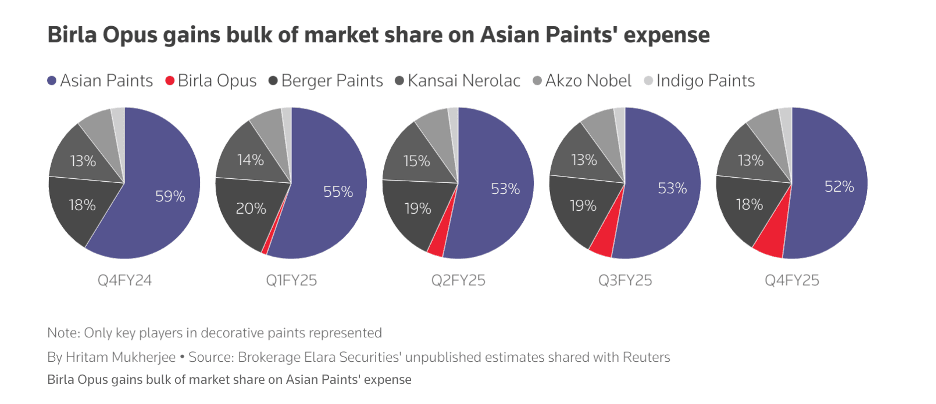
Paints went through the same script. Aditya Birla Group announced its paints entry in 2021 and launched Birla Opus on 22 February 2024. Asian Paints initially wobbled for a week, then recovered, trading above launch-day levels by September 2024. The real fall came in November 2024, when consolidated margins dropped to 15.5% in the September quarter.
By March 2025, Birla Opus had captured nearly 7% of the market, while Asian Paints' share fell from 59% to 52% in a year.
Source: Reuters, May 2025
The stock bottomed twice, in March 2025 and March 2026, both about 40% below its pre-launch peak. More than two-and-a-half years after launch, it remains about a third below that peak and would need to rise roughly half to recover.
The business, however, recovered. Asian Paints didn't beat Birla Opus by winning a price war. It defended its dealer network, strengthened its brand, pushed premium products and B2B, improved execution and benefited from lower input costs. By the June 2026 quarter, earnings had returned to roughly pre-Birla Opus levels, with margins recovering most of the lost ground. The share price has not.
Now, what’s the lesson here? The parallels are clear: both entrants came with deep pockets and powerful distribution. Birla Opus built about a quarter of industry capacity, while Ultravolt starts as the second-largest wires player by capacity. Both pushed incumbents to protect volumes at the expense of pricing.
But paints show that incumbents don't necessarily lose. Asian Paints remains the leader; the bigger risk is that new capacity ends scarcity and erodes the valuation premium long before earnings recover.
What should investors watch from here?
Here is where the story stops being about UltraTech and Adani, and starts being about the numbers incumbents report over the next few quarters.
Watch gross margins, not revenue
Revenue will keep growing on copper inflation and grid demand. The tell will be gross margin and spending on advertising and dealer incentives. If incumbents start buying loyalty, it shows up there first, well before any market-share data does.
Watch the copper pass-through
With copper near record highs, the speed at which price hikes stick is a live test of pricing power. Delayed or partial hikes would suggest the newcomers are already shaping behaviour.
Watch the mix
The safest revenue sits where newcomers cannot easily follow: EHV cables, exports and specialised industrial cables. Companies growing these faster have a wider moat. KEI's EHV and export order books, and Polycab's institutional cable business, are the places to look.
Watch the valuation, not just the business
Leading cable stocks traded close to 50 times earnings before September, and even after the sell-off the wire-heavy leaders still trade above 40 times. At that level, even a small dent in expected growth or margins can knock a big chunk off the share price, without a single rupee of profit being lost. The September 4 sell-off was a reminder that the risk here is as much about the multiple as the earnings.
The bottom line
India’s wires and cables boom is real, powered by a grid rebuild, record renewable additions and a strong construction cycle. But two deep-pocketed new entrants could change the game. Demand may keep growing, but pricing power could come under pressure as competition heats up. For investors, the question is no longer just how big the market gets, but who gets to keep the profits.
About The Author
Next Story

