
Market News
UltraTech’s ₹1,800 crore Ultravolt entry hits cable & wire stocks: Polycab, RR Kabel, KEI, Finolex tumble up to 9%

4 min read | Updated on September 04, 2026, 09:44 IST


SUMMARY
Aditya Birla Group on Wednesday announced the launch of the wires and cables business, Ultravolt, marking the group’s fourth new business foray in three years. Backed by an investment of ₹1,800 crore, Ultravolt will be the second-largest player in the wires segment by capacity, the statement said.

UltraTech's move is expected to intensify competition for established players such as Polycab India, KEI Industries, Havells India, RR Kabel and Finolex Cables. Image: Pexels
Shares of cables & wires (C&W) companies such as Polycab India, RR Kabel, KEI Industries, and Finolex Cables, among others, were under selling pressure on Friday, September 4. This is because Aditya Birla Group on Wednesday announced the launch of the wires and cables business, Ultravolt, marking the group’s fourth new business foray in three years.
"Backed by an investment of ₹1,800 crore, Ultravolt will be the second-largest player in the wires segment by capacity. Housed under UltraTech Cement Limited, the business aims to build a scaled national brand and become one of the top two players within five years," the company said in its press release.
UltraTech’s entry in the wires and cables market extends its participation in the construction value chain beyond grey cement, ready-mix concrete, building products, and white cement, consistent with its stated Building Solutions strategy. It also enables UltraTech to participate more deeply in the growing opportunity around home building, infrastructure and electrification, the press release added.
Cables and wires stocks in focus
How stocks were faring
KEI Industries shares slipped as much as 8.98% to ₹4,848.50 apiece on the NSE, while Polycab India shares were down over 4% to ₹8,448.50 apiece. Finolex Cables traded 1.60% lower at ₹1,243.70, and R R Kabel was down 3.66% at ₹2,521.80.
Havells India shares were also down over 3% to ₹1,162.30 apiece on the NSE.
UltraTech Cement, on the other hand, was up 0.49% at ₹11,330.
What top officials at Aditya Birla Group said
"More than 100 million new homes over the next decade, expanding energy infrastructure, and the rapid rise of data centers are poised to fuel a boom in the category. Our distinctive advantage comes from a deep understanding of the product, its underlying components and the adjacent ecosystems," Birla added.
"With this thought, we are launching with a portfolio of home wires, flexible wires, and cables designed for residential, commercial, industrial, and infrastructure applications. Over time, we plan to expand into a broader range of electrical accessories," Rangarajan added.
India wire and cable market size - growth trends and forecast (2026 - 2031)
The India wire and cable market size is expected to grow from $21.22 billion in 2025 to $23.13 billion in 2026 and is forecast to reach $35.58 billion by 2031 at 9.01% CAGR over 2026-2031.
According to a report by Mordor Intelligence, housing demand, renewable-energy targets, and rapid telecom upgrades are converging to keep large-volume orders flowing to cable makers, while mandatory BIS certification is nudging buyers toward organised suppliers.
Utility projects linked to the government’s pledge of 500 GW of non-fossil capacity by 2030 are creating multi-year procurement pipelines for extra-high-voltage (EHV) products.
At the same time, 5G fiberisation and data-centre corridors are expanding the addressable market for low-loss optical-fiber cables.
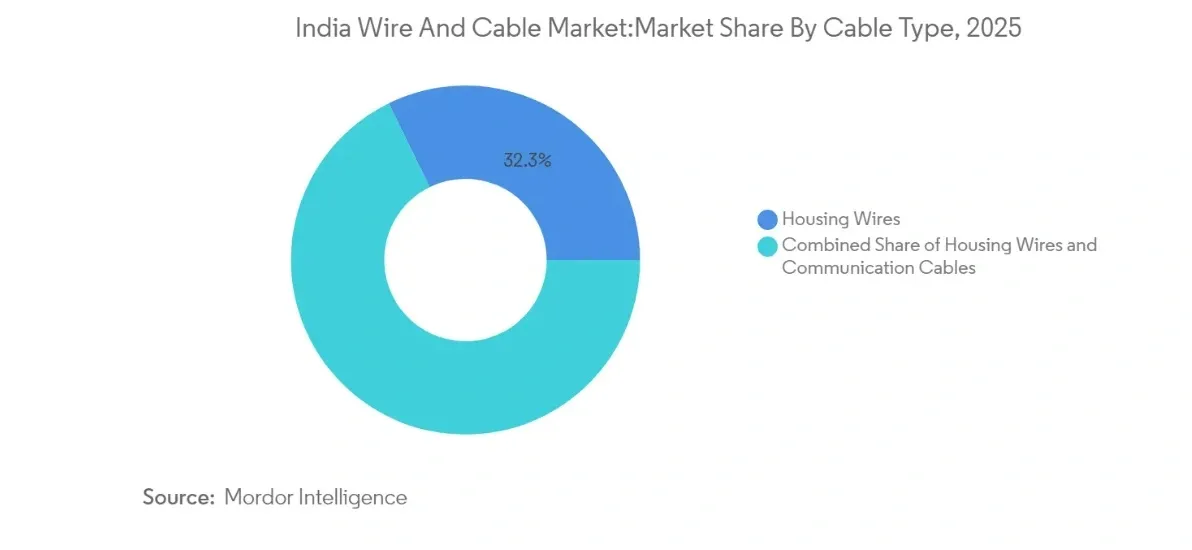
Competitive intensity is rising as new copper smelters and backward-integration moves lower raw-material risk for large entrants, prompting incumbents to accelerate capacity and brand investments.
Real Estate market
The report notes that rising urban incomes and favorable mortgage terms are fuelling a wave of premium apartment and office projects that specify flame-retardant, low-smoke housing wires.
About 600,000 new urban homes were finished in 2023, and developers continue to report strong booking velocity in Tier-1 and Tier-2 cities.
Higher-end projects increasingly demand 180-meter and 200-meter rolls to minimise joints, giving organized brands a pricing edge.
A shift away from sub-25 lakh rupee units toward premium categories also lifts average cable value per dwelling.
Developers expanding to Bangalore and Pune underline the west-south axis as a core consumption corridor.
In parallel, commercial real-estate completions are embedding smart-building protocols that require additional data and control cabling. Together, these dynamics keep residential wiring the single largest contributor to the India wire and cable market.
Related News


About The Author
Next Story

