
Upstox Originals
Quick commerce industry set to witness a battle of David vs Goliath amid Zepto IPO buzz

8 min read | Updated on July 31, 2026, 19:24 IST


SUMMARY
India's quick commerce industry is growing rapidly, driven by Blinkit, Instamart and Zepto, but profitability remains the biggest challenge. While advertising, private labels and better store utilisation are improving economics, but these companies also face intense competition from Amazon, Flipkart and JioMart.
Annual transacting users across these apps have hit 75-85 million in CY2025.
For millions of urban Indians, quick commerce has become less of a novelty and more of a reflex. Whether you've run out of milk, need ice cream before guests arrive, or simply don't feel like stepping out, a few taps on any quick commerce app can solve the problem in minutes.
Not surprisingly, what began with groceries has now expanded into beauty, medicines, toys, books, electronics, medicines, and even curated products for every occasion. Annual transacting users across these apps have hit 75-85 million in CY2025, up from 30-40 million in CY2024. It is today one of India’s fastest-growing consumer internet stories.
Much of the credit for creating and building this category goes to Blinkit (formerly Grofers), Instamart and Zepto. Of these, the first two are already listed on the Indian exchanges through their parent companies, Eternal and Swiggy, respectively. Zepto too was planning a public issue. But it has reportedly paused its plan for now, instead opting to raise funding in a pre-IPO round.
So far, so good. Now here’s the twist.
When these companies started out, they were all selling essentially the same promise: groceries delivered to your doorstep in 10 minutes. That proposition helped them build a habit among consumers and scale at remarkable speed.
But scale alone doesn't make a great business.
For investors to appreciate this sector as much as consumers, the growth needs to be matched by sustainable profits. And that’s the demanding phase that the industry finds itself in.
A market that’s only getting started
Let’s make one thing clear. No one is disputing the opportunity. It is massive and barely tapped into.
Here’s why we say this: India’s overall retail market was estimated at about ₹91 trillion ($1,066 billion) in CY2025 and projected to grow to ₹135-148 trillion ($1,586-1,743 billion) by CY2030. In comparison, the quick commerce market stood at just ₹1 trillion ($11.3 billion) in CY2025, barely 1% of the total market.
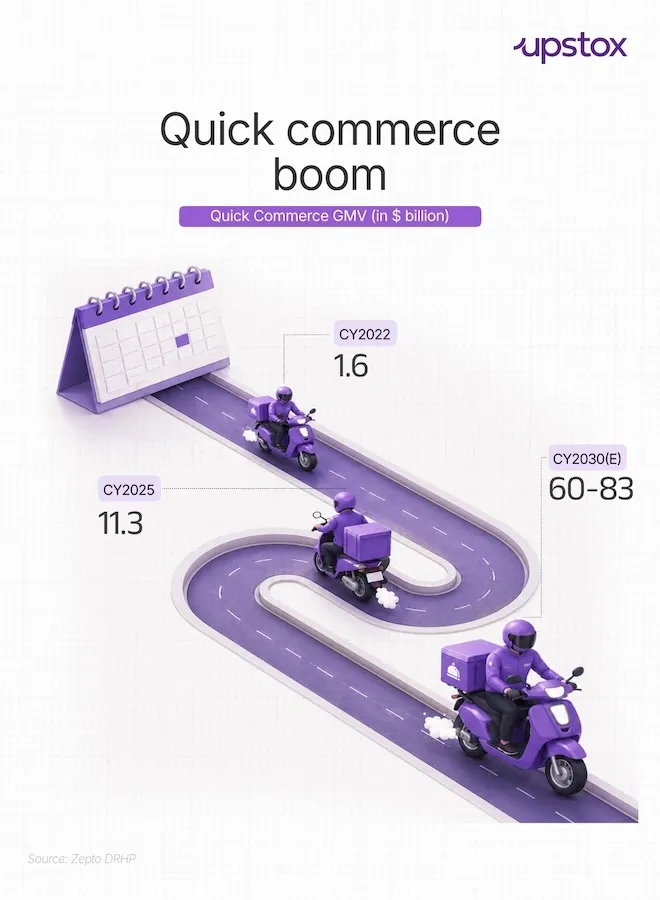
This growth potential explains why the category has moved from a convenience-led niche to a fiercely contested retail battleground. It is also why the format continues to attract capital even as competition intensifies.
From growth to discipline
In the early years, Blinkit, Zepto and Instamart spent heavily to build the category. You are likely to (fondly) remember how almost every order came with a discount coupon and delivery felt practically free? Those days are slowly disappearing. Because the goal is not to acquire customers at any cost. It's about getting existing customers to order more often, making dark stores more productive and finding new ways to make money beyond delivery fees.
Each player is at a different point on that journey.
Zepto entered the market in 2021 and quickly became Blinkit’s closest challenger with a ~35% order share. But it is not yet the most efficient one as it is competing against rivals that enjoy a distinct advantage.
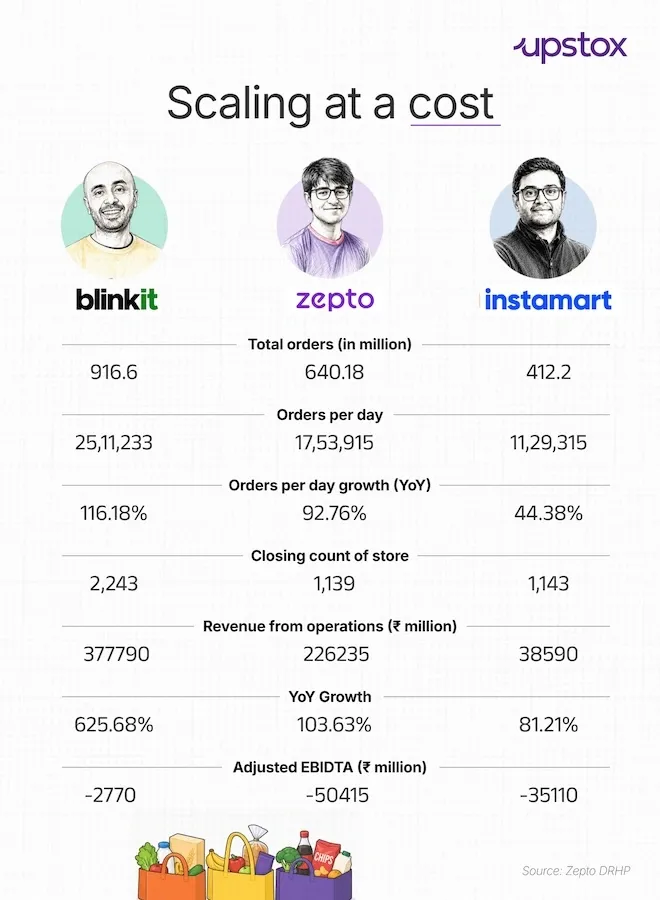
It’s not about superior technology or automation—that’s almost a given in this business for all three. The bigger differentiator actually lies in the ownership structure.
Blinkit operates as a standalone app and secured its status as an Indian-owned and controlled company (IOCC) in May 2025.
A quick detour here: Being an IOCC is lucrative because under India's FDI rules, only companies with greater domestic ownership are allowed to own the inventory instead of just acting as a ‘marketplace’. That can translate into tighter control over supply chains, better margins and greater operational flexibility. It also allows them to recognise the full value of products sold as revenue. In contrast, in a marketplace model, only take rate (i.e. percentage of revenue retained out of total transaction value) is considered.
This is reflected in the 412% increase in Blinkit’s revenue in Q2FY26 over Q1, as it transitioned to an inventory-led model. In the subsequent quarters, it also became the only major quick-commerce player to report a positive adjusted EBITDA per order.
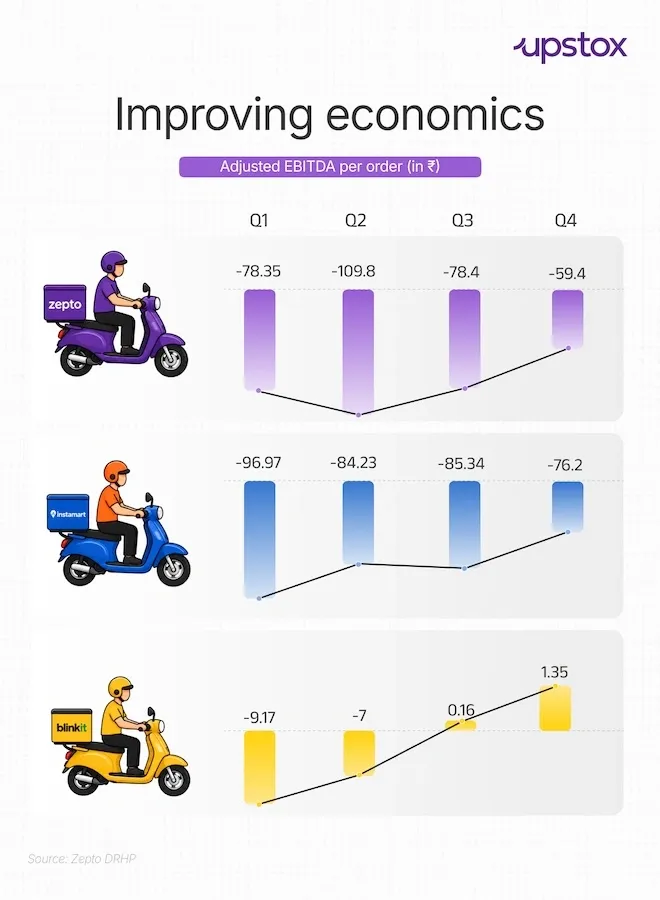
Meanwhile, Instamart benefits from sitting inside the Swiggy ecosystem as this gives it both ready traffic and cross-sell potential. More importantly, the company has reduced foreign ownership below 50% and is working hard towards becoming an IOCC.
Zepto's position is more nuanced. Backed largely by global venture capital, it is classified as a foreign-owned and controlled company (FOCC). To comply with India's regulations, it has built a multi-entity structure. Zepto Marketplace facilitates transactions between vendors and customers, Zepto Limited runs the technology platform and app, while Kiranakart Wholesale sources products from brands and supplies them to retailers and distributors.
In effect, it has created a way to exercise greater control over its supply chain without operating as a conventional inventory-led retailer.
While that structure is clever, it also reflects the constraints of the regulatory environment. Zepto itself flags the risk of evolving FEMA and e-commerce rules in its DRHP. And in an industry where margins are already razor-thin, who owns the business could end up being just as important as how fast it delivers.
The bet on everyday shopping
Clever structuring aside, one of Zepto’s key differentiators is its EDLP, or everyday-low-price, approach. Instead of occasional discounts, it aims to keep prices consistently attractive enough for consumers, à la value-led retailers like DMart. Put simply, Zepto isn't trying to maximise what you spend every time you open the app. It's trying to become the default place you shop from.
That explains why Zepto’s average order value (AOV) is lower than its peers’. Its net AOV is about ₹357, compared with roughly ₹530 for Blinkit and ₹490 for Instamart. And if lower prices encourage consumers to place four or five orders a week instead of one stock-up purchase, the platform benefits from greater engagement and stronger retention.
This connects to "densification", a fancy industry term that just means getting more people in the same neighbourhood to order more often. As order flow increases, fixed costs such as rent, staff and delivery infrastructure are spread across a larger number of transactions. That lowers the cost of fulfilling each order and gradually improves profitability.
Zepto’s strategy isn't without risk. Customers need to keep coming back often enough for the economics to work. But if that happens, every additional order strengthens the network rather than simply adding revenue.
Diversifying revenue streams
To get to profitability, these companies are gradually moving from logistics businesses to becoming a broader retail platform.
One of the biggest opportunities is advertising. Brands want to be visible where purchase intent is high, making quick commerce apps a valuable channel. A Datum Intelligence estimate suggests Blinkit, Zepto and Instamart together could generate nearly ₹4,900 crore in advertising revenue in the current calendar year.
For Zepto, advertising constituted 8% of its Net Receivables Value (NRV) in FY26, making it one of the company's fastest-growing revenue streams. Blinkit and Instamart are also pushing hard on this front, because ad revenue can improve economics without requiring consumers to pay dramatically more for convenience.
Private labels too are being amped up. Alongside third-party brands, these players have started selling their own brands, as it offers better margins and greater control over pricing. Instamart has been relatively more active here with its flagship brand, Noice, targeting high-impulse categories like gourmet snacks, dairy, and beverages. Blinkit has built out a staples and home-care portfolio, and Zepto is building brands such as Daily Good, Bay6 and Jai Kashi. Zepto Café also allows consumers to order fresh food and beverages. Though still nascent, these brands point in the same direction: a pivot from pure delivery toward higher-value retail economics.
At an inflection point
Just as the early leaders were finding firmer ground, the competitive landscape started widening again.
The original Davids–Blinkit, Zepto and Instamart–created the market and changed the way millions of Indians shop. Now they are up against Goliaths with deeper pockets, larger ecosystems, and the ability to stay in the fight for years.
In June this year, Amazon said it will expand Amazon Now to over 300 cities in India. Flipkart is also looking for a share of this market with Flipkart Minutes. Their existing logistics infrastructure, seller relationships, customer data, and strong balance sheet makes them formidable challengers.
Note that since both Amazon and Flipkart are foreign-owned e-commerce players, they will operate as marketplace models.
Which brings us to perhaps the industry's most interesting wildcard: Reliance Industries-owned JioMart. Unlike pure-play quick-commerce companies, JioMart can combine its vast offline retail network with online ordering and hyperlocal fulfillment. It has already converted and activated 3,100 physical stores into hyperlocal fulfillment hubs and in Q4FY26, its hyperlocal orders grew 300% year-on-year. As in telecom, here too, Jio’s pricing power and aggressive growth strategy, could become a serious disruptor.
It is important to reiterate that India’s quick commerce industry has significant room to grow, for everyone. Just that the yardsticks to measure success are no longer limited to the number of dark stores opened or delivery times.
Investors will look keenly at other metrics such as loss per order, dark-store utilisation, and pace of expansion relative to capital consumption. As business-models evolve, the real test will be whether India's quick-commerce companies can create lasting shareholder value alongside consumer convenience.
About The Author
Next Story

