
Upstox Originals
Will hosting the FIFA World Cup pay off for the US economy?

7 min read | Updated on July 13, 2026, 15:57 IST


SUMMARY
Hosting the World Cup sounds like an economic jackpot: millions of fans, booming businesses, billions of dollars sloshing through the economy. So why do so many host nations end up nursing a financial hangover once the trophy's been lifted? And if FIFA walks away with the biggest slice of the pie, what's actually left on the table for the United States?

The FIFA 2026 World Cup is projected to add $40.9 billion to global GDP and support 824,000 temporary jobs. | Image: Shutterstock
We've all been glued to our screens these past few weeks. Was that a penalty? Who's lifting the trophy? But here's a question nobody asks between matches: what does hosting a World Cup actually do for an economy?
The headline numbers are dazzling. The 2026 FIFA World Cup; co-hosted by the US, Canada and Mexico from June 11 to July 19, is projected to add $40.9 billion to global GDP and support 824,000 jobs, according to a joint FIFA-World Trade Organization study.
This edition is also the biggest the sport has ever seen: 48 teams (up from 32), 104 matches, and 78 of them played across 11 US cities. Since America is where most of the economic buzz has been building for the past year, that's where we're pointing the lens.
Strip out Canada and Mexico, and the US alone is expected to pocket $17.15 billion in economic contribution and 185,000 temporary jobs. Sounds massive; until you set it against a $31.9 trillion economy. Do the maths, and the World Cup's entire contribution works out to roughly 0.05% of US GDP.
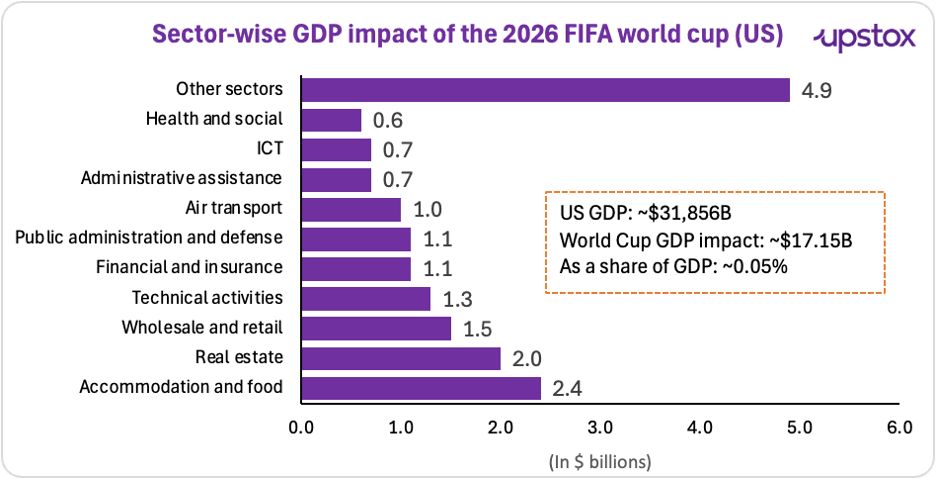
Source: FIFA
So is this a big deal or a rounding error? A bit of both, actually. Here's the case for why it could still work in America's favour.
The US barely had to lift a finger (or a crane)
Every previous World Cup has come with the same warning label: new stadiums, new roads, sometimes entire cities conjured from scratch. Qatar spent over $220 billion turning the desert into a football-ready nation. Brazil spent $15 billion. Germany, $4.3 billion.
America's advantage? It already had the infrastructure sitting there; a ready-made network of NFL and MLS stadiums that just needed a facelift, not a foundation.
The total bill: $2.7 billion. Of that, only $0.9 billion went towards actual capital investment; turf upgrades, facility touch-ups; while $1.8 billion covered the running costs of hosting: transport, security, keeping the whole operation from falling apart. Compare that $2.7 billion to Qatar's $220 billion, and the US isn't just cheaper; it's playing an entirely different game.
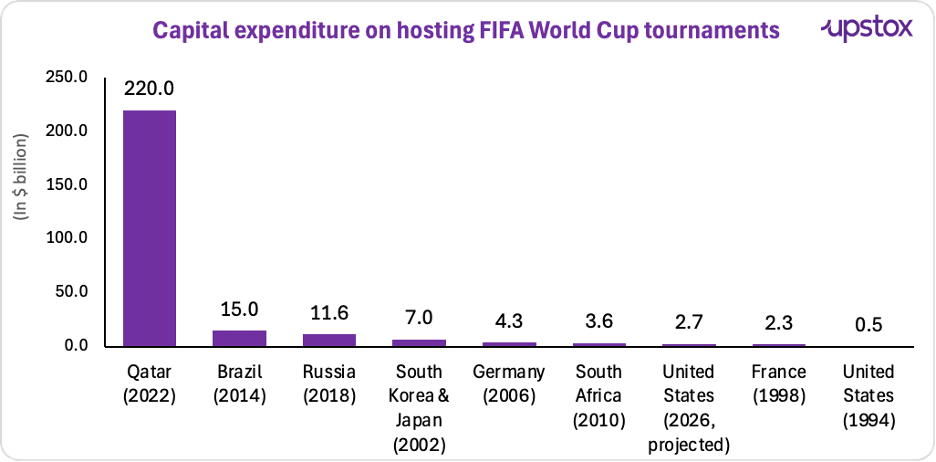
Source: Statista Note: Values are not adjusted for inflation.
And that low spend matters, because history shows most hosts end up spending more than they earn. Independent research tracking costs against revenue across World Cups since 1966 finds host after host limping away with only marginal surpluses; or outright deficits running into the billions. Low capex isn't just thrifty. It's the difference between breaking even and quietly footing someone else's party.
As the chart below shows, hosting the FIFA World Cup has often meant spending more than earning. Several host countries ended up with only marginal surpluses, or sizeable deficits.
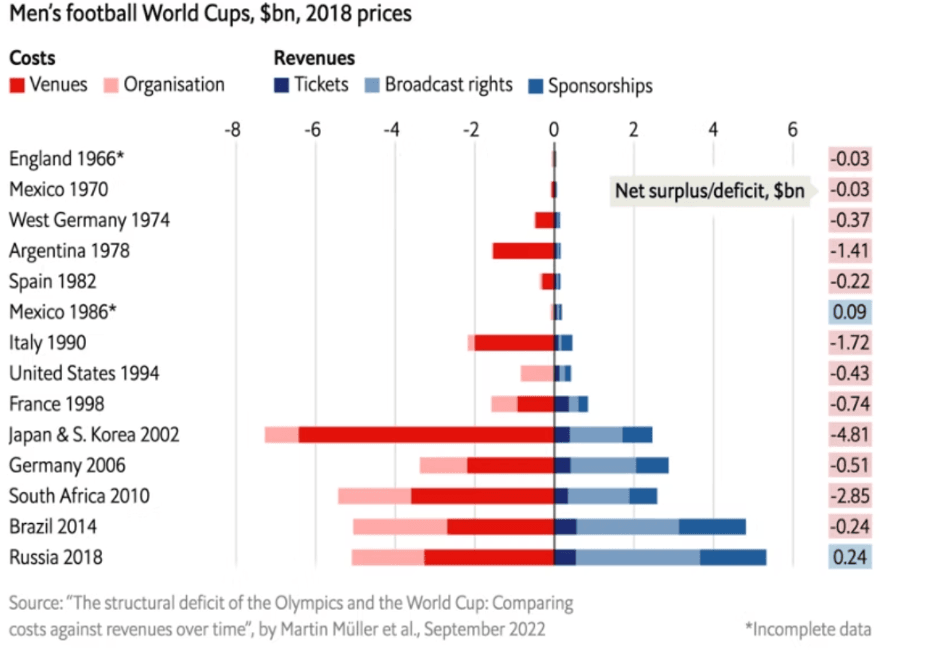
Note: Qatar is not included in the chart due to limited data availability.
Fans are actually opening their wallets
Numbers on a spreadsheet are one thing. Real spending on the ground is another; and this is where the tournament is already delivering.
According to the Bank of America Institute, consumer spending across host cities jumped 5.4% YoY during the group stage (June 10–28, 2026). Strip that down further, and spending by non-local visitors; the tourists, the away fans, the people flying in just for this, leapt 17.4%. That's the real tell: it's not locals shuffling money around, it's fresh money entering these cities.
Seattle and Los Angeles, riding the Team USA wave, saw spending rise 5.0% and 6.8%, respectively.
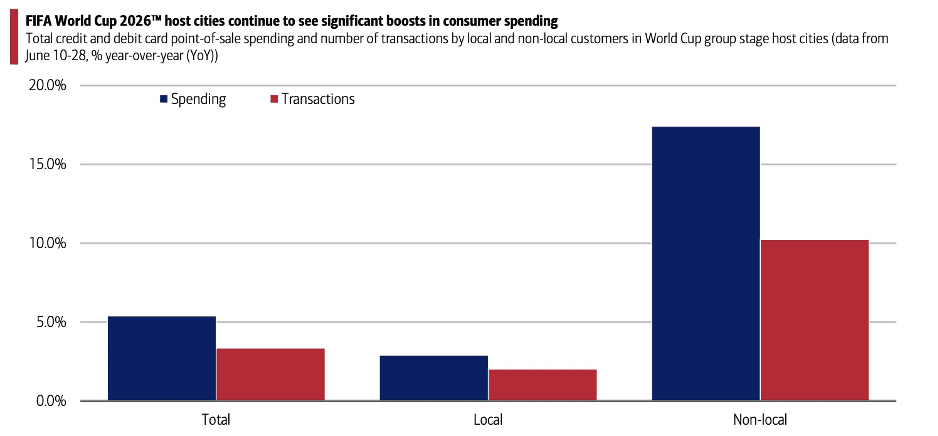
Source: Bank of America Note: Across all 16 World Cup host cities (US, Canada, Mexico), 11 of which are in the United States
The taxman never misses a match
Every hotel booking, every overpriced stadium hot dog, every Uber to the venue; it all funnels back into public coffers. FIFA estimates North America will generate $9.4 billion in tax revenue from this tournament, with $3.4 billion of that landing in US treasuries alone.
Stadiums get paid to show up
One of the few genuinely direct paydays for host cities: FIFA pays rent to use the venues. Houston's host committee has pointed to the fees FIFA pays for NRG Stadium as a real, tangible line of revenue — money that wouldn't exist without the tournament.
This isn't a monthly occurrence
A World Cup lasts a little over a month. The chance to host one doesn't come around again for 30 to 40 years. The last time the US hosted, back in 1994, it left behind something no spreadsheet fully captures: Major League Soccer, launched in 1996, which gave football in America a permanent home it never had before. Legacy doesn't show up in a GDP forecast, but it compounds long after the final whistle.
So who actually keeps the money?
Here's the catch nobody puts on the tourism brochure: hosting doesn't mean owning the revenue. FIFA runs the show, and FIFA keeps the crown jewels. In 2026, the organisation expects to pull in roughly $8.9 billion — and the breakdown is telling:
| Revenue Source | Share of Revenue | Projected Revenue ($ million) |
|---|---|---|
| Television broadcasting rights | 44% | 3,925 |
| Hospitality rights & ticket sales | 34% | 3,017 |
| Marketing rights | 20% | 1,786 |
| Licensing rights | 1% | 111 |
| Other revenue & income | 1% | 72 |
Source: FIFA
Ticket sales alone are getting a serious upgrade this year. For the first time ever, FIFA has introduced dynamic pricing; tickets that behave like airline seats, climbing in price as demand climbs with them.
The results are already eye-watering. A hospitality package for the New York/New Jersey venue can run as high as $73,200. The priciest ticket for the July 19 final at MetLife Stadium was listed around $71,373. Even the cheapest general admission seat starts near $10,000 — roughly ten times what fans paid for the cheapest Qatar 2022 final ticket.
Put another way: that "cheap" final ticket costs about 1.77 months of the average New York mortgage payment, or 1.49 months of the average city rent.
How do other events stack up?
The world cup definitely stacks up; the multi-city sprawl, the month-long runtime, the truly global audience. It's less a sporting event and more a travelling economic ecosystem.
| Tournament / Event (Host Country) | Host Country Net Economic Impact |
|---|---|
| Paris 2024 Olympic Games (France) | $9.7 billion |
| ICC Cricket World Cup 2023 (India) | $1.39 billion |
| Rugby World Cup 2023 (France) | $0.95 billion |
| F1 Las Vegas Grand Prix 2024 (United States) | $0.55 billion |
Source: News articles
The final whistle
Hosting the World Cup isn't the guaranteed jackpot the highlight reels make it look like; but it isn't a bad deal either. FIFA takes the lion's share of the glamorous revenue, but the US still walks away with real tourism dollars, real tax receipts, and infrastructure it already owned rather than debt it had to build.
Maybe that's the real scoreboard here: not how much money flows through during the tournament, but what's still standing; and still paying dividends; long after the final whistle blows.
About The Author
Next Story

