
Upstox Originals
Performance up, stock down: What Tesla teaches investors

7 min read | Updated on July 24, 2026, 18:16 IST


SUMMARY
For most companies, beating sales expectations is enough to send the stock higher. Not Tesla. Despite reporting its best-ever second-quarter deliveries and comfortably beating Wall Street's expectations, the EV giant's shares continued to fall. Is Tesla's stock now being driven less by vehicle sales and more by concerns over its valuation and AI spending?
Tesla’s stock price has corrected over 10%. | Image: Shutterstock
Tesla's stock has had a rough ride in 2026. As of July 20, 2026, Tesla shares were down about 13.5% since the start of the year, significantly underperforming the broader market. During the same period, the S&P 500 gained roughly 9%, highlighting how investors have become increasingly cautious about the electric vehicle maker.
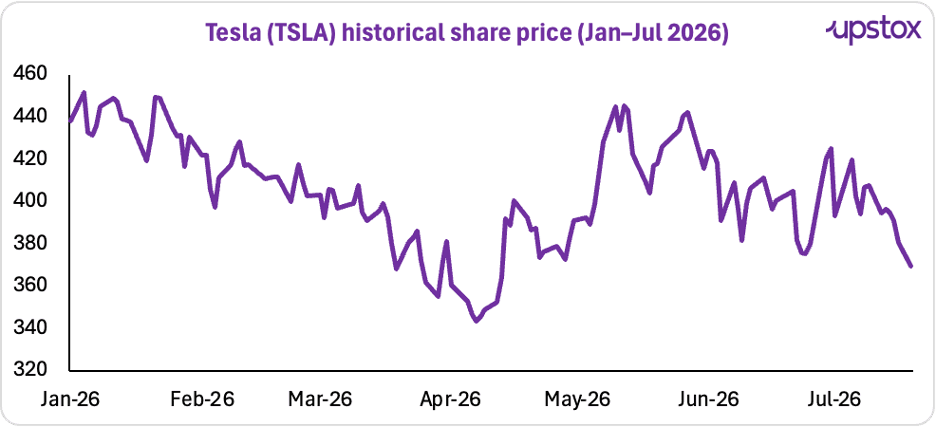
Source: Investing.in; As of Jul 20, 2026
What's surprising, however, is that this decline hasn't come because Tesla’s car sales have dipped. In fact, quite the opposite happened.
Tesla's second-quarter vehicle deliveries came in at around 480,126 units, marking one of the company's strongest operational quarters. Deliveries were about 25% higher than the same period last year and exceeded Wall Street's consensus estimate of just over 400,000 vehicles by roughly 18%–20%.
Normally, such a delivery beat would have sent the stock soaring. Instead, Tesla shares fell nearly 7–8% on July 2, recording their worst single-day decline in almost a year.
Are strong deliveries enough to justify Tesla's valuation?
At first glance, Tesla's operating performance doesn't look like that of a company whose stock has been under pressure.
Vehicle deliveries have steadily improved over the last few quarters, while analysts also expect revenue and earnings to remain resilient during the second quarter.
| Metric | Q2 2025 | Q1 2026 | Q2 2026 |
|---|---|---|---|
| Vehicle deliveries | 384,122 | 358,023 | 480,126 |
| Total revenue | $22.50B | $22.39B | $28.24B |
| GAAP gross margin | 17.20% | 21.10% | 16.80% |
| Operating margin | 4.10% | 4.20% | 1.40% |
| Non-GAAP EPS | $0.40 | $0.41 | $0.33 |
| Free cash flow | $146M | $1.44B | -$1.09B |
Source: Tesla
Looking at these numbers in isolation, it's difficult to argue that Tesla is facing a demand problem. Deliveries are climbing.
But, almost every profitability measure moved the other way.
Gross margin didn't merely slip from the previous quarter's 21.1%; at 16.8% it fell below where it stood a year ago. Operating income dropped 57% year-on-year to just $398 million, pushing operating margin down to 1.4% from 4.1%. Tesla sold a record number of vehicles and earned very little from doing so.
Free cash flow turned negative for the first time in two years, at –$1.09 billion, as capital expenditure jumped 142% to $5.79 billion.
So, why are investors still selling Tesla?
AI ambition becoming too expensive?
Over the last two years, Tesla's investment story has shifted dramatically. The company is no longer pitching itself as just an electric vehicle manufacturer. Instead, Elon Musk has repeatedly described Tesla as an AI company whose future depends on products such as Robotaxis, Optimus humanoid robots, custom AI chips, and large-scale autonomous computing infrastructure.
Building that future, however, requires enormous amounts of capital. Tesla now expects its 2026 capital expenditure (CapEx) to exceed $25 billion, almost three times higher than the roughly $9 billion spent in 2025.
As the chart below illustrates, Tesla's AI-led investment spree has pushed capital spending sharply higher while free cash flow has deteriorated.
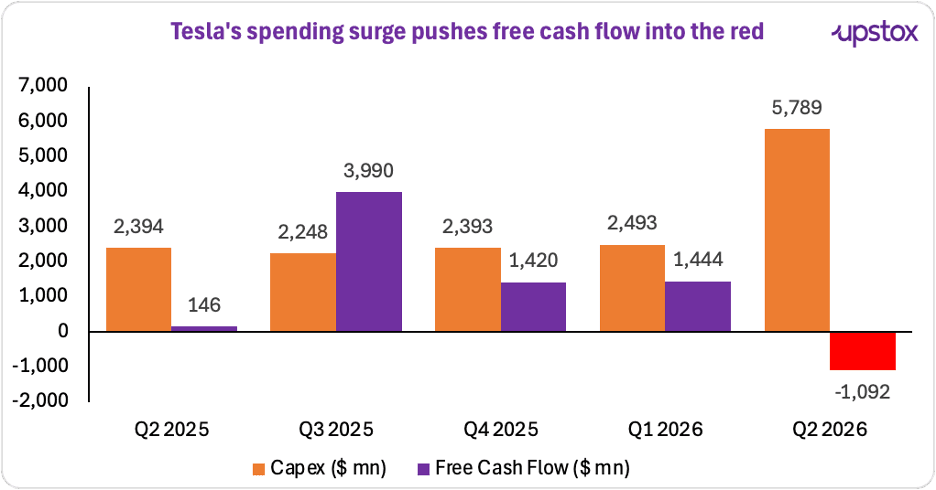
Source: Tesla
Are higher deliveries coming at the cost of lower profitability?
Strong deliveries don't always translate into stronger earnings. While Tesla delivered a record 480,126 vehicles in the second quarter, analysts believe those volumes came at a significant financial cost.
Adjusted earnings per share came in at $0.33, well short of the roughly $0.54 the market had been expecting.
Why the downgrade? A combination of macroeconomic and industry-specific factors has made selling EVs significantly more expensive.
The biggest blow came after the $7,500 US federal EV tax credit expired in late 2025. Without that incentive, Tesla had to work harder to keep demand intact. At the same time, high interest rates made auto financing more expensive for consumers, while rising prices of key raw materials such as lithium and copper continued to inflate manufacturing costs.
To maintain delivery momentum, Tesla leaned heavily on zero-interest and ultra-low-interest financing offers, alongside other promotional incentives to clear inventory. The strategy worked from a volume perspective; deliveries comfortably beat expectations; but it also diluted automotive margins.
Is competition becoming too intense?
Tesla may still be one of the world's most recognisable EV brands, but the competitive landscape is changing rapidly.
The biggest challenge continues to come from China. During the second quarter, BYD delivered 557,090 battery-electric vehicles (BEVs), comfortably ahead of Tesla's 480,126 units, further widening its lead as the world's largest pure EV manufacturer. Competition isn't limited to China either.
Across Europe, established automakers continue expanding their electric vehicle line-ups, while lower-cost Chinese manufacturers are steadily increasing their market share.
In North America, Tesla faces a fresh challenge from Rivian's upcoming R2 platform, which directly targets the Model Y; the company's best-selling vehicle.
Has Tesla's AI premium become too expensive?
Perhaps the biggest reason behind Tesla's recent weakness isn't operational performance.
It's valuation. Even after this year's decline, Tesla trades at roughly 310x trailing earnings and close to 180x forward earnings (as of July 22, 2026), a multiple that stays extreme even after crediting the company for the earnings growth analysts expect. Such lofty valuations leave virtually no room for execution delays.
Investors are no longer valuing Tesla purely on the basis of vehicle sales. A large portion of its market capitalization now reflects expectations around Robotaxis, Optimus humanoid robots, AI software, and autonomous mobility.
The problem is that these businesses are still in their early stages. Prediction markets currently assign only around a 16% probability that Optimus will achieve meaningful commercial scale this year. Similarly, the probability of fully unsupervised Robotaxi deployments across key markets such as California stands at roughly 19%.
That creates a sizeable gap between what investors are paying for today and what Tesla is realistically expected to deliver over the next few quarters. For a company trading at such elevated multiples, even small execution delays can have an outsized impact on the stock price.
What could drive Tesla's stock in the coming quarters?
Despite the recent weakness, Tesla's outlook remains far from one-sided. The balance sheet still offers a cushion. Cash and investments stood at $43.52 billion at the end of June, down only $1.2 billion over the quarter, and the company retains access to substantial debt capacity to fund its investment programme.
One of the unexpected tailwinds during the second quarter came from energy markets. Geopolitical tensions in the Middle East pushed gasoline prices higher beginning in February, making electric vehicles relatively more attractive and likely supporting Tesla's delivery momentum during the quarter.
However, that advantage may prove temporary. With the ongoing ceasefire between the United States and Iran, fuel prices have started easing again, reducing one of the short-term catalysts that may have encouraged consumers to switch to EVs.
Going forward, investors are likely to focus less on quarterly delivery numbers and more on a different set of questions.
Can Tesla stabilise automotive margins despite rising competition and the loss of regulatory credit revenue?
Will its $25 billion-plus AI investment programme begin generating meaningful returns; and will it stop at $25 billion?
Can Robotaxi deployments move beyond pilot programmes? Will Optimus evolve into a commercially viable business? And perhaps most importantly, can Tesla return to generating healthy positive free cash flow while continuing to invest aggressively in artificial intelligence?
For investors, these factors could prove just as important as Tesla's ability to maintain strong vehicle deliveries.
About The Author
Next Story

