
Upstox Originals
US markets at all-time highs: Is the party about to end?

6 min read | Updated on April 22, 2026, 15:36 IST


SUMMARY
America's stock market is at an all-time high, but three warning signs suggest the rally may be running on borrowed time. Investor sentiment has turned sharply bearish, US consumer confidence has hit an all-time low, and stock valuations are stretched well beyond historical norms. For India, a potential US market correction could redirect global capital toward India, turning someone else's anxiety into a genuine opportunity.

The S&P 500 has returned 16.3% for the year ending March 2026. | Image source: Shutterstock
Imagine a packed stadium. The music is playing. The crowd is cheering. But quietly, one by one, people are starting to leave. Nobody's panicking yet. The exits aren't jammed. The show still looks great from the outside.
That is more or less what is happening inside the US stock market right now.
The S&P 500 is at a lifetime high. Yet underneath the surface, the cracks are quietly spreading. Three independent signals — investor sentiment, consumer confidence, and stock valuations — are all flashing warning signs at the same time.
But here is the twist: if Wall Street sneezes, Dalal Street might not necessarily catch a cold. In fact, Indian investors could stand to benefit. More on that towards the end.
So, what is the data actually saying?
US markets near all-time high
To set the stage, let us look at where the US stands. Their equity markets (S&P 500 — one of the major benchmarks index for American stocks) have been one of the best performing markets globally.
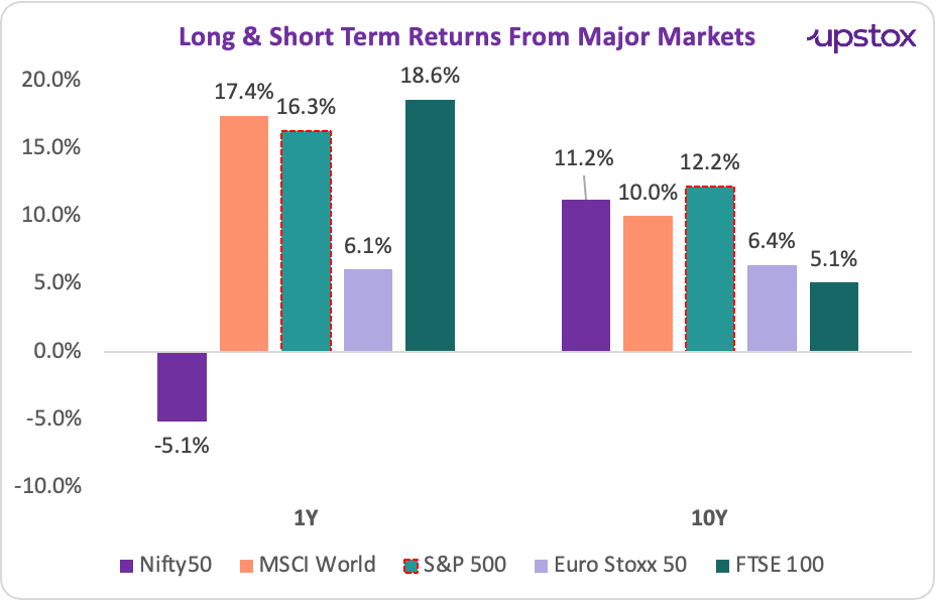
Source: NSE’s April 2026 issue of Market Pulse; *Note: returns till March 2026
Despite all the uncertainty since the start of Trump’s second term, the S&P 500 has continued to make new highs and is currently at its lifetime high.
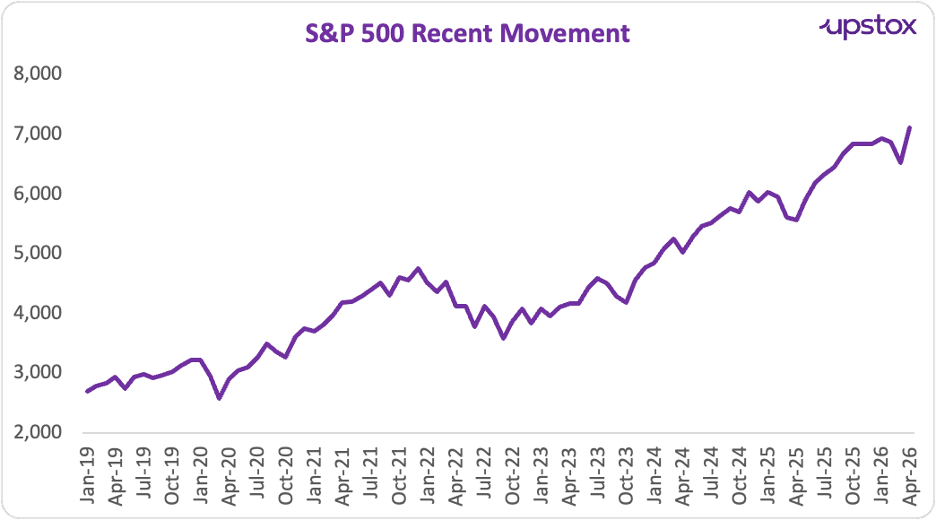
Source: Investing.com; *Data till 21 April 2026
On the surface, things look great. America’s war with Iran is now winding down, so ideally things should look upbeat. But, some underlying data points seem to suggest that underneath all this, some trouble is brewing.
So, what is going on?
Investor sentiment is poor
Investor sentiment in the US markets has been turning increasingly bearish. The American Association of Individual Investors (AAII) conducts a weekly survey asking ordinary investors a simple question: Are you bullish, neutral, or bearish about the stock market over the next six months? Data show bearish sentiment among investors is rising with an average ~45% investors are now bearish.
Unlike India, where equity participation is in single digits, the US has an equity participation of around 60%. As such, if retail investor sentiment sours, it can have a serious impact on the equity market. An analysis of the past 10 years shows a strong inverse correlation between the bearish investor sentiment and market returns. As bearishness rises, returns from the S&P 500 tend to fall.
Currently, this has not fructified with markets still making highs despite the increasingly bearish mood. Although the sentiment has soured, the market hasn't followed — yet. That gap rarely lasts forever.
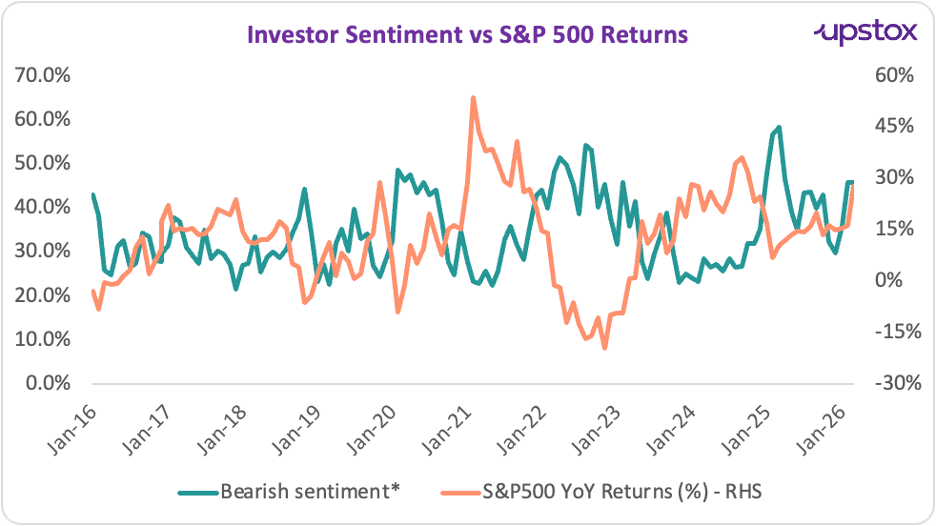
Source: American Association of Individual Investors; *Note - Average bearish sentiment for the month
Consumer confidence at an all-time low
Investor sentiment is just one thing - but underlying consumption data also shows a similar trend. Consumer confidence data published by the University of Michigan shows that US consumer confidence is at an all-time low (as seen in the chart below). The last time it reached this level in 2022, market returns saw a steep fall.
The logic is simple. A consumer who feels insecure about his job, savings, or future does not buy a new car, renovate the kitchen, or take a vacation. Over time, this should translate into weaker earnings, which could push down stock prices.
The stock market, right now, seems to be betting that this low confidence is temporary — that consumers will bounce back. That is possible. But it is a large, risky bet.
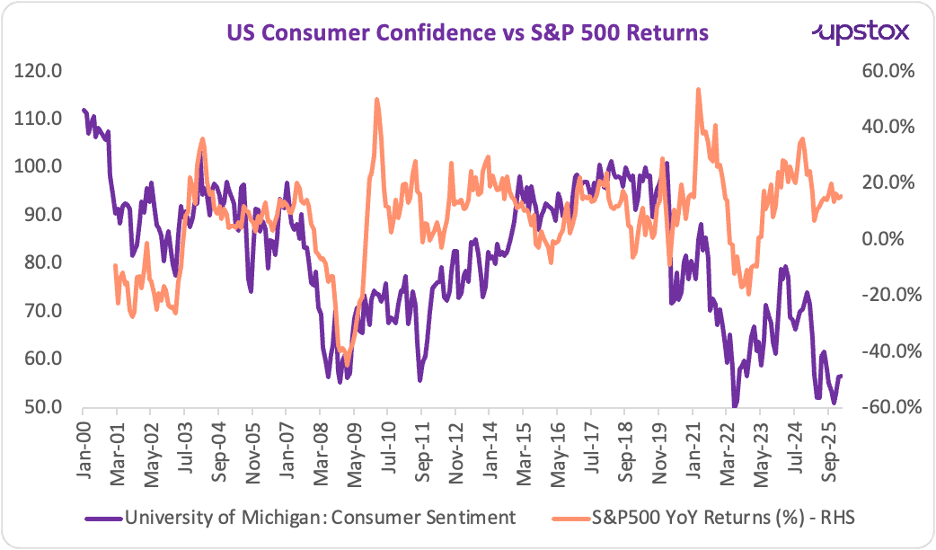
Source: Federal Reserve Bank of St. Louis; *Data till Feb 2026 (latest available)
Finally, let’s look at valuations. In my articles, I had highlighted how valuations of the S&P 500 have been consistently rising versus the peer nations. In the table below, a look at the valuations of S&P 500 versus its own past shows that it is currently elevated.
S&P 500 valuation measures
| Valuation measure | Latest | 30-Y Average |
|---|---|---|
| Forward P/E | 22.0x | 17.1x |
| Dividend Yield | 1.4% | 2.0% |
| Earnings Spread** | -0.5% | 0.7% |
Source: JPMorgan Estimates; *Data as of January 2026 (latest available)
-
Forward P/E of 22x vs. average of 17x: This means investors are paying 29% more than the historical average. Markets are basically trading at a premium.
-
Dividend yield of 1.4% vs. average of 2.0%: A lower yield means investors are paying more and receiving less in return.
-
Earnings spread of -0.5% vs. average of +0.7%: This is perhaps the most important signal of all. The earnings spread compares the earnings yield of stocks against the yield on safe government bonds. It is essentially the question: am I being compensated enough to take on the risk of stocks versus the safety of bonds? Right now, the answer is no. When stocks offer lower returns than bonds, history suggests smart money starts quietly moving away from equities.
Why does this matter?
Conventional wisdom says if the US market crashes, global markets fall too. And historically, that has often been true. But, here we are talking about corrections and not crashes.
For Indian investors, the last couple of years have been a study in patience. Indian markets have not just underperformed compared to global peers. And in the previous year, not only have they underperformed peers, they have also delivered negative returns
Global investors manage large pools of capital. When they grow nervous about one market, they do not just go to cash — they rotate into markets that look relatively more attractive. And right now, India ticks several of those boxes.
To be clear, it’s not a given that any money flowing out of the US has to come to India, but as US concentration declines, India could definitely be a beneficiary.
Before you go.
Markets can stay irrational — and expensive — for longer than anyone expects. Thus, it is very difficult to say when the markets turn and that is not even the point of this article. The idea is to be on the lookout. When markets react to underlying factors, investors should be ready to take the necessary action to protect their portfolio. Three independent signals are all saying the same thing at the same time.
About The Author
Next Story

