
Upstox Originals
How this heatwave is weighing on the Indian economy

6 min read | Updated on May 11, 2026, 13:45 IST


SUMMARY
India's worsening heatwaves are not just a public health concern — they are quietly eroding economic output across agriculture, construction, energy, and household budgets. With the strongest El Niño (reduced rainfall) expected, economists are expecting heatwaves may impact India’s GDP by upto 2.5% in 2026.

With the strongest El Niño expected, economists are expecting heatwaves may impact India’s GDP by upto 2.5%
India has always known summer. But the summers of recent years have crossed a threshold that meteorologists, economists, and public health experts are increasingly finding hard to ignore. As per AQI, India is home to 19 of the world's top 20 hottest cities.
More than 57% of Indian districts are now categorised as having a high to very high heat risk, exposing over 76% of the population to severe heat waves. This escalating crisis is causing significant impacts on labour productivity, health, and agriculture as per the Council on Energy, Environment and Water (CEEW) report.
Why are heatwaves an economic challenges?
The starting point is labour. Roughly 75% of India's workforce is employed in heat-exposed occupations, such as agriculture, construction, street vending, logistics, and manufacturing, among others, as per World Bank. When temperatures climb, so does the physiological cost of working outdoors, and productivity tends to fall well before workers stop altogether.
Research cited in the ClimateRISE Alliance and Dasra Insights framework suggests industrial productivity declines by around 2% for every 1°C rise in temperature. Across an economy of India's size, small percentage shifts translate into large absolute losses. Overall, the McKinsey Global Institute and World Bank projections suggest India's GDP could face a drag of up to 5.4% by 2030 if heat stress continues on its current trajectory without substantial adaptation measures.
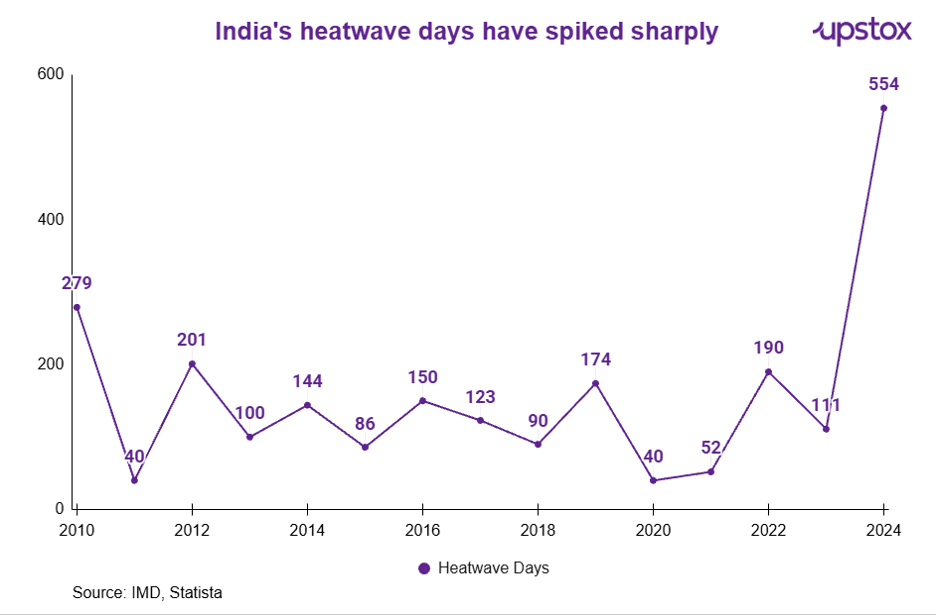
Has this happened in the past? In 2024, the combined effect of prolonged heatwaves resulted in a potential income loss of $194 billion and 247 billion labour hours lost, as per Dasra Insights.
What are Indian companies saying?
Companies have also raised concerns about subdued demand and business activities. Bloomberg data cited by ET said “heat wave” appeared at least 80 times in Nifty 500 earnings calls for the June quarter, versus just 7 times a year earlier.
| Company | Sector | Heatwave impact indicated |
|---|---|---|
| VRL Logistics | Logistics | Extreme heat in North India reduced staff efficiency, delayed services, impacted tonnage growth and utilisation. |
| Larsen & Toubro | Infra/EPC | Domestic execution was subdued due to heat + elections; extreme heat reduced full-day site productivity. |
| Sula Vineyards | Wine / Tourism | Scorching heatwave hurt wine demand and wine tourism footfalls in Q1 FY25. |
| Cera Sanitaryware | Building products | Retail pickup was delayed due to elections, the extended monsoon, and the extreme heatwave. |
| Senco Gold | Jewellery retail | Some Q1 sales shifted to Q2 due to the election + heatwave impact. |
| Bata India | Footwear retail | Q1 FY25 subdued demand was linked to elections, extreme heatwaves, and fewer weddings. |
| Raymond | Apparel / Lifestyle | Lifestyle revenue weakened as a prolonged heatwave impacted retail footfalls, alongside elections and weak wedding demand. |
| VIP Industries | Luggage | Q1 FY25 demand was subdued due to lower wedding days and a severe heatwave. |
| Asian Paints | Paints | Q1 FY25 decorative demand was impacted by the heatwave and the general elections. |
| Zomato / Eternal | Food delivery | Heatwave was cited as one factor behind sequentially lower margins. |
| CreditAccess Grameen | Microfinance | Asset quality and business momentum were hit by transient factors, including elections and heatwave. |
Source: Exchange filings, media interviews, concalls, investor presentation
For FY27, El Niño risk is mainly negative for rural FMCG, tractors, agrochemicals, fertilisers and rural finance, but positive for power, ACs, cooling products and beverages. SBI Research says El Niño alone may have negligible GDP impact, but El Niño + drought could reduce GDP by around 20 bps median and up to 65 bps in an extreme case. Please note that the table below is not an exhaustive list, but rather a representation of a few companies to explain the point.
| Company | Sector | Management commentary |
|---|---|---|
| HUL | FMCG | Analyst flagged that H2 rural demand may get tested due to El Niño; management said reservoir levels and MSP/rainfall spread need to be watched. |
| Dabur India | FMCG | El Niño was discussed as a risk that could pressure rural growth in FY27. |
| Escorts Kubota | Tractors | Latest commentary indicates emerging El Niño signals remain a key monitorable for agri/tractor demand trends. |
| Mahindra & Mahindra / M&M Finance | Tractors / Rural finance | El Niño risk is relevant through tractor demand, farm cashflows and rural credit demand . |
| Rallis India | Agrochemicals | El Niño/monsoon deficit risk is relevant for crop protection demand; latest Q4 FY26 commentary discussed weather/monsoon sensitivity. |
| Tata Power, Adani Power, NTPC, IEX | Power | El Niño is actually a demand tailwind here: hotter weather and lower rainfall can lift cooling-led power demand. |
Source: Exchange filings, media interviews, concalls, investor presentation
Why this Is structural, not seasonal
It is tempting to treat each summer's heatwave as an anomaly — an unusually bad year to be filed away and forgotten. But the rising number of heatwave days over the years points towards a structural and strategic problem.
The opportunities in India’s heatwave eradication
Economic stress from heat is not uniformly negative for investors. Several themes stand to benefit from India's structural need to adapt:
-
Power and renewable energy: The push to expand generation capacity and shift toward cleaner baseload is now partly driven by climate necessity, not just energy access goals
-
Cooling and HVAC: With AC penetration in India still low by global standards, the structural demand runway is long — and accelerating
-
Water infrastructure: Heat stress increases water demand for both agriculture and urban use; companies in water treatment, irrigation, and storage are addressing a growing structural need
-
Climate-resilient agriculture: Seed technology, precision irrigation, and agritech focused on heat-tolerant crop varieties are areas where investment appetite is rising
-
Healthcare: Rising heat-linked morbidity creates demand for primary healthcare infrastructure, particularly in rural areas
In summary
India's heat problem is increasingly economic. The losses from 2024 — $194 billion in potential income, 247 billion labour hours — are not one-off events. They reflect a structural shift in operating conditions for a large and labour-intensive economy.
For investors, the picture is nuanced. Some sectors face genuine headwinds; others — power, cooling, water, agritech — are positioned to grow as India is pushed to respond. The more important question is whether the response comes fast enough to prevent the economic drag from compounding over the remainder of this decade.
About The Author
Next Story

