
Upstox Originals
The RBI’s well tested move to boost the rupee

4 min read | Updated on June 11, 2026, 18:18 IST


SUMMARY
The RBI’s recent move has transformed one of India’s most overlooked deposit products into a high-yield opportunity for NRIs. Fixed returns for NRIs have nearly doubled within a month to as much as 7%. This well-tested move offers a two-pronged solution: draw foreign currency back home and help banks with steadier deposits. Here’s how the move works, why it has succeeded before, and what it means for the rupee, for banks, and for the NRIs it is aimed at.

Fixed returns for NRIs have nearly doubled within a month to as much as 7%. | Image: Shutterstock
In the space of a month, the interest an NRI can earn on a dollar deposit in India has roughly doubled — from around 3.35% to as much as 7%. Behind this, sits a deliberate and well-tested move by the Reserve Bank of India (RBI).
The accounts in question are Foreign Currency Non-Resident, or FCNR(B), deposits—fixed deposits held in dollars, pounds, euros and other major currencies. One point matters up front: they are open only to NRIs, people of Indian origin and OCI cardholders.
A resident Indian cannot open one. For those who qualify, the appeal is real—the money stays in foreign currency, so there is no exchange-rate risk, and the interest is tax-free in India. Yet demand had dried up: inflows fell from $7.08 billion in FY25 to just $946 million in FY26. The new rates are built to turn that around.
| Bank | Earlier | New rates |
|---|---|---|
| Karur Vysya Bank | 2.63% | 7.00% |
| AU Small Finance Bank | 5.15% | 7.10% |
| HDFC Bank | 3.65% | 6.00% |
Source: Bank disclosures
What is going on?
So how can a bank pay 6–7% on a dollar deposit? The clever part lies in a single RBI decision. Normally, a bank that takes dollars but lends in rupees must pay to protect itself against the rupee weakening—a hedging cost of around 3.5% a year that quietly eats into what it can offer.
Until September 30, the RBI is bearing that cost. It has also freed these deposits from the CRR and SLR rules that usually lock away part of every deposit. With the hedging cost covered and the full sum available to lend, a bank can pay the depositor well, lend the rupees at home and keep a comfortable margin.
There is a second reason banks are leaning in. For much of the past three years, lending has outpaced deposits, leaving the system stretched. The all-important credit-deposit ratio touched a record 83% in March, above the 80% mark generally considered comfortable.
Against that backdrop, FCNR money is doubly welcome. At the bullish end, $40–45 billion is ~₹4 lakh crore—a little over 1.5% of the system’s ₹250 lakh crore deposit base—and, being exempt from CRR and SLR, every rupee of it can be put to work. It is stable, three-to-five-year money rather than flighty savings.
The INR Impact
FCNR dollars are a dependable way to top up the reserves. The forecasts are bullish. SBI Research expects inflows worth $40–45 billion through this route, while Barclays projects $25–30 billion. Even the lowest estimate would dwarf last year’s trickle.
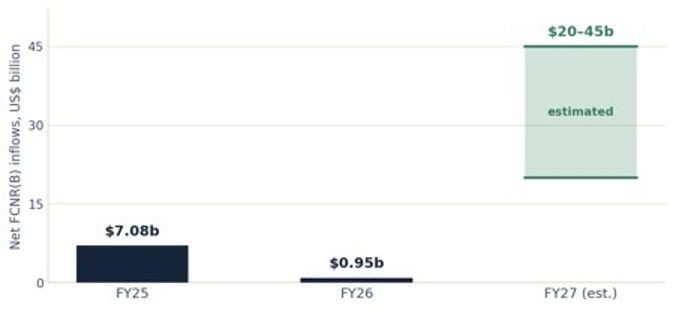
Source: RBI data, brokerage reports and news articles
A proven playbook?
The Indian central bank reached for the same tool in 2013, when the US Federal Reserve’s “taper tantrum” battered emerging-market currencies and the rupee hit a then-record low. The RBI opened a concessional swap window for FCNR(B) deposits.
Basically, the RBI stepped in to absorb the currency risk on dollars that banks raised from NRIs, which let them offer much higher rates. It pulled in between $26–$34 billion and helped steady the currency.
When those deposits matured three years later, banks repaid more than 90% of them without disrupting the currency market. This is a strategy with a strong track record, not an untested gamble.
Is it really attractive?
It helps to see the offer through an NRI’s eyes. Bank deposits across the developed world still pay reasonably after the rate rises of recent years, yet India’s new dollar rates sit above them all.
| Market (Currency) | 1 year FD rates |
|---|---|
| United States (USD) | ~4.1% |
| United Kingdom (GBP) | ~4.8% |
| Eurozone (EUR) | ~2.0% |
| India — FCNR(B), US dollar | 6.0–7.1% |
Sources: US Federal Reserve, Bank of England, Moneyfacts, ECB, and news articles
Before you go
For NRIs, this is a genuinely attractive window: a safe, foreign-currency deposit offering a meaningful return, with a one-year lock-in. It is worth remembering that global interest rates are higher than they were in 2013, so the premium over other dollar options—while real—is slimmer than the 7% headline suggests.
For Indian banks, it is a welcome, low-cost source of funding that should support margins over the coming quarters. And for the rupee, it offers solid reinforcement at a useful moment, even if the longer-term task of attracting durable foreign investment remains.
About The Author
Next Story

