
Upstox Originals
How TBO Tek and RateGain are powering your travel behind the scenes

7 min read | Updated on October 29, 2026, 15:46 IST

SUMMARY
Booking a trip, whether through an online agency or a local agent, has never been easier. Behind the scenes, a hidden ecosystem is hard at work. TBO Tek links suppliers to agents across continents; RateGain helps hotels and airlines price and market their inventory smartly. Their shared bet: as travel turns more global and AI-led, the infrastructure behind a booking will matter as much as the app.
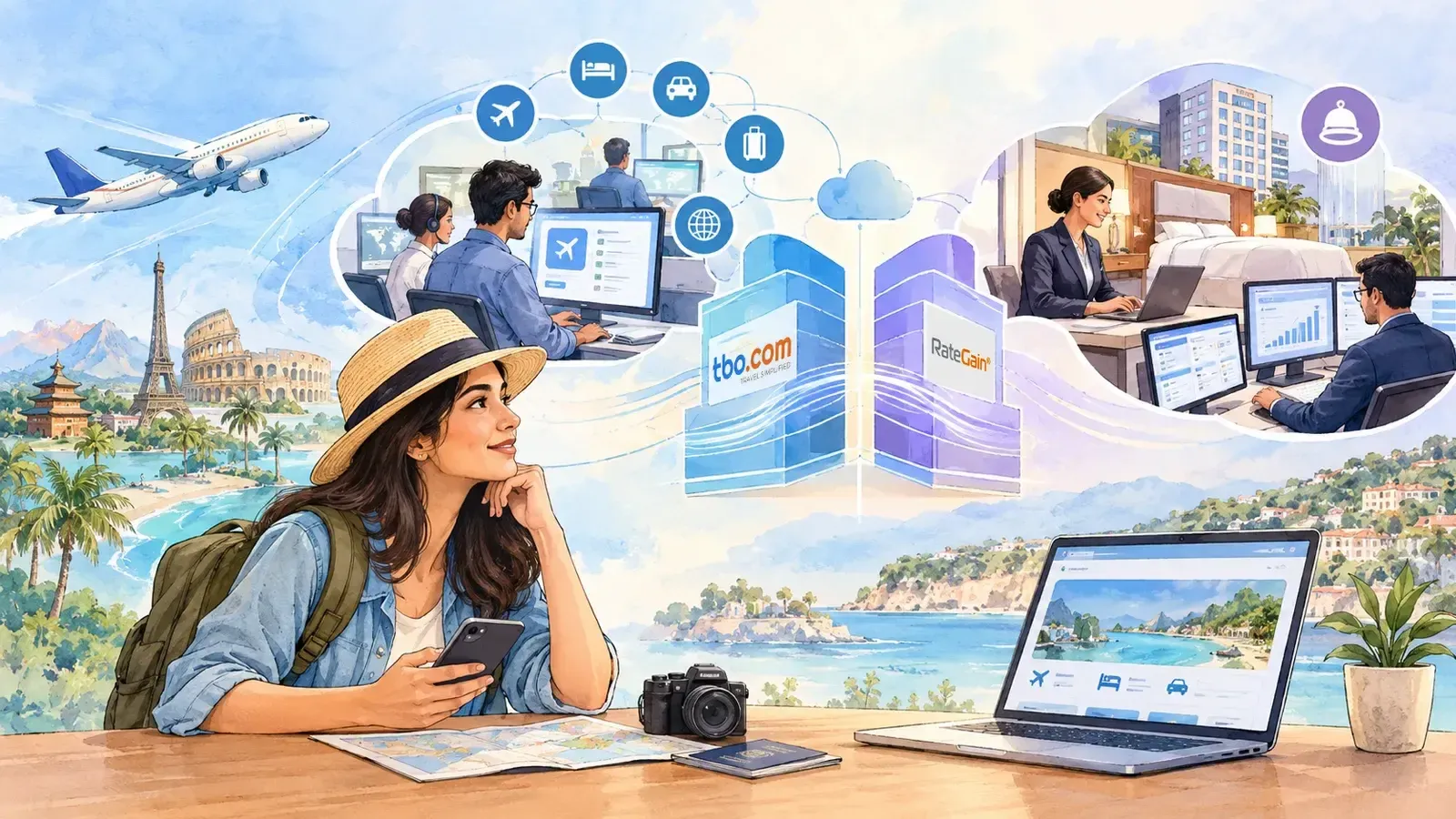
TBO Tek platform provides access to over 1 million hotels and 750 airlines across ~150 countries.
It’s fair to say that the modern traveller is spoilt for choice. With just a few taps, you can get a plethora of flight and stay options for pretty much anywhere in the country or the world – from Kashmir to Kanyakumari or Munich to Melbourne! You could also outsource the work to a travel agent and get a detailed itinerary in no time.
Either way, the front-end experience feels pretty seamless. But behind-the-scenes, there is a complex ecosystem at work. For any ‘search’ entered, someone has to pull up all the hotel and flight information, then confirm the flight seats in real time, check which hotel rooms are free across time zones, pick a competitive room rate, and nudge you with the right ads to complete the booking.
Each of these requires a solid, tech-backed solution. And two Indian companies, TBO Tek and RateGain Travel Technologies, have built their businesses around precisely this opportunity.
Their business models differ, but their underlying bet is similar: As travel becomes more global, experience-led, and AI-influenced, the infrastructure behind a booking would be just as important as the app or agent through which it is made. They aim to turn that growing dependence into a competitive advantage.
Connecting a fragmented travel market
Think of how an independent travel agent would put together a multi-country holiday. The customer needs flights, hotels, airport transfers, well-crafted itinerary and related bookings. But the agent is unlikely to have the bargaining power or network, making it cumbersome and costly for him to approach and strike deals with every supplier individually.
The challenge is similar on the supplier’s side. An independent hotel in a foreign location would struggle to reach overseas agents or potential travellers.
The solution, clearly, is to bring all these stakeholders on the same platform. That’s what TBO Tek does.
Founded in 2006, the company has evolved from an air-ticketing platform into a business-to-business (B2B) travel marketplace spanning hotels, flights, transfers, sightseeing, cruises, rail and car rentals. It also offers services such as payments and foreign-exchange support to make cross-border transactions easier. Basically, it acts as a one-stop-shop for travel agencies and advisors, as also tour operators, online travel agencies, and travel management companies.
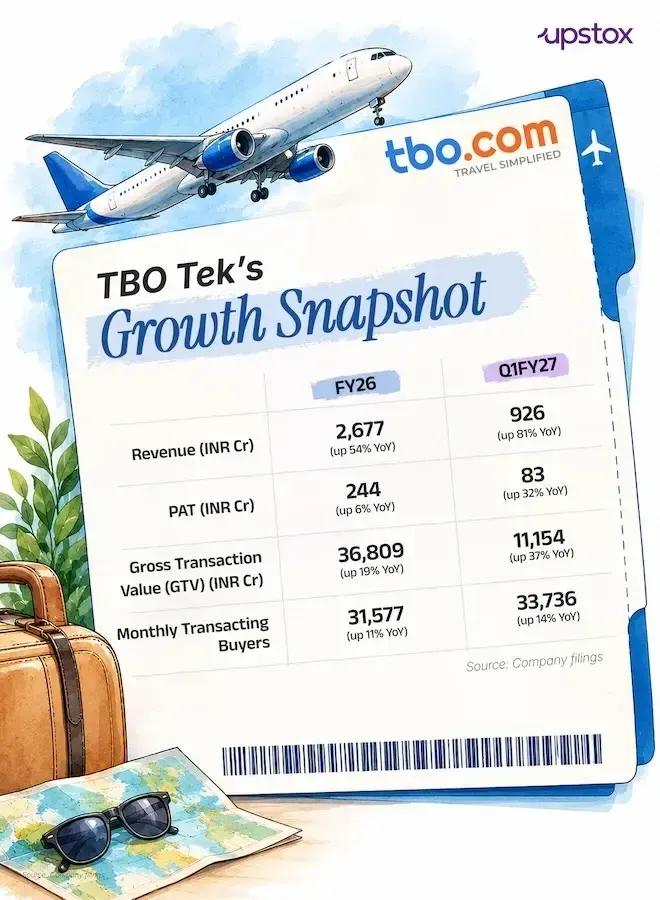
Its platform provides access to over 1 million hotels and 750 airlines across ~150 countries. The agent network too is steadily growing.
That network matters because the agent is far from obsolete.
Offline booking is estimated to account for nearly 55% of the market share. This underscores the continued importance of agents and intermediaries, despite the growing popularity of online. Especially for customised itineraries, group travel and complicated multi-city trips, personal assistance tends to matter as much as price and that’s where agents specialise. TBO Tek's proposition is to give these agencies and independent advisors access to inventory and capabilities that would otherwise be difficult to assemble on their own.
In the process, it also earns itself a sweet deal. On airline tickets, TBO earns a commission. But since airlines leave little room to vary prices across distributors, that tends to be thin (~2.2% take rate in Q1FY27). On hotels and ancillaries, TBO Tek gets to negotiate a net rate from the seller and add a markup for the buyer, making it a higher-margin opportunity (10.5% take rate in Q1FY27). The take rate is basically the percentage of total transaction value that the company collects as revenue.
Simply put, a larger share of hotel bookings can make a meaningful difference to how much revenue TBO Tek earns from the same overall volume of travel. That’s why it has been focusing on expanding the share of this segment. The share of Hotels in Gross Transaction Value (GTV) has risen from around 45% in FY23 to 64% in FY26.
In addition to the segment, it has also diversified its business geographically with a roughly 40:60 split in transaction value between India and international in FY26. These have largely been led by acquisitions, including Island Hopper, Gemini, Bookabed and Jumbonline, and the luxury wholesaler Classic Vacations. Each deal strengthens its supplier and buyer network globally. And the larger the network becomes, the more useful it can be to both sides.
Selling the intelligence behind the booking
Now, if TBO Tek helps an agent get a hotel room, RateGain helps the hotel decide how to sell it, and to whom. Consider the decisions a hotel must make every day. Are competing properties charging less? Is the demand likely to rise next month? Should rooms be offered through an online travel agency, sold directly through the hotel's website or promoted through a targeted marketing campaign? So on and so forth…
RateGain helps businesses find answers to such pertinent questions through three key offerings.
Through its data and pricing intelligence (DaaS) business, it helps customers collect prices, availability and demand signals. This helps them track rivals and spot pricing gaps. Through ‘Distribution’, it automates inventory, rates, and availability across channels in real time. Lastly, with marketing technology (MarTech), it provides tools to identify audiences, run campaigns, and measure results.
These services are now availed by around 700 partners across more than 160 countries, including 33 of the world's top 40 hotel chains.
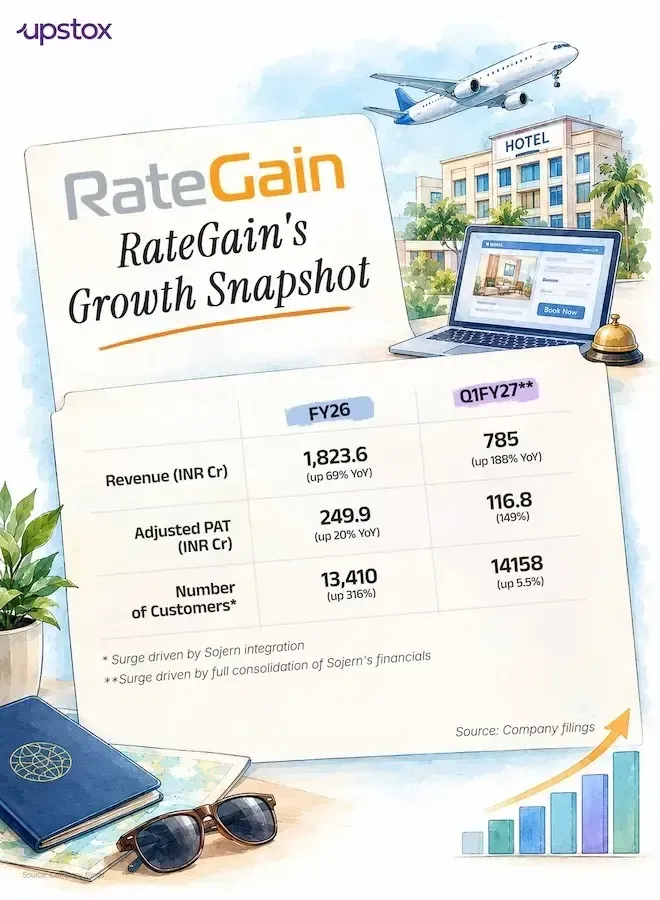
Like TBO Tek, RateGain too has transformed its revenue mix. Between FY23-26, the share of DaaS reduced from around 30% to 20% and Distribution dropped from about 34% to 11%. In the same period, MarTech share rose from 37% to 69% as it continued moving up the travel value chain.
With this, it also pivoted its revenue model from pure software subscription fees to a more outcome-based approach. As of FY26, about 70% of revenue was transaction-based. So, instead of a fixed fee, it earns a percentage of the gross booking value, or fee-per transaction, or a share based on the success metrics of a campaign. It might seem a risky move, but the company is relying on its tech-stack driving superior outcomes for clients, which would in turn translate into higher contract value.
Another similarity with TBO Tek is the acquisition-led expansion. RateGain bought businesses including BCV Social, MyHotelShop and Adara before acquiring global travel-marketing company Sojern in 2025. This led to a multi-fold increase in scale. The customer base rose from 3,224 in FY25 to more than 14,000. It also strengthened its capabilities, making them ‘the only company in our market that connects demand generation, distribution, pricing, and guest engagement through one integrated platform,’ according to its FY26 annual report.
Building Sustainable Value
While the headline numbers flatter both companies, it is important to note that a major chunk of recent growth has been fuelled by acquisitions. The next phase will depend on how well these companies capitalise on these capabilities.
For TBO Tek, that means a richer hotel and ancillary mix, more international business and tools that make agents more productive. For instance, it is working on Voya, an AI-enabled platform that helps advisors plan, customise and manage complex itineraries more efficiently.
Meanwhile, the opportunity for RateGain lies in connecting the different parts of its technology stack. A hotel that can track demand, adjust prices, distribute rooms across channels and target potential guests through one connected set of tools may be better positioned to win bookings without overspending to acquire them. RateGain's ability to cross-sell these services to its expanded customer base will be an important test of whether its acquisition strategy can deliver more than scale.
Alongside, they need to factor in and work around the possible headwinds, such as travel downturns, geopolitical shocks as well as shifting customer habits.
Still, on paper, there is room for both businesses to grow. India’s Leisure & Business Travel Booking market is projected to grow at 7.74% CAGR between 2026–2032. More importantly, even if more and more travellers start planning their trip on social media or using an AI assistant, the trip still needs inventory, pricing, distribution and marketing to become a completed booking.
That is the moat both companies claim to have built. How well they leverage and scale it will determine their ability to become indispensable in the B2B travel market.
Related News
About The Author
Next Story

