
Upstox Originals
Why the real winners of India's aviation boom are on the ground

8 min read | Updated on November 08, 2026, 14:34 IST

SUMMARY
While airlines grapple with thin margins and fuel costs, businesses on the ground are quietly profiting from India’s aviation boom.

Taneja Aerospace & Aviation, a smaller, pure-play civil-MRO business.
Think aviation and your mind instantly conjures up the image of a flight soaring in the blue skies. Or perhaps you may recollect headlines around IndiGo's market share, Air India's turnaround, or Akasa's expansion.
That is understandable. After all, airlines are the most visible part of the industry.
But what often goes under the radar are the aviation businesses making money on ground – inside hangars, terminals and lounges – rather than at 35,000 feet.
So, on one hand you have airlines grappling with wafer-thin margins and volatile fuel prices. On the other, you have the ecosystem around them: maintenance providers and airport operators, who are capturing a growing share of the traveller's wallet without bothering about a single litre of jet fuel.
And this broader ecosystem is poised to be one of the key beneficiaries of India’s aviation boom. Let’s delve into factors fuelling their growth.
The maintenance business
The first are the MROs, i.e., Maintenance, Repair and Overhaul. Simply put, these are the people who make sure a plane stays airworthy and safe throughout its lifespan. It's unglamorous work, but it's expensive work: airlines spend 12-15% of their revenue on it, second only to fuel, according to a NITI Aayog report.
Now, here's the opportunity: India is poised to become the third-largest aviation market in the world within the next decade, up from fifth currently, with its commercial aircraft fleet set to nearly triple to 2,250 planes by 2035.
This fleet will naturally need maintenance. But there's a gap: roughly 85% of India's aircraft maintenance is still outsourced abroad, to Singapore, the Middle East and Sri Lanka. Simply because, for years, it cost more in tax to fix a plane at home than to fly it out and back.
The government has spent the last few years trying to close that gap. Here’s a quick look at the reforms introduced:
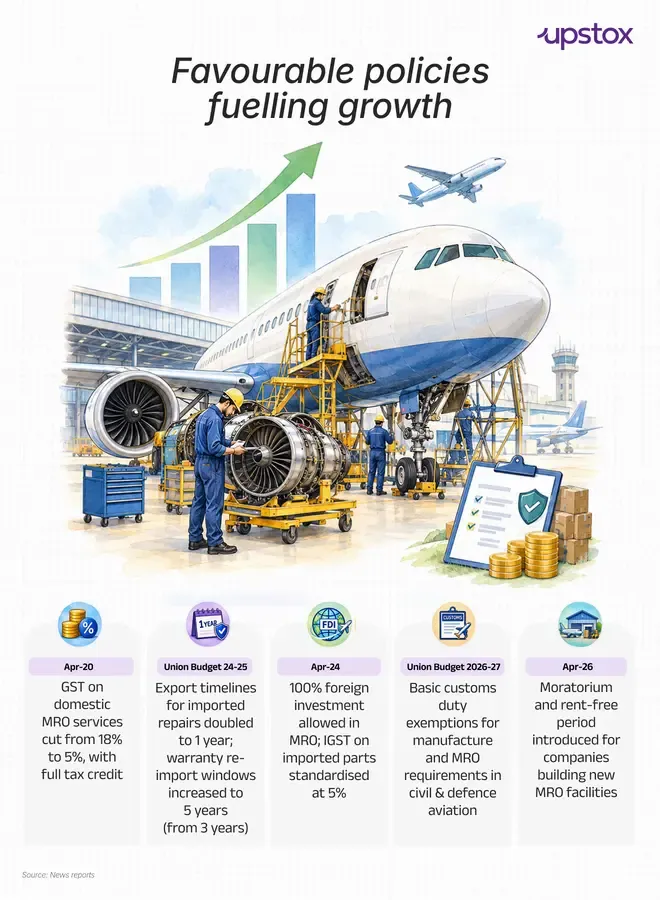
The logic running through all of it is simple: make it cheaper to fix a plane in India than to fly it overseas and back.
The government believes we already have the pre-requisites: a well-qualified pool of engineers and comparatively lower labour cost than global counterparts. With easing policy framework, the Niti Aayog report notes that the Indian MRO sector can not only establish a stronghold in Indian aviation but also compete with global MRO hubs to service international aircrafts in India.
Oliver Wyman, a global consulting firm specialising in aviation and aerospace, states that India's MRO market will be the fastest-growing in the world, expanding at 8.4% CAGR between 2026-2036. In the same period, annual MRO spending is projected to rise from $3.1 billion to $6.9 billion.
So, who's likely to benefit from this growth?
On the unlisted side, AIESL (Air India Engineering Services) is the heavyweight. It is a government-owned company and India's largest MRO organisation by far, with a turnover north of ₹2,000 crore, 50+ line stations and 6 full base-maintenance facilities spread across the country. Then there's Air Works, among India's largest private MRO. Adani Defence & Aerospace took it over almost entirely in March 2026, raising its stake to 99.98%, thereby adding MRO capability directly into the Adani Group's growing aviation footprint.
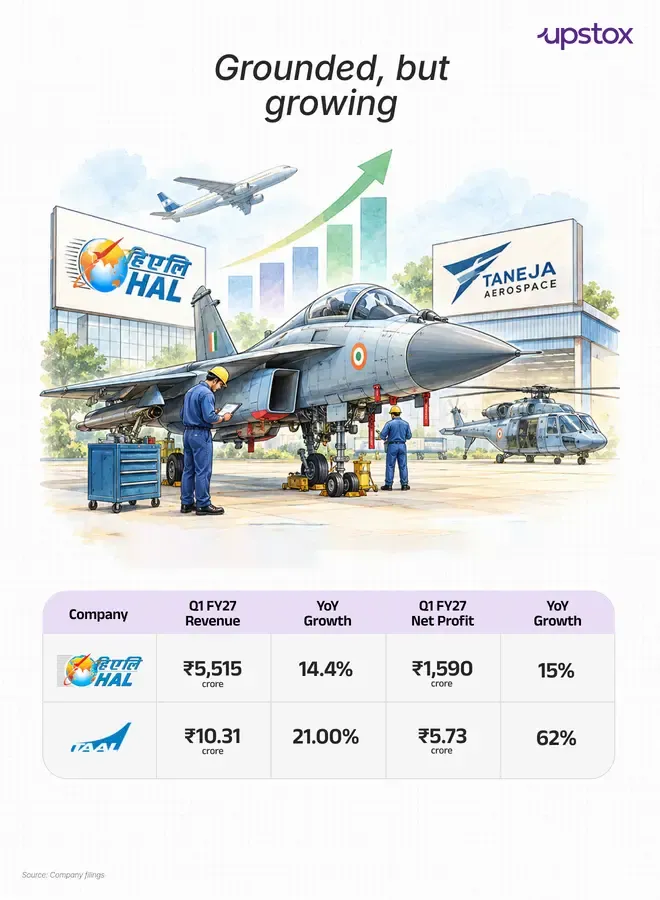
On the listed side, Hindustan Aeronautics (HAL) is the name most people would know. Besides building fighter jets, the company also has a thriving MRO business, which contributes about a third of the company's total revenue.
It's important to note that most of the business comes in from the Indian Armed Forces, to service their aircrafts, helicopters, and engines. HAL has, however, also started building a genuine civil-aviation MRO arm: it partnered with Airbus in November 2023 to set up an A320 check facility at its Nashik plant, performed its first commercial overhaul (for IndiGo) in 2025, and is targeting 25% its revenue from civil aviation work within a decade.
Another example would be Taneja Aerospace & Aviation, a smaller, pure-play civil-MRO business. It leans more toward private jets and chartered helicopters, and is also India's first authorised Cessna service centre. It operates primarily out of its 248-acre facility in Hosur, Tamil Nadu, which features four dedicated hangars capable of servicing everything from light trainer aircraft and helicopters to commercial narrow-body jets.
Pampering the passenger
While the MRO companies are benefitting from the government’s favourable policies, there are some that are doing pretty well on their own! These are the airports of course.
More often than not, we have time to kill after a security check. Which means, we end up buying overpriced coffee or browsing the duty-free aisles. If in an indulgent mood, we might even pay for lounge access during longer waiting periods (unless, of course, the right credit card is already doing the heavy lifting for you!). Multiply that by the hundreds of millions of people flying every year, and you start to see why airports have become a massive business in their own right.
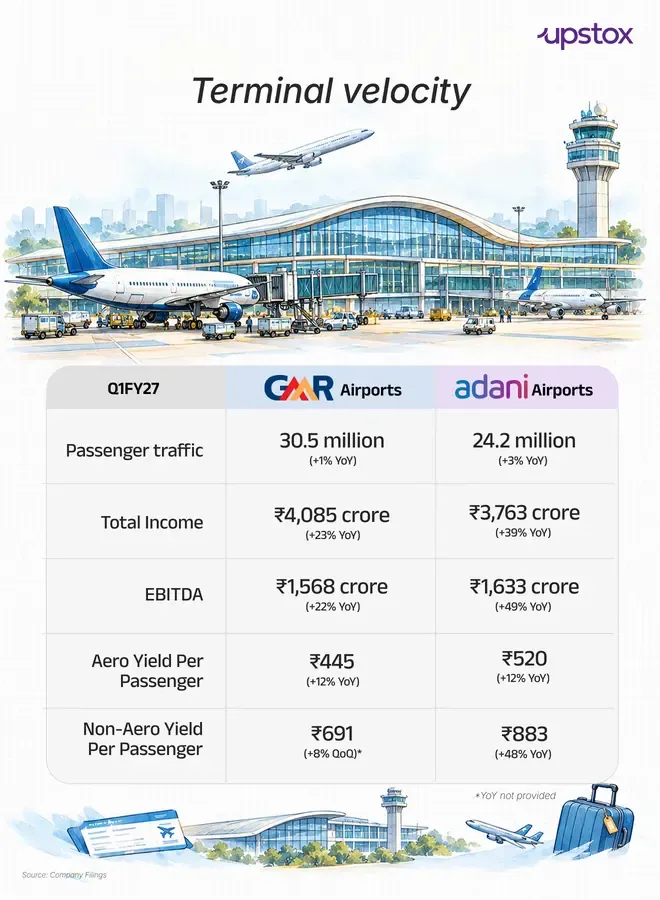
In fact, here's an interesting fact: India's aviation passenger growth has generally been strong, but between January and August 2026 it actually shrank slightly, hit by the West Asia conflict, costlier jet fuel and a weaker rupee. Yet two of India's biggest airport operators just had strong quarters.
Because an airport really runs two separate businesses. The first is like a toll booth: landing fees, parking charges, and other taxes and fees that are baked into every air ticket. That is money every airline and passenger has to pay just to use the runway and terminal, whether or not they buy so much as a bottle of water. This is regulated by the Airports Authority of India, so it's predictable, but it's also capped and falls under the ‘aeronautical revenue’.
The second business is ‘non-aeronautical revenue’, comprising everything else: duty-free, restaurants, shops, parking, even real estate around the airport. This part is unregulated, and where the real margins come in.
Take for instance a retailer having a store inside the airport. He has to typically pay a mix of fixed rent plus a cut of whatever he sells. So, every purchase you make inside a terminal indirectly pays the airport operator twice: once through what you spend, and again through the share it takes off the top. Lounges work the same way with rent plus revenue share as well as utility charges, branding rights, and so on.
Increasingly, this non-aeronautical revenue is forming a major chunk of the revenue for airport operators.
Case in point GMR Airports. More than half of its total income now comes from non-aero businesses. It expects this segment to grow at about 15% annually. Likewise, for Adani Airports, part of Adani Enterprises, the share of non-aero revenue stood at ~56%, and the company expects this to hit 70% by 2030.
The flight path ahead
While the tailwinds are significant for MROs and airport operators, some turbulence cannot be ruled out.
There are two possible risks here. The nearer-term one is macro: the West Asia conflict has already dented international routes, a weaker rupee raises expenses across the board, and the removal of airfare price caps in May 2026 could soften passenger demand. This could have a ripple effect on the overall aviation ecosystem.
The other risk is specific to MRO. Introducing tax breaks will not instantly translate to foreign airlines sending their planes to India. Consistent quality and proven turnaround times will play a key role in establishing their trust and their business.
But with structured improvements and concerted efforts by major stakeholders, the government expects the MRO businesses to play a strategic role in boosting the aviation sector. It has laid out an ambitious target: servicing 90% of Indian carriers' MRO needs domestically and ensuring at least 20% of the industry's income comes from foreign-registered aircraft. Even if achieved only half-way, this would translate into massive business for domestic operators.
The long-term outlook remains promising for airport operators too. Real-estate consultancy Knight Frank, in a 2025 report, projects Indian airports’ non-aero revenue nearly tripling by 2030, from under $1 billion to around $2.95 billion. Translating these ambitious targets into reality will require meticulous planning and strategic execution. For now, it’s safe to say the runway for growth is long. Not just for the airlines, but for the aviation ecosystem powering India's skies.
Summary:
While airlines grapple with thin margins and fuel costs, businesses on the ground are quietly profiting from India’s aviation boom. Maintenance firms especially stand to gain as tax cuts and policy support push repairs onshore, while airport operators are witnessing increase in non-aero revenue from retail and lounges. So, with India poised to become the third-largest aviation market, the growth story may lie not just in the skies, but on the ground too.
Related News

About The Author
Next Story

