
Upstox Originals
Beyond homes and offices: Decoding the rise of India’s warehouse economy

7 min read | Updated on October 17, 2026, 12:34 IST


SUMMARY
India’s industrial and warehousing real-estate market is emerging as a significant new growth story. Leasing is at record levels, developers are adding capacity and institutional investors are taking a growing interest in the segment. And as India makes and moves more goods, the humble warehouse is becoming an increasingly important part of the economy.
Manufacturing remained the largest source of demand in H1 2026, accounting for 46% of total leasing.
When we think of India’s real estate sector, we usually picture sprawling skyscrapers, apartment towers and luxury homes, or even posh office buildings.
But there is another property segment that is silently expanding and becoming an integral part of India’s real-estate economy. And that is the industrial and warehousing real estate.
Unlike residential real estate, where demand depends heavily on household affordability and sentiment, or offices, where leasing is closely tied to hiring and corporate expansion, warehousing is being pulled by something more fundamental: the reorganisation of how India makes, stores and moves goods.
The numbers show the scale of the shift.
Industrial and warehousing leasing across India’s top eight cities reached a record high of 72.5 million sq ft in 2025, increasing 29% year-on-year. The momentum has continued in 2026 in spite of macro headwinds including geopolitical headwinds, higher freight costs and currency volatility. Leasing volumes reached 36.8 million sq ft between January-June (H1 2026), up 15% from 32.1 million sq ft in the corresponding period last year. Alongside, rental costs also rose in the range of 4-7% across these cities.
As the demand strengthens, the supply side is witnessing increasing capex – with companies queuing up to create warehouses compliant with evolving needs of its potential occupiers. Institutional money is also beginning to follow. According to insights from CBRE, 33% of new warehousing supply in H1 2026 was institutionally backed, signalling growing participation by large investors and developers in the segment.
What makes this even more interesting is that the growth is not being driven by one hot sector, industry, or city. It is a culmination of multiple trends and tailwinds, making it a structurally strong segment.
Let’s delve further into what’s driving this growth, and why.
Evolving economy
Think about what has changed in the Indian economy over the last decade.
Roll-out of a uniform pan-India Goods and Services Tax (GST) has reduced the need for companies to maintain a patchwork of state-level warehouses purely to manage tax structures. Highways and dedicated freight corridors have improved the economics of moving goods over longer distances. E-commerce has created demand for large fulfillment centres. Quick commerce has created demand for smaller facilities closer to consumers. And the government's push for domestic manufacturing is creating another source of industrial demand.
These developments have acted as a tailwind, leading to increasing demand for industrial and warehousing facilities. And the demand is not limited to mega fulfilment centres, but extends across mid and small-size facilities too, as reflected in the deal volumes in H1 2026.
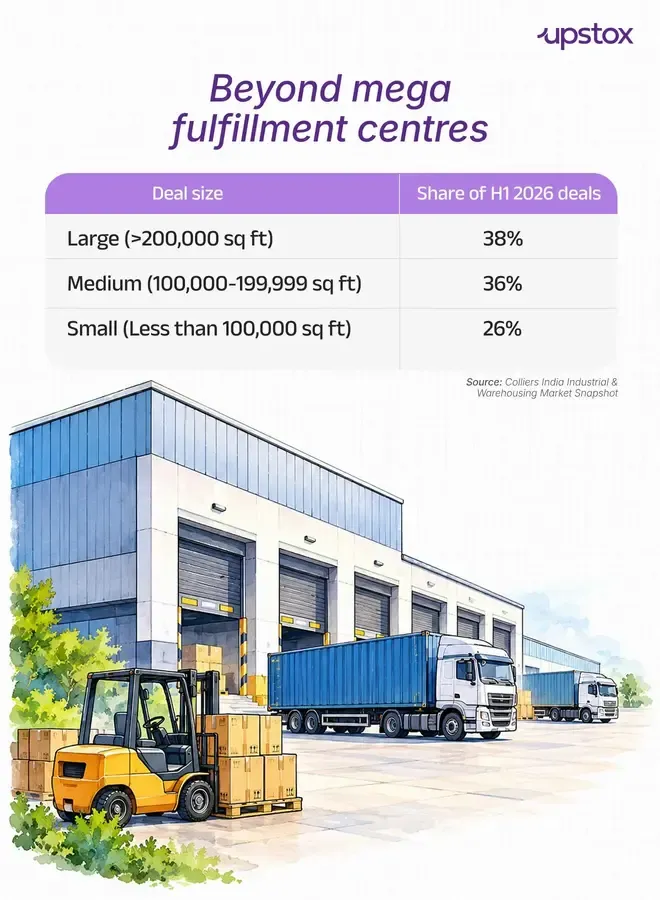
Besides demand, the quality aspect has also received an upgrade.
Companies are increasingly preferring facilities that can handle automation, faster movement of goods and stricter sustainability and compliance requirements. And warehouses are aiming to accommodate this need. Grade-A assets now account for 47% of the total industrial and warehousing stock across India's eight primary markets, up from 45% in 2025 and 41% in 2025. Grade-A essentially means high-quality facilities that are designed for improved operational efficiency, automation, and supply chain speed.
Suffice to say, a confluence of these changes is fuelling the demand. But from whom?
Who is driving the demand
Manufacturing, excluding FMCG and FMCD, remained the largest source of demand in H1 2026, accounting for 46% of total leasing, or 17 million sq ft, up 17% year-on-year.
But the fastest structural shift is happening in third-party logistics, or 3PL. These are companies that manage warehousing, distribution and fulfillment for other businesses. The gain in this segment denotes a structural shift as more and more manufacturers prefer to rely on specialist logistics operators such as Maersk, Safexpress and Xpressbees for distribution and fulfilment instead of managing their warehousing activity in-house.
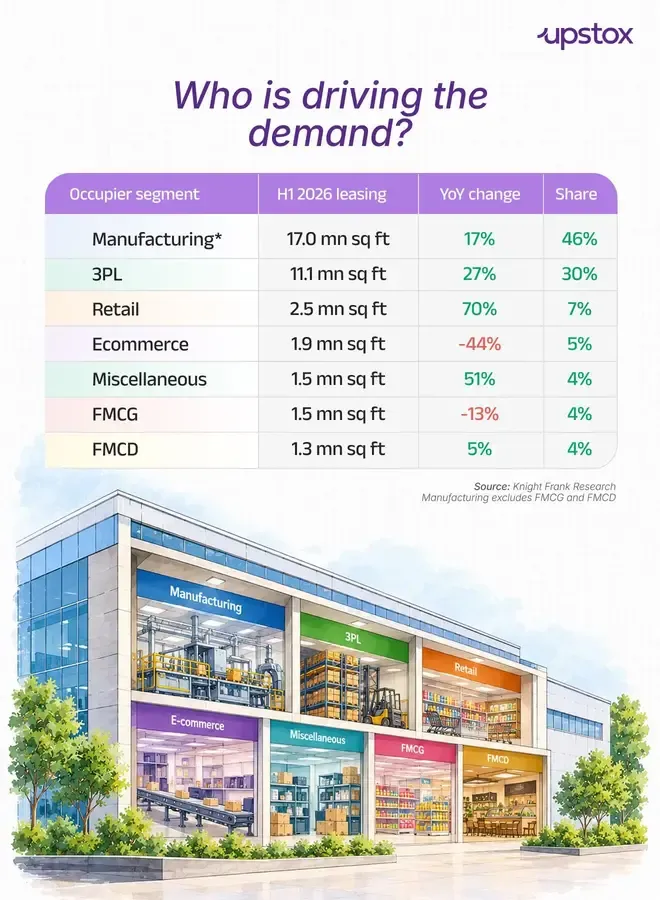
A surprising data here is that e-commerce, which is often assumed to be the biggest force behind India's warehousing boom, saw leasing volumes fall 44% year-on-year in H1 2026. That, however, does not necessarily mean the e-commerce story is weakening. Knight Frank’s report notes that several large platforms were consolidating the distribution footprints they had aggressively built in previous years rather than adding more capacity.
The overall demand growth, despite sluggishness in certain segments, shows that this real-estate segment is becoming less dependent on one industry. And that is arguably a healthier market.
Who is supplying this new infrastructure
Now, let us understand the ecosystem being created around this growth.
There are companies that own and lease the warehouses, companies that develop industrial parks, and companies that operate the supply chains running through them. The businesses may look different on the surface, but they are responding to the same underlying trend: companies need more organised, better-connected and more sophisticated logistics infrastructure.
Here are some of the key players in this space (though the list is by no means exhaustive).
A good starting point would be NDR InvIT. It is a warehouse-focused infrastructure investment trust that listed privately on the exchanges in 2024 and filed its IPO papers earlier this year. The company already owns a portfolio of 22 million sq ft across 75 warehouses and 42 industrial parks, and continues to remain on an expansion spree. It even raised ₹726.8 crore through a preferential issue in April 2026 to fund acquisitions and capital expenditure.
The logic is fairly straightforward: if more companies need organised warehousing, owning a portfolio of well-located, leased assets can create a relatively predictable rental-income stream.
Likewise, the recently listed Horizon Industrial Parks, backed by Blackstone, develops and leases large warehouses and industrial facilities. It has 28.5 million sq ft of operational warehousing space and plans to double this over the next four years.
Then there is TVS Infrastructure Trust, which listed on the NSE in July 2025 and is among India's first corporate developer-led warehousing InvIT. With a capex outlay of ~₹2,500-2,700 crore, it aims to expand warehousing portfolio to 20 million sq ft by 2028, up from around 12 million sq ft currently.
These expansion plans show that developers are not treating the current demand as a short-term cycle. They are committing capital in anticipation of increasing demand over the years.
However, owning warehouses is not the only way to participate in this segment. Take for example TVS Supply Chain Solutions, which relies on an asset-light approach. It manages more than 25 million sq ft of warehouse space globally, including 19.6 million sq ft in India. This gives it exposure to the growth of warehousing without necessarily having to own the asset.
Snowman Logistics, meanwhile, has adopted a blended approach that includes owning as well as leasing properties. The company operates a network of temperature-controlled and cold-storage facilities. Around 45 warehouses across 21 cities. These serve storage and distribution needs for pharmaceuticals, food and other products that require controlled environments.
Maintaining a balance
For now, the demand-supply balance seems healthy. Total industrial and warehousing stock across the eight markets rose 14% year-on-year to 584.9 million sq ft by H1 2026. In the same period, overall vacancy levels reduced to 11.4% from 12.1%.
This is encouraging, though it also means developers cannot assume that every new warehouse will automatically find a tenant. It is important to avoid a scenario where supply far outstrips demand, as that could lead to increase in vacancy levels and drop in rent.
It is also essential to expand in line with occupier requirements of quality and location. And developers seem to be paying heed. Many of the newer warehousing parks are being designed with Grade-A parameters in mind, ‘reflecting the rising institutionalisation of the sector and changing occupier expectations,’ according to the Knight Frank report.
To be sure, the industrial and warehousing segment has not yet reached the institutional depth of offices or residential real estate. CBRE’s India Market Monitor – Investments report notes that India’s broader real-estate market attracted a record $8.5 billion of equity capital in H1 2026, up 32% year-on-year. But, land/development sites and built-up offices accounted for ~94% of investment inflows. Industrial and logistics was still a relatively small part of the capital pool.
So, the market is still nascent and the runway for growth is pretty long. But the potential evidently exists. As long as goods continue to be manufactured, imported, sold and moved across the country, they need somewhere to go in the interim. Increasingly, that somewhere is a warehouse.
About The Author
Next Story

