
Upstox Originals
FMCG sales are rising, but your shopping bag doesn’t feel heavy

7 min read | Updated on November 06, 2026, 14:36 IST

SUMMARY
FMCG companies are selling more, in rupees. Sales grew 8.6% in July–September, the fastest in six quarters. But much of that is higher prices, not more packets. In the latest count, Indians bought fewer packets than a year ago. And the extra money is mostly going into food, suggesting rising kitchen bills may be squeezing the rest of the shopping list. Here's what is driving prices up, and what to watch next.

As per RBI's September survey, 90% of urban households said they were spending more on essentials than a year ago/ | Image: Shutterstock
India's FMCG companies have a reason to celebrate. Sales are growing at their fastest pace in six quarters. But there is a catch: a bigger sales number does not always mean more products are flying off the shelves. Sometimes, it simply means consumers are paying more for the same packet.
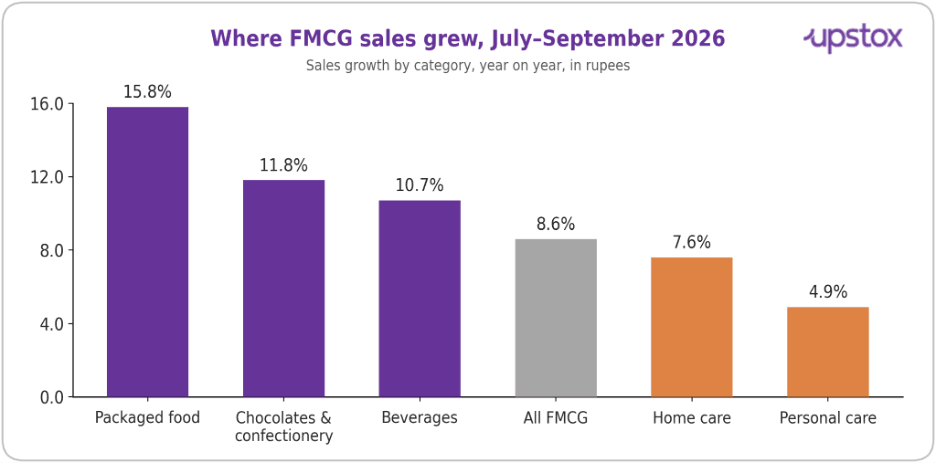
Bizom, which tracks distributor sales to kirana stores, says FMCG sales grew 8.6% in the July–September quarter, the fastest pace in six quarters. Rural India led growth, while urban demand picked up through the quarter. But these are sales measured in rupees, not packets, and Bizom attributes part of the growth to price hikes.
So, how much of this rebound is coming from higher volumes, and how much from higher prices?
Source: Bizom
What does that tell us? Most of the growth is in things a household cannot skip. Food prices are rising fastest: food inflation was 7.74% in September against 5.54% for prices overall. So the kitchen bill grows whether or not families buy more. Personal care, the easiest part of the basket to postpone, grew the slowest.
So is spending weakening because more of it is going on food? Partly, yes. In the RBI's September survey, 90% of urban households said they were spending more on essentials than a year ago, but only about a third said the same for non-essentials. Households haven't shut their wallets. A bigger share of each rupee is going to the kitchen, leaving less for the shampoo, the face cream and the extra pack of detergent.
How much of this growth is coming from higher prices?
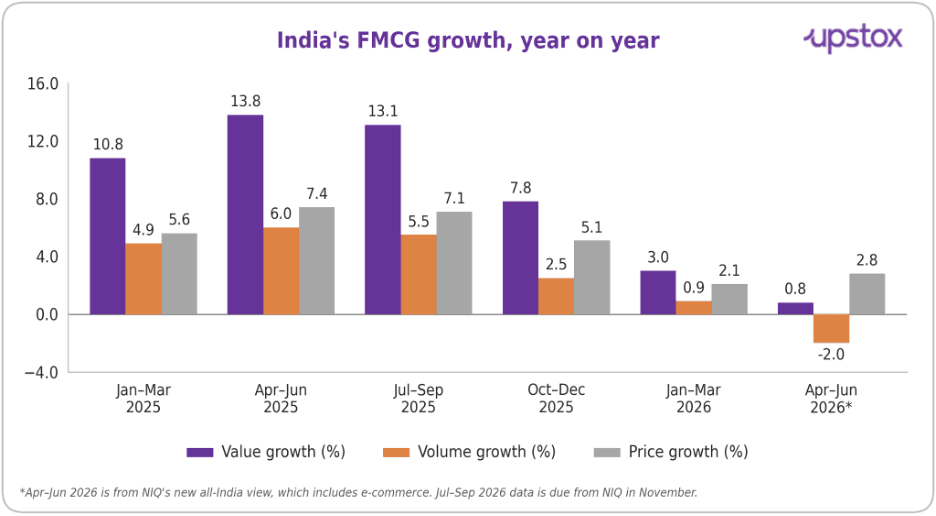
For five consecutive quarters, prices have contributed more to FMCG growth than volumes.
NielsenIQ (NIQ), which tracks what shoppers actually carry home, splits growth into two parts: more packets (volume) and higher prices. Since early 2025, prices have done more of the work every quarter. In April–June 2026, its latest reading, sales value grew just 0.8% while the number of packets fell 2%, and 68% of categories sold fewer units.
Source: NielsenIQ
Company results tell the same story. Hindustan Unilever's sales grew 10% in April–June, its best in 13 quarters, but half of that came from price; volumes grew 5%. Nestlé India's sales jumped 25%, led by volumes, and ITC's FMCG business grew 15%. Profits moved in different directions for company-specific reasons: a tax-credit base at HUL and a cigarette duty change at ITC.
FMCG companies' performance, April–June 2026
| Company | Revenue (₹ crore) | Revenue growth | Net profit (₹ crore) | Net profit growth |
|---|---|---|---|---|
| Hindustan Unilever | 17,341 | +10% | 2,673 | −3% |
| ITC | 29,523 | +28% | 4,394 | −16% |
| Nestlé India | 6,378 | +25% | 959 | +48% |
Source: Company filings. Consolidated numbers.
The common thread: revenue is up everywhere, but how many more packets that represents varies a lot from company to company.
So, why are companies raising prices again?
What got dearer for FMCG makers, September 2026
| Input | Change, year on year | Shows up in |
|---|---|---|
| Onions | +108% | Sauces, pickles, ready meals |
| Ginger / garlic | +63% / +55% | Spice mixes, noodles, snacks |
| Palm oil | +21% | Soaps, biscuits, snacks |
| Sugar | +18% | Biscuits, confectionery, drinks |
| Freight | +15% | Every pack that travels |
| Food overall | +7.7% | Most packaged food |
| Rupee vs dollar | −7.5% | Imported inputs: palm oil, crude, cocoa |
Source: MoSPI, Grant Thornton Bharat
The point: it isn't one commodity. The fat, the sugar, the spices, the plastic around the pack and the truck that carries it all cost more than a year ago, and crude near $100 a barrel keeps packaging dear. Companies can raise prices or shrink packs, and most have said bigger price decisions will come after the festive season.
The squeeze, however, is not universal. Nestlé expects wheat and coffee prices to remain range-bound, while copra, used in coconut hair oil, is about 35% below its peak.
GST cuts in September 2025 reduced tax rates on soaps, shampoos, toothpaste, biscuits and noodles from 18% to 5%. NIQ's measured price growth subsequently fell to 2.1% in the January–March 2026 quarter, its lowest in six quarters. With input costs rising again, companies face renewed pressure to raise prices, even as consumers become more sensitive to what they pay.
Are rising costs quietly shrinking your FMCG packs?
When the cost of making a biscuit, soap or packet of chips rises, companies have two choices: increase the price or reduce how much the pack contains. The second option, known as shrinkflation, allows brands to manage costs without changing the familiar ₹5 or ₹10 price tag that many consumers rely on.
This matters because small packs account for a significant share of sales. Roughly 60–65% of Britannia's sales and 30% of HUL's come from packs priced at ₹10 or less. Parle-G's small pack, for instance, shrank from 100 g in 1994 to 55 g by 2022, while its price remained ₹4 until 2021. Britannia also told investors it would take another 1.5–2% of pricing in the September quarter through grammage cuts in its ₹5 and ₹10 biscuit packs. Similarly, a ₹5 pack of chips that once contained about 17 g now holds 8 g, according to an industry body cited by Outlook Business.
But there is a limit to how much companies can cut. If a pack offers too little for its price, shoppers may switch to a larger pack or another brand, making it harder to pass on rising costs without hurting demand.
The impact is also uneven across the industry. NIQ attributes 88% of the June-quarter volume decline to manufacturers outside the largest companies, while those with sales below ₹100 crore saw volumes fall 10.5%. Larger brands can continue raising prices while gaining market share from smaller regional players.
This helps explain why Bizom's distributor data and NIQ's retail audit can paint different pictures. Distributor sales may reflect stronger performance among organised brands, while retail audits capture purchases across the wider market, including smaller regional competitors.
What to look out for
Whether this becomes a buying story rather than a pricing story will show up in five places.
-
Packets, not rupees. HUL reports its September-quarter results on 28 October; the split between volume and price is the number that matters. NIQ's July–September report, due in November, will show whether packets finally followed rupees.
-
Input costs. Some are easing: sugar is 21% off its peak and copra about 35% below its peak. If that spreads, price hikes slow and volumes get room to recover.
-
Food inflation. The October inflation print on 12 November. As long as food keeps rising faster than everything else, more of every rupee goes to the kitchen.
-
An easier comparison. Volumes dipped between September and December 2025 as shops adjusted to the GST cuts; HUL's volumes were flat that quarter. Growth over the next two quarters will be measured against that soft patch, so read early gains with care.
-
Where people shop. E-commerce volumes grew 34.8% and modern trade 17.5% in April–June even as overall volumes fell, and Datum Intelligence expects online festive sales of ₹1.50–1.55 lakh crore this year, up 25–29%. The growth is real; it is just moving out of the neighbourhood kirana.
Until the packets agree with the rupees, this looks more like a pricing-led recovery than a broad-based revival in consumption.
About The Author
Next Story

