
Upstox Originals
Oil is swapping ships mid-sea to reach India. Has it got any cheaper?

8 min read | Updated on November 05, 2026, 16:43 IST

SUMMARY
The Strait of Hormuz has been a danger zone since the Iran war began in February 2026, yet India’s Gulf crude imports just hit a seven-month high. The trick: oil now switches ships mid-sea before heading our way, a relay called a ship-to-ship transfer. Is it making oil cheaper? Not really. Gulf sellers’ bigger discounts mostly cover the extra cost and risk of wartime shipping, so they only stop oil from getting even more expensive.
India has imported about 2.8 million barrels per day (bpd) of Middle Eastern crude in September. | Image: Shutterstock
All of us might have seen planes refuel mid-air. But ever heard of crude oil being purchased mid-ocean? That is exactly what India is doing to overcome the challenges of the ongoing Iran war!
This is one of the ways India has managed to maintain its import of Gulf crude despite the ongoing skirmishes. The technical term is ship-to-ship transfer, and it could have implications for India's oil bill. First, the numbers.
According to Reuters ship-tracking data, India imported about 2.8 million barrels per day (bpd) of Middle Eastern crude in September, double August's level and the highest since February, the last full month before the war.
So the Gulf is back in India's import basket, even though the route out of it is not back to normal. How is the oil getting out? And does its return make India's oil any cheaper?
Ship-to-ship transfer, explained simply
It’s pretty much what it sounds like. One ship transfers its oil cargo to another, right in the middle of the sea. Here’s how it works. A smaller tanker carries crude oil through the Strait of Hormuz, taking on the riskier part of the journey. It then pulls up alongside a much larger tanker, called a very large crude carrier (VLCC), waiting in calmer waters in the Gulf of Oman. These supertankers can carry around 2 million barrels of oil. The crude is pumped from the smaller vessel into the larger one, which then continues the journey towards India.
How big has this relay become?
Big enough that it’s no longer just a workaround. It’s becoming a major way of moving oil out of the Gulf.
There’s no official count of these transfers, so energy trackers rely on satellite images and ship-tracking data to estimate how much oil changes hands at sea. According to Rystad Energy’s estimates, the volume transferred to supertankers has been around 5–7 million barrels per day since September. That’s roughly 60–70% of all the oil flowing out through the Strait of Hormuz. These are global figures. They cover all crude and fuel leaving the Gulf for any buyer, not just India-bound cargoes.
And here’s where things get interesting.
The usual transfer points off Fujairah in the UAE and Sohar in Oman are getting crowded. According to Vortexa, the overflow has spread east, all the way to India’s Gulf of Kutch, off the Gujarat coast. In September, 82 cargoes changed ships there, moving around 680,000 barrels per day. Much of this was refined fuel headed to countries such as South Korea, India, China and Japan.
In other words, this isn’t just an emergency workaround anymore. The transfers are happening at scale, the usual locations are running out of room, and the spillover has reached Indian waters.
Why does this arrangement suit Indian refiners?
Refiners can leave the riskiest leg to the seller. Saudi Aramco, ADNOC, Iraq, Qatar and now Kuwait offer delivery arrangements that allow crude to be handed over outside the Strait of Hormuz. This means Indian refiners can buy Gulf crude without sending their own tankers into the strait. The seller arranges the riskier part of the journey, while the buyer takes charge once the cargo is transferred.
The location helps keep delivery times manageable. A tanker collecting crude in the Gulf of Oman can reach India in about 20 days versus the normal 50-55 days. The trade-off is that the Gulf of Oman transfer points are becoming congested, with queues now stretching beyond a week.
Sellers are offering bigger discounts to keep the oil moving. Iraq, which has no pipeline to bypass Hormuz, offered October-loading Basrah Medium at a discount of $34.50 a barrel and Basrah Heavy at $37. Both discounts were deeper than in August. Saudi Aramco, meanwhile, set its November price for Asian buyers at its steepest discount since 2020. For refiners, these lower prices can help offset the additional costs and risks of shipping oil during the conflict.
Russian crude may no longer have the same cost advantage. An Indian refining source told Reuters that Russian oil was landing at roughly the same cost as some Iraqi grades, despite the longer voyage. At the same time, China is competing more aggressively for Russian barrels. Kpler data shows India imported 1.82 million barrels per day of Russian crude in September, compared with China's 1.49 million. If Gulf suppliers offer comparable prices and a shorter route, Indian refiners have a stronger reason to consider them.
Does this mean India's oil is getting cheaper?
Not really. Gulf sellers are offering discounts, but those mostly cushion the extra cost and risk of shipping during the war. So oil has not got cheaper. It has just not got as expensive as it could have.
India's crude import bill rose 47% year-on-year to $15.4 billion in September, according to the Petroleum Planning & Analysis Cell (PPAC). Volumes rose only 7%, to 21.7 million tonnes. Price did the rest.
The chart below tracks the Indian basket, a weighted average of the Oman-Dubai sour grades and Brent sweet crude that PPAC uses to track what India pays.
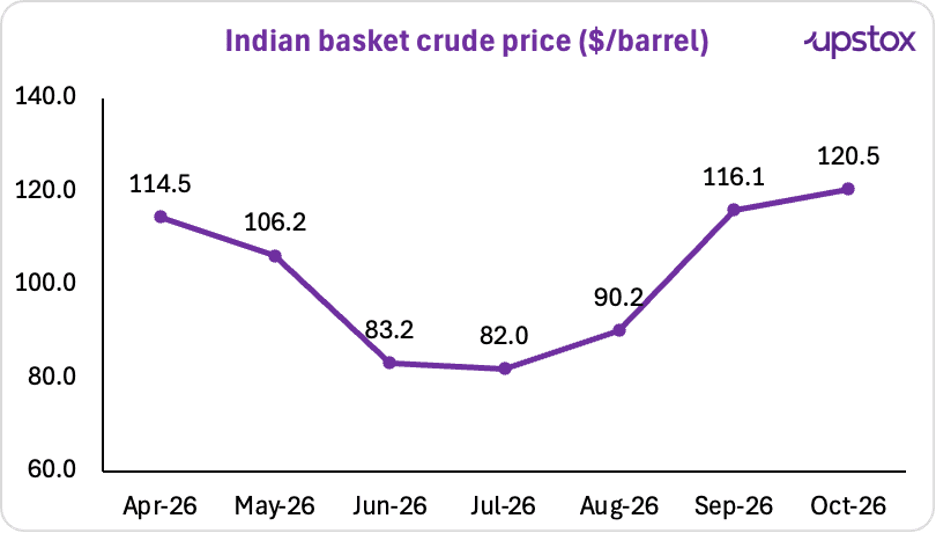
Source: PPAC, Data as of Oct 26, 2026
What does this mean for refinery margins and Indian refiners?
It depends on which side of the business you look at.
Making diesel has rarely been this profitable. A refiner's diesel margin is simply what it earns on each barrel: the price it sells the diesel for, minus the cost of the crude it was made from. Before the war, Asian refiners made about $22 a barrel this way. On 16 September, that hit a record of just over $87, almost four times as much, according to LSEG data. So a refiner that buys discounted Iraqi crude and sells diesel at today's prices earns well on every barrel it processes.
Selling fuel at home is a different story. Pump prices have not moved since the war began, so every time crude gets costlier, the state-run retailers absorb the difference instead of passing it on. In September, that gap was about ₹8 a litre on petrol and ₹9 on diesel, per ICRA, which works out to a combined loss of roughly ₹530 crore a day for the three state-run retailers. By mid-October, Jefferies put the gap at about ₹26 and ₹30 a litre. In plain terms: the pump is selling fuel for less than it costs to buy and refine the crude behind it.
That split matters for investors. Indian Oil, BPCL and HPCL both refine and retail fuel. Their refineries gain from record diesel margins and discounted Gulf crude; their petrol pumps absorb the gap between crude costs and frozen prices. Cheaper barrels help the first business. They do not yet rescue the second.
But how durable is this workaround?
The counter-argument deserves equal space.
Three things could break it.
- First, congestion: the spillover to Kutch happened because the main zones were full, and each handover now takes over a week against five–six days earlier in the war, per Rystad.
- Second, the risky leg is still risky: a tanker was struck off Fujairah recently, the first attack there in six months, and the shuttle run to the transfer point is where the danger sits.
- Third, Russia hasn't left: on 16 October the US waived its tariffs on major buyers of Russian crude, and Kpler expects India's Russian imports to hold at 1.8–1.9 million bpd in October. If an incident closes the relay, or discounts stop covering the freight, the mix can swing back as fast as it swung in.
So, has India's oil really changed course?
The route has. The price has not. Oil has not got cheaper. It has just been kept from getting even more expensive. Ship-to-ship transfers have brought Gulf crude back into India's mix, but they came in the very month the benchmark price hit its highest monthly average of this financial year.
Three things will show whether the shift lasts: October's ship-tracking data, which will reveal whether Gulf volumes held as Russian flows steadied; Aramco's term contracts for next year, which it is negotiating with loadings outside Hormuz; and the state-run refiners' September-quarter results, which will show how much of the refining gain the marketing losses ate.
About The Author
Next Story

