
Upstox Originals
Why won't Indian households sell gold even at record prices?

6 min read | Updated on August 26, 2026, 14:46 IST


SUMMARY
Gold has nearly doubled in a year. Yet Indian households aren’t rushing to sell. Net gold recycling fell to just 19 tonnes in the June 2026 quarter; an 11-quarter low; even as families spent a record ₹1.98 lakh crore on gold. So, what’s keeping all that old gold locked away?
India’s households are estimated to hold roughly $5 trillion worth of gold as of March 2026. | Image: Shutterstock
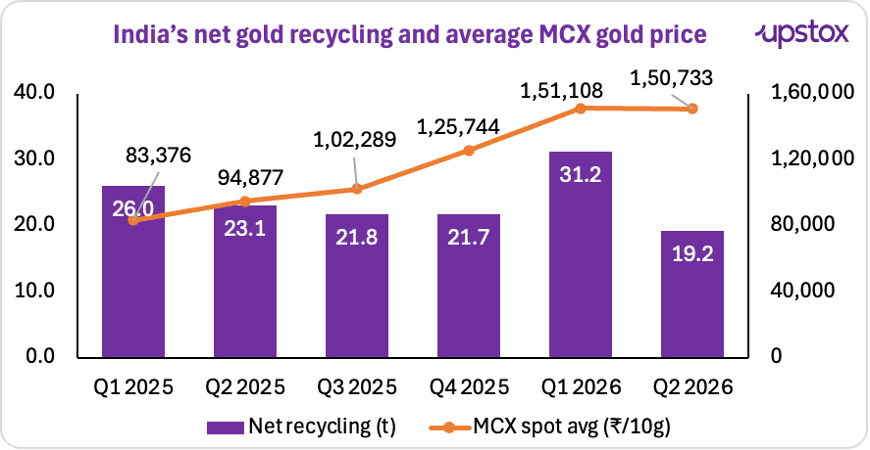
Imagine you bought something in early 2025 for ₹83,376. By this June, the same thing was worth ₹1,50,733.
Most owners of most assets would at least think about it. Indian households didn't. As the price climbed, the quantity of old gold Indians sold back into the market went the other way. Net recycling was 19.2 tonnes in the June 2026 quarter — down from 31.2 tonnes in the March quarter, and from 23.1 tonnes in the same quarter a year earlier, when gold was nearly 60% cheaper.
Stretch it over a full year and it looks stranger still. India recycled about 92.6 tonnes in 2025, roughly a fifth less than the 114.3 tonnes it recycled in 2024 — in a year when the price did almost nothing but rise.
It's no surprise that Indians love gold, but at times when one could yield higher profits, it's surprising to see that the net gold recycled actually started to reduce.
So what exactly is gold recycling?
Here is the part that trips up most readers of the headline numbers. The World Gold Council counts gold as "recycled" only when privately held gold is sold for cash and refined back into bullion. That bullion then re-enters the market as new jewellery, coins or bars.
Two very common things do not count:
- Exchange. Handing your old necklace to a jeweller and adjusting its value against a new piece is not recycling. The metal moves; the ownership of gold value doesn't leave the household.
- Pledging. Gold given as collateral for a loan isn't recycling either. You still own it.
How much did India recycle in the past?
Enough to make the current number look strange. India recycled 119.5 tonnes in 2019, the highest on record at the time, and was close to that again in 2023 at 117.1 tonnes. Recycling only collapses when prices collapse; in 2021, it saw just 75 tonnes.
Then the pattern broke. Prices went vertical, and recycling went down.
Source: World Gold Council
Why aren’t households rushing to cash out all those gains?
Gold has become more valuable as collateral, reducing the need to liquidate Because gold has become more valuable as collateral as well as an asset. India’s households are estimated to hold roughly $5 trillion worth of gold as of March 2026, equivalent to about 125% of the country’s GDP, according to Kotak Institutional Equities. Gold accounted for roughly 65% of household non-property wealth in the estimate.
That creates a unique situation.
When prices rise, household gold becomes more valuable. But higher prices also make owners more reluctant to sell because the opportunity cost of giving up the asset increases. If prices continue rising, selling today could mean losing exposure to future gains. A gold loan, by contrast, allows the household to unlock part of the asset’s value without immediately parting with it.
The result is a kind of “hold, pledge or exchange” strategy rather than a straightforward “sell when prices rise” strategy.
They're borrowing instead
Rather than selling their gold, households are increasingly using it as collateral. Outstanding retail gold loans reached ₹5.1 lakh crore at banks and ₹3.3 lakh crore at NBFCs by end-May 2026. Bank gold loans more than doubled year-on-year, while NBFC portfolios grew 70%. Together, the ₹8.4 lakh crore gold-loan market highlights how India's household gold stock is increasingly being integrated into the formal credit system.
They're exchanging instead
Jewellers have pushed exchange schemes hard, and it worked: retailers reported exchange volumes rising 10–20% in Q2, with old-gold trade-ins accounting for up to 70% of sales in some cases. The household reduces its cash outgo without giving up an ounce of gold exposure.
Why should anyone recycle gold at all?
Fair question; Indians don't buy gold planning to sell it. But there is a case, and it is rarely made properly.
Old jewellery is the worst-performing form of gold you can own. When you sell, you're paid for metal weight and purity alone. The making charges you paid, typically 8–25%, and the GST on that original bill are gone the moment you walk out of the shop. Design has no resale value. A necklace and a biscuit of the same weight fetch nearly the same money.
A loan is not a free lunch. Pledging feels like keeping the gold and getting the cash. But it's borrowed money with interest attached, secured against an asset whose price can fall. Loan-to-value ratios sit at roughly 55% for banks and 60% for NBFCs, which is a real cushion; but a 105% jump in gold-loan books in one year is a household-debt story as much as a gold story.
And nationally, recycling is the only supply India controls. In Q2 2026, imports made up 82% of India's gold supply, recycling 16%, and domestic mines just 2%. With the import duty hiked from 6% to 15% in mid-May, the steepest increase on record, every tonne recycled at home is a tonne India doesn't buy with dollars.
How many Indians even know this is an option?
Almost certainly fewer than you'd think.
There's no published survey measuring awareness of gold recycling in India, so we have to read behaviour instead. And behaviour says households know they can exchange, up to 70% of jewellery sales prove it, but treat outright liquidation as something you do in a crisis, not something you do on price.
The clearest evidence is the government's own attempt to change this. The Gold Monetisation Scheme, launched in 2015 specifically to draw idle household gold into the formal system, had mobilised 31,164 kilograms, about 31 tonnes, as of November 2024. India's households are estimated to sit on 23,000–25,000 tonnes.
That's roughly one-tenth of one percent, in nine years. In March 2025, the government discontinued the scheme's medium- and long-term deposit windows.
When a policy designed to unlock household gold captures a rounding error, the problem isn't the interest rate. It's that most people never knew the door was there.
In summary
The unusual part isn't that Indians aren't selling gold at record prices. It's what that tells us about the role gold plays in household finances. For most assets, a sharp rise in prices creates an incentive to realise gains.
Gold behaves differently because it serves multiple purposes at once: a store of wealth, a hedge against uncertainty and a source of liquidity. As prices rise, so does the opportunity cost of selling, particularly when households expect gold to retain its value or appreciate further.
India's household gold stock, therefore, isn't simply an asset waiting to be sold. It is a large pool of household wealth that can continue to appreciate without necessarily translating into higher market supply or recycling.
About The Author
Next Story

