
Upstox Originals
Why Volkswagen is worth only as much as Maruti

6 min read | Updated on September 30, 2026, 12:56 IST


SUMMARY
Volkswagen owns Audi, Porsche, Bentley and Lamborghini, yet the stock market now values it at about the same as Maruti Suzuki, despite being 18x larger by revenue. For any aspiring business, this presents a classic case study on how legacy players need to adapt to disruption or see a value erosion. For investors, this is about reading beyond the headlines and finding an investment that blends “cheap valuations” with strong growth prospects.
Stock list
VW’s shares have lost ~77% of their value in the last five years. | Image: Shutterstock
Think of a luxury car. Maybe it's an Audi pulling up at a wedding, or the Porsche you've only ever seen behind the glass of a showroom. If you're dreaming properly, it's a Lamborghini. All three belong to one company, the Volkswagen (VW) Group. It also owns Skoda, Bentley, among others.
Why are we talking about it? VW’s shares have lost ~77% of their value in five years. Today, the owner of Audi and Porsche is now valued like Maruti, even though it brings in almost 18x as much revenue.
| VW Group | Maruti Suzuki | |
|---|---|---|
| Market capitalisation | $40.47 billion | $39.34 billion |
| Revenue (last 12M) | $367.48 billion | $20.69 billion |
Source: Company reports, Screener
VW’s share price trajectory since 2021
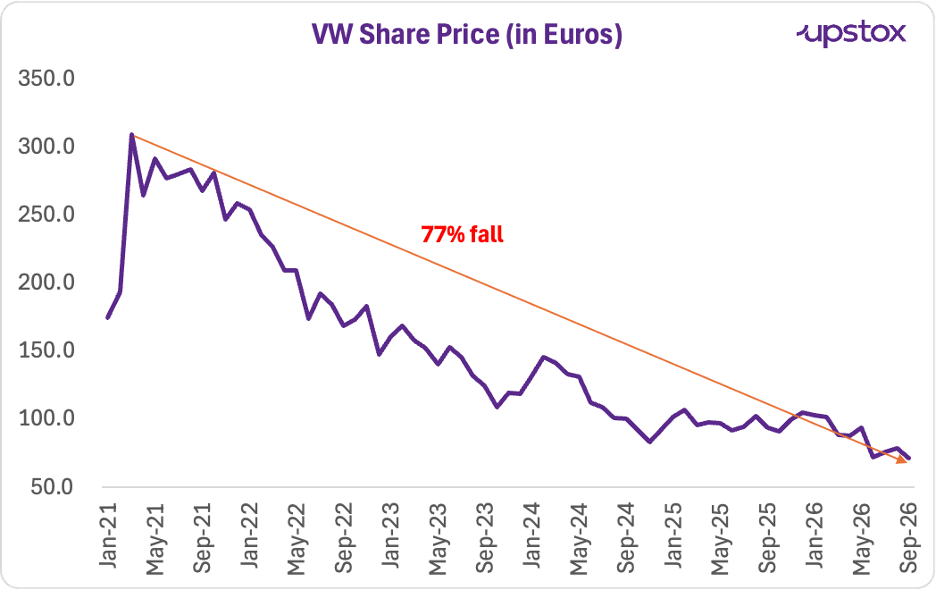
Source: Investing.com
What could have gone wrong? Why is the company behind some of the world's most iconic car brands seeing its performance take such a hit?
Is it about electric car sales?
The most common (mis)conception is that VW is losing the EV battle to Tesla and Chinese brands. But that is not necessarily true, as the numbers below show.
| Company | EVs sold in 2024 | EVs sold in 2025 | Change |
|---|---|---|---|
| BYD | 1,764,992 | 2,256,714 | +27.9% |
| Tesla | 1,789,226 | 1,636,129 | -8.6% |
| Geely Auto | 576,488 | 1,073,805 | +86.3% |
| VW Group | 744,600 | 983,100 | +32.0% |
Source: Company reports, press releases, news articles
Yes, VW is not at the top of the league table and has a long way to go. But it is definitely a serious contender. So, what has gone wrong?
VW is losing ground in China, where it sells nearly a third of its cars
China is where the real story sits, where VW makes 25-30% of its global sales. For years, VW was the biggest carmaker in China, until BYD overtook it in 2024. By 2025, VW had slipped to third, with a 10.9% share behind BYD and Geely. The slide continued this year.
VW's China deliveries fell over 20% in the first half of 2026. Picture a sweet shop near your house that makes most of its yearly profit during Diwali. Then three new shops open on the same lane, with fresher stock, flashier boxes and lower prices. The old shop still sells plenty of sweets, but it just can't charge what it used to.
Software changes further exacerbated the issue. VW set up its own software unit, CARIAD, in 2020 to build one system for all its brands. Instead, software problems delayed launches such as the electric Porsche Macan by years. VW increasingly relies on strategic software partnerships, including Rivian in the US and Xpeng in China, after CARIAD struggled to deliver a unified software platform.
VW has been dropped from Europe's benchmark index
This September, VW was removed from the Euro Stoxx 50, the index of Europe's biggest blue-chip companies. Imagine Maruti being dropped from the NIFTY50. Funds that track the index now have to sell the stock.
Is VW going the Nokia way?
Remember Nokia? Kodak? Both brands felt permanent. Neither was, but they failed in very different ways.
| Company | What changed | What happened next |
|---|---|---|
| Kodak | Digital photography replaced film | Filed for bankruptcy in January 2012 |
| Nokia | Value moved into smartphone software | Sold its phone business to Microsoft in 2014 |
| VW | Chinese rivals and software-led cars | Still profitable, but now relies on partners for software |
Kodak's product disappeared, even though Kodak invented the digital camera itself. Cars are not going the way of film rolls.
Nokia is the closer match. People never stopped buying phones. The profit simply moved into software that other companies controlled. VW relying on Rivian and Xpeng for its cars' software carries a similar risk.
What is VW doing?
VW has been trying to shrink its way back to health. In December 2024, it agreed with its German unions to cut more than 35,000 jobs across its German sites by 2030 and to reduce factory capacity there by 734,000 cars a year.
Further cuts at Audi, Porsche and the software unit CARIAD took the agreed total to about 50,000 jobs. Recently, the VW board approved 50,000 more, about 8% of the global workforce, doubling the reductions agreed since late 2024.
What about BMW and Mercedes?
BMW and Mercedes have also seen their fortunes suffer over the same time period, both having lost about 30% of their value over a similar time period. And the answer remains the same. China. Overall economic weakness in the country and a sharp pivot towards homegrown brands has left a mark on these players as well. Mercedes' China deliveries fell 30% in Q2 2026.
VW has still had it worse compared to its German counterparts for two reasons 1) VW sells far more ordinary, mid-priced cars in China, and local brands have managed to make a serious dent there as well; 2) Its software challenges have weighted on its sales in a country that prioritises technological proficiency in car.
What the VW story means for Indian investors
A few things are worth carrying into your own stock research.
- A low P/E can be a warning. VW trades at about 6.8x earnings, which looks like a bargain. But a closer look would reveal that the company’s net income fell 35.9% over the past year. Sometimes, a low P/E can genuinely be deserved because investors are worried about the future prospects. It's an investor's job to find out why before calling it cheap.
- Find the profit engine. Like China was for VW, companies often have one market or product that does most of the heavy lifting. When local rivals pushed VW down to third place in China, the impact on its profits was severe despite its European business holding up. The same logic applies to any stock you research. Once you know where the money comes from, ask a simple question: what happens if new rivals offer the same thing cheaper, or better, in that exact spot?
- Look beyond the headline. For years, the story was Tesla versus the old carmakers. Yet, the real pressure came from Chinese brands that grew fast in their home market, with BYD's EV sales up 27.9% and Geely's up 86.3%. When you track a company, look past the rival everyone is talking about. Pay attention to the smaller competitors gaining share quietly, and to problems inside the company itself.
About The Author
Next Story

