
Upstox Originals
Tiruppur's rise: How one textile cluster became India's export powerhouse

7 min read | Updated on September 29, 2026, 18:11 IST


SUMMARY
Tiruppur has no port, and its river runs dry for much of the year. Yet the town known as India's knitwear capital exported ₹46,000 crore of knitwear to more than 50 countries in FY26, most of it made by small firms that each do one thing. Now its exporters want ₹1 lakh crore by 2030. So, what built Tiruppur, and can the same model more than double its exports?

Tiruppur supplies about 55% of India's knitwear exports and 90% of the country's cotton knitwear exports. | Image: Shutterstock
₹1,39,352.5 crore! That's how much India exported in ready-made garments in FY26. Now, guess how much came from a single town? ₹46,000 crore. Yes, you read that right, nearly one-third of India's garment exports came from one town!!
And the Tiruppur Exporters' Association is aiming higher: ₹1 lakh crore of exports by 2030. And here is what makes this achievement even noteworthy. Tiruppur has no port. Its river, the Noyyal, is seasonal. Its industry grew out of a farming town, and in 2011 a court ordered its dyeing units shut.
None of that stopped Primark, Walmart, H&M and neither of that stopped it from becoming what its municipal corporation calls the "Knitwear Capital of India". The Tiruppur Exporters' Association (TEA) says it supplies about 55% of India's knitwear exports and 90% of the country's cotton knitwear exports.
Clusters are supposed to begin with cheap land, a port and a big investor. What built this one, and can the same thing carry it through a tariff war, two trade deals and a labour shortage?
How did a town of vest-makers end up dressing the world?
Slowly, then all at once.
The first knitting unit opened in 1925; by 1961 there were 230, all making white cotton vests for the Indian market. Until the 1970s the town did not export.
Then, in 1978, an Italian importer called Verona came looking for white T-shirts, and in 1981 the retail chain C&A followed. Exports were ₹18.69 crore in 1985, ₹289.85 crore in 1990 and ₹3,581.00 crore in 2000.
Two policy shifts did the rest. Liberalisation in 1991 opened Western markets and eased machinery imports. When the quotas capping how much clothing India could sell to the West ended in 2005, firms running 100 or 200 machines began installing 1,000.
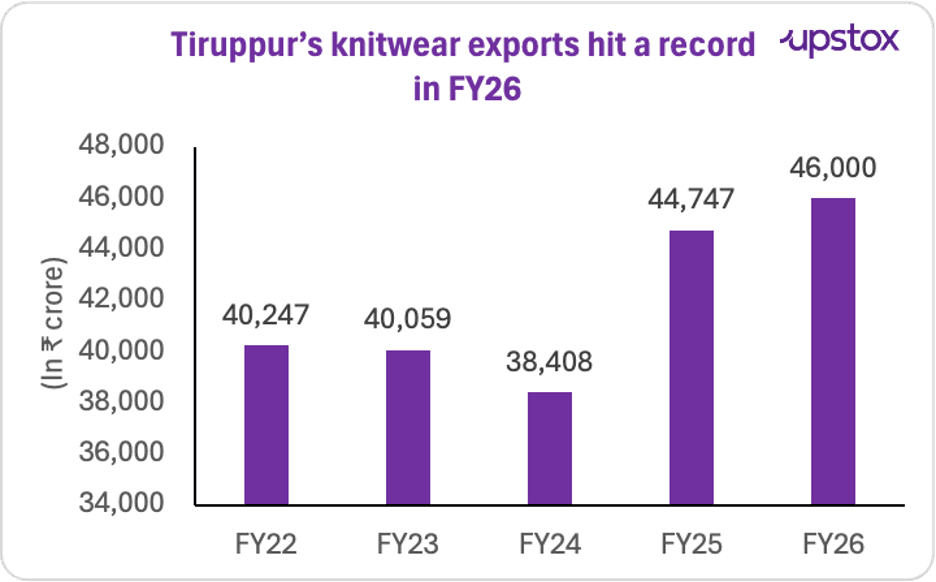
Source: Tiruppur Exporters' Association
The recent climb has been slower. Exports stayed between ₹38,408 crore and ₹40,247 crore from FY22 to FY24, then set records in FY25 and FY26.
What does the cluster actually look like?
Less like a factory, more like a bazaar.
Tiruppur has around 20,000 units spread across the town. Most of them specialise in one stage of making a garment rather than handling the entire process themselves.
| Stage | Units | What it means for an order |
|---|---|---|
| Knitting | 2,500 | Yarn becomes fabric in stand-alone mills that knit for anyone |
| Wet processing | 810 | 360 dyeing, 50 bleaching and 400 printing units |
| Garment making | 4,200 | 2,500 exporters and 1,700 domestic and job-work stitchers |
| Finishing | 1,390 | 600 embroidery and 790 compacting and calendaring units, hired by the piece |
| Other ancillary units | 11,100 | Labels, packaging, trims and everything in between |
Source: Tiruppur Exporters' Association
TEA’s general secretary, N Thirukkumaran, points to how businesses share the work: an exporter with a few hundred sewing machines can take on orders it could never fill alone, with dyeing, printing and embroidery handled across town. “Competition is coupled with cooperation,” he said.
That also explains the industry's shape. TEA, formed in 1990, had 1,316 exporter-members in 2024, nine in ten of them MSMEs, yet 100 of those units shipped half of Tiruppur's exports. A few large stalls, and thousands of small ones that make them possible.
How did a pollution crisis become a selling point?
By being forced to.
The weakness of a bazaar is that nobody owns the river. For decades the dyeing units discharged into the Noyyal, which, being seasonal, could not dilute it. The Supreme Court intervened in 1996. On 28 January 2011, the Madras High Court ordered more than 700 bleaching and dyeing units closed until they achieved zero liquid discharge, meaning wastewater is recovered and reused rather than discharged.
The answer was cluster logic applied to compliance. Of the town's 360 dyeing units, 60 built their own treatment plants; the rest share 18 common ones. Together they treat 130 million litres a day and recycle 96% of it, according to TEA.
That infrastructure now sells. A brand auditing its supply chain for water compliance finds it already built, at a scale no single unit could have afforded.
Who buys, and what changed in the last year?
More than 50 countries, but mostly America and Europe.
The US is the single biggest buyer. In August 2025, ₹15,000 crore of Tiruppur's ₹46,000 crore a year went to America and ₹13,000–14,000 crore to the European Union. The rules have changed since in all three of India's biggest garment markets, as the table shows.
| Market | Share of India's apparel exports, FY26 | Where things stand, September 2026 |
|---|---|---|
| United States | 30.52% | Extra 10% duty since 24 July 2026; trade deal not yet signed |
| European Union | 29.47% | Trade deal concluded in January 2026; not yet in force |
| United Kingdom | 9.48% | Cotton T-shirts and vests duty-free since 15 July 2026 |
Source: AEPC compilation of DGCI&S data (FY26 shares)
What could trip up Tiruppur?
The other side deserves attention too. So far, the model has worked brilliantly. But can it keep up? A few risks are starting to show:
-
Tiruppur is big for India and small for the world. Bangladesh exported $38.70 billion of garments in the year to June 2026, according to its Export Promotion Bureau; Tiruppur's FY25 exports were $4,682 million. Buyers placing orders in the millions of pieces need factories, not stalls.
-
Product is the second constraint. TEA calls Tiruppur a cotton-only exporter, with man-made fibre (MMF) around 10% of turnover in 2025[NK1] , while the brands it wants to add, Adidas, Reebok and Nike, buy performance fabrics. The industry's own target, set out with the textiles minister in June, is a 50:50 cotton-MMF mix.
-
Labour is the third. TEA has described a perennial shortage of about 1.5 lakh workers; around 200,000 of the workforce are migrants, Business Standard reports, and Odisha, which once supplied many of them, is building its own textile industry.
-
US tariffs are the fourth risk.The 50% tariff imposed on 27 August 2025 was followed by a 10.1% fall in India’s garment exports in September and 12.9% in October, in dollar terms. India faces an extra 10% duty, while Bangladesh and other rivals will get exemptions for some garment shipments linked to US cotton purchases. CITI warns this could draw orders away from India, whose garment exports were already down 10.5% year-on-year in dollar terms in April–July 2026.
So, can Tiruppur get to ₹1 lakh crore by 2030?
Only if the rest of the decade looks nothing like the last four years.
TEA's target is ₹1 lakh crore of exports by 2030, more than twice FY26's ₹46,000 crore. In the four years from FY22 to FY26, exports rose by ₹5,753 crore on TEA's own figures. The target needs another ₹54,000 crore, more than the town exports in a whole year today. The Centre is counting on it too: of India's $100 billion textile export goal for 2030, Tiruppur is expected to deliver $11.5 billion.
TEA's plan leans on new products and more hands. It wants MMF exports to grow more than fivefold, to ₹25,000 crore by 2030, and has asked the Centre for worker hostels, zero import duty on cotton and an extension of RoSCTL, a scheme that refunds state and central levies exporters cannot otherwise claim back. Tamil Nadu has set aside ₹1,250 crore over five years for hostels for women workers.
The model that built Tiruppur is still in place. What the target needs is new: a synthetic-fibre supply chain, US duties that favour India over its rivals, an EU deal in force and enough workers. Until those arrive, ₹1 lakh crore by 2030 is an ambition, not a forecast.
About The Author
Next Story

