
Upstox Originals
No housing boom, yet building-material profits keep rising

6 min read | Updated on August 26, 2026, 14:40 IST


SUMMARY
India’s housing market has slowed, but some of the country’s larger building-material companies are still growing sales, margins and profits. The latest results show that the advantage is not coming from one broad recovery; organised players are leaning on distribution, pricing, manufacturing scale and exports to keep growing even when demand offers less support.

Leaders in the building material sector have reported strong numbers. | Image: Shutterstock
A slow housing market usually sounds like bad news for building-material companies. Pan-India housing sales are down more than 30% from their Q1 ’24 level, and the June 2026 quarter was weaker both year-on-year and sequentially.
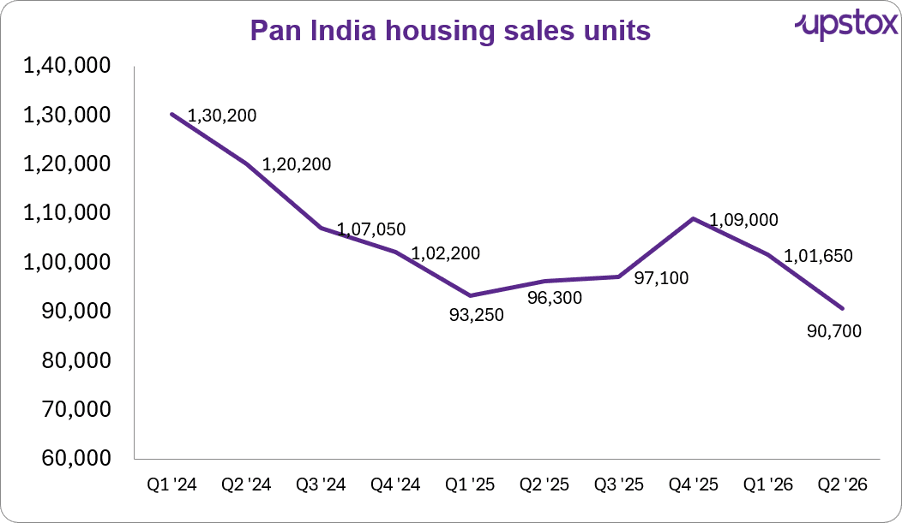
Source: Anarock
But that is not quite what the latest numbers are showing. The June-quarter earnings have thrown up an unusual split: across parts of the building-material sector, organised players are reporting double-digit sales growth and even faster profit growth despite the softer demand backdrop. So, the interesting story is not a construction boom. It is how some of the larger players are still finding ways to grow when the market itself is giving them less help.
What do we mean by building materials?
“Building materials” covers almost everything that goes into making or finishing a house: cement, steel, pipes, sanitaryware, tiles, plywood, MDF, laminates, glass and more.
We are focusing on a narrower slice of that market: plywood, MDF, tiles and laminates. These are some of the categories where the latest results show the divergence most clearly; underlying demand remains subdued, but organised players are still growing faster and expanding profits. They also sit closer to the interior, furnishing and finishing side of construction rather than the basic structure of the building.
They are also very different businesses. Plywood is still highly dealer and carpenter driven. MDF is more factory-made and capital-intensive. Tiles have a large manufacturing base centred around Morbi, while laminates have a stronger design and export component.
So, while they all sit under the same “building materials” label, their demand cycles, margins and competitive advantages do not move in exactly the same way.
The market is slow. The leaders are not
| Company | Sales (₹ Cr) | YoY growth | EBITDA (₹ Cr) | YoY growth | Net profit (₹ Cr) | YoY growth |
|---|---|---|---|---|---|---|
| Century Plyboards | ₹ 1,561 | 34% | ₹ 198 | 54% | ₹ 83 | 55% |
| Greenply Industries | ₹ 725 | 21% | ₹ 73 | 38% | ₹ 38 | 50% |
| Kajaria Ceramics | ₹ 1,328 | 20% | ₹ 260 | 39% | ₹ 171 | 52% |
| Stylam Industries | ₹ 326 | 15% | ₹ 69 | 30% | ₹ 48 | 70% |
Source: Screener.in, Note: Figures for the quarter ended June 2026.
The common thread is visible in the gap between the top and bottom lines. Across all four companies, profit growth comfortably outpaced sales growth, but the reasons were not the same.
Century Plyboards combined strong revenue growth with better profitability. Greenply’s stronger earnings were helped by higher MDF volumes, better realisations and operating leverage. Kajaria’s quarter was more price-led, while Stylam benefited from higher utilisation and efficiency.
So, the profit jump is not simply coming from higher sales. The additional revenue is also coming through at better margins. And there are signs this began before the latest quarter, with margin improvement already visible across parts of the sector in FY26. That distinction matters. If this were simply a demand recovery, we would expect the same tide to lift everyone.
Why organised players have more levers
Weak demand does not shrink the market evenly. It tends to expose the gap between companies that can rely only on price and those that can lean on brand, distribution and scale.
-
Plywood: The opportunity is still large because the market remains fragmented. Century Plyboards alone has an estimated 25–30% share of the organised plywood segment, supported by more than 3,900 dealers and 18,000 retailers across India, according to ICRA. That kind of reach matters when demand is weak: a dealer is more likely to back a brand that sells faster and can replenish stock reliably.
-
MDF: The advantage here comes from standardisation rather than brand alone. MDF is increasingly used in modular furniture, wardrobes and factory-made interiors because of its uniform surface and density. The key point is that these applications favour large automated plants like Greenply, for instance, which uses German automated technology to produce consistent boards. As furniture-making becomes more industrial, the material supplier also needs to become more organised.
-
Tiles: This is where consolidation is harder. Morbi has around 700 ceramic units and produces about 5.1 million tonnes of tiles a year, according to the Bureau of Energy Efficiency. In other words, branded players are not competing against a cottage industry; they are competing against a huge manufacturing cluster. Their edge therefore has to come from design, distribution, service and relationships with large projects rather than scale alone.
-
Laminates: Scale can come from outside India too. Stylam sells in more than 80 countries, with roughly two-thirds of revenue coming from exports. That gives a larger laminate manufacturer another demand pool when the domestic market is soft, something a smaller, locally focused producer may not have.
That is why consolidation will not look the same across building materials. Plywood is largely a distribution-and-brand battle, MDF is increasingly about manufacturing consistency, tiles still face a formidable regional manufacturing base, and laminates can use exports to build scale.
The common advantage is having more levers to pull. When demand slows, smaller manufacturers often have price as their main weapon. Larger players can rely on distribution, brand, technology, project relationships and exports as well.
In summary
The latest results suggest that this is not a broad building-material recovery yet. Demand remains soft, but larger organised players are still finding ways to grow through distribution, pricing, utilisation, manufacturing scale and exports.
The bigger shift, then, may not be that the market is suddenly getting stronger. It may be that stronger companies are learning how to take more from a market that is still moving slowly.
About The Author
Next Story

