
Upstox Originals
Is the NFO boom slowing down for mutual funds?

7 min read | Updated on August 10, 2026, 18:22 IST


SUMMARY
In the three months to June 2026, India's mutual fund industry raised just ₹1,759 crore, 73% lower than a year ago. Yet investors didn't stop investing. Monthly SIP contributions and flows to equity mutual funds were both strong. So, are investors losing interest in NFOs, or simply becoming more selective about where they put their money?

NFO collections fell to a five-year low of ₹1,759 crore in the April-June quarter. | Image: Shutterstock
Every year, mutual fund houses launch new schemes to expand their product offerings. But in 2026, investors are committing far less money to these launches than they have in years.
In fact, NFO collections fell to a five-year low of ₹1,759 crore in the April-June quarter. And that's not all. For the first time in nearly five years, fund houses went an entire quarter without launching a single active sectoral or thematic scheme.
Now, you'd think investors were turning their backs on mutual funds.
Not quite. Investors contributed an average ₹31,283 crore every month through SIPs during the same quarter, while industry assets remained robust at ₹82.22 lakh crore. So, what's really changed? Investors are still investing; they're simply becoming more selective about where their money goes.
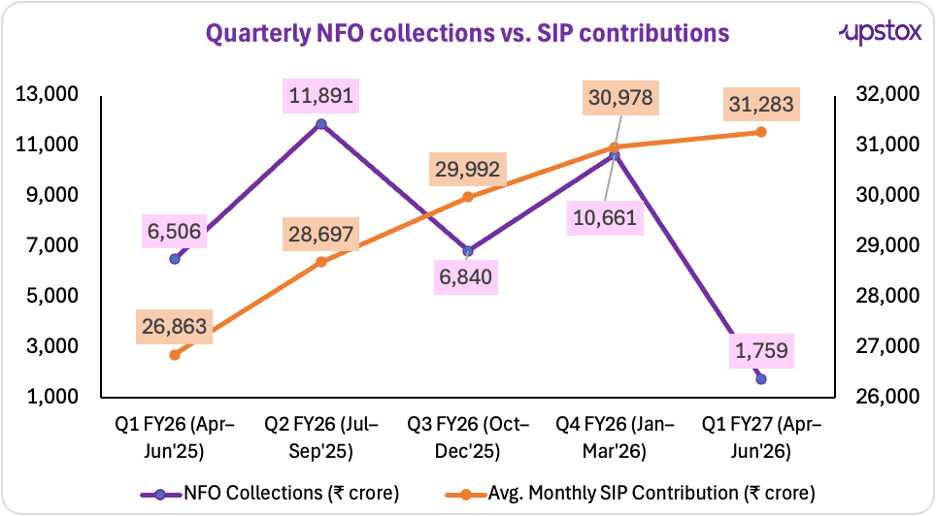
Source: AMFI
Look past the collection figure and something subtler shows up: the launches themselves didn't really stop. Between January and June 2026, fund houses launched 120 NFOs, only slightly lower than the 127 launched a year earlier. The difference wasn't the number of schemes; it was the money they attracted. By June-end, the 2026 launches had accumulated ₹26,356 crore in assets, compared with ₹49,335 crore for the previous year's batch.
| Metric | Jan–Jun 2025 | Jan–Jun 2026 | Change |
|---|---|---|---|
| NFO Collections (₹ crore) | 19,092 | 12,420 | -35.00% |
| NFOs Launched | 127 | 120 | -5.50% |
| AUM as of June-end (₹ crore) | 49,335 | 26,356 | -46.60% |
Source: Moneycontrol
Why is this happening?
The end of the thematic frenzy?
Thematic funds were the industry's growth engine. In 2024, 53 sectoral and thematic NFOs raised ₹79,109 crore between them, and thematic funds soaked up 47.3% of all FY25 equity inflows; ₹96,489 crore. That was the pipeline.
Then SEBI changed a few regulations. From February 2026, fund houses can only launch sectoral or thematic schemes off a list AMFI publishes twice a year; and no new scheme's portfolio can overlap more than 50% with the AMC's existing equity funds.
The effect was instant. In Q1FY27, fund houses launched exactly zero new active sectoral or thematic schemes; something that hadn't happened in nearly five years.
Market volatility are making investors more selective
Then there's the market itself, which spent early 2026 doing its best to scare people off new bets. Indian equities walked into the year on the back foot after two storming years. For the first six months of 2026, the Nifty50 was down more 8.0%. With various uncertainties looming (America-Iran war, US tariffs, rising inflation, etc) market sentinment continues to remain subdued.
Are investors finally pricing in valuations?
The biggest shift may be in how investors are approaching new launches.
Think back to 2024. The mutual fund industry raised a record ₹1.18 lakh crore across 239 NFOs, with thematic and sectoral funds accounting for over ₹79,000 crore. Many investors rushed into popular themes such as defence, PSUs and manufacturing, often at peak valuations. Several of those funds have since underperformed, leaving investors more cautious about chasing the latest market trend.
That shift suggests investors are becoming more selective. The average amount raised per NFO has fallen to ₹143 crore, from ₹165 crore a year earlier, and fund houses didn't launch a single active thematic fund in Q1FY27. Whether that's because investors are paying more attention to valuations or simply avoiding themes that disappointed them, the outcome is the same: enthusiasm for every new fund launch has faded.
That said, not all of this change is driven by investor behaviour. As we'll see next, tighter regulations have also reduced the supply of new thematic funds.
Does weaker NFO demand mean shallower participation, or better capital allocation?
There are two ways to look at this.
The optimistic view is that money which once chased the latest NFO is now flowing into diversified funds through SIPs or into existing schemes with proven track records. That's arguably a healthier investing pattern. The numbers support this too. Index funds and ETFs now account for over 25% of NFO collections and more than half of all new launches, while passive fund AUM has crossed ₹14 lakh crore.
But the other side deserves attention too.
The SIP stoppage ratio crossed 100% in March and April 2026, meaning more SIP accounts were closed than opened, even though overall inflows remained strong. That suggests existing investors are contributing more, while new participation may be slowing. At the same time, weaker NFO demand could simply reflect cautious sentiment rather than better investing.
The truth probably lies somewhere in between. Investors do appear to be allocating capital more carefully, but the slowdown in NFOs is also being shaped by tighter regulations and a more uncertain market environment.
What does a world of fewer, smaller NFOs actually do to an AMC's economics?
For asset management companies (AMCs), this isn't just a slowdown in fund launches; it changes how the business grows.
NFOs have traditionally helped AMCs gather assets quickly while generating distributor activity. But as investors shift towards SIPs and existing funds, the quality of assets improves. SIP money tends to be more stable, stays invested for longer, and requires far less marketing than launching a new fund.
The trade-off? Lower margins.
A growing share of investors is choosing passive funds, where expense ratios are far lower than actively managed funds. So while recurring SIP flows make earnings more predictable, they also put pressure on profitability.
The impact won't be the same for everyone. Large AMCs with established brands and strong SIP books are better placed because they rely less on NFOs for growth. Smaller fund houses, however, have fewer opportunities to launch differentiated products and may find it harder to attract new investors.
For investors in listed AMCs, the takeaway is fairly simple: future growth is likely to depend less on blockbuster NFO launches and more on steady SIP inflows and long-term market appreciation.
So, is the industry actually maturing?
On balance, the answer appears to be yes, but with a caveat. The signs of a more mature market are hard to ignore: SIP inflows have stayed resilient despite volatility, investors seem less willing to chase every new theme, passive investing continues to gain ground, and tighter regulations have curbed the flood of thematic launches.
At the same time, it's too early to call the industry fully mature. The SIP base is narrowing even as inflows remain strong, its resilience is yet to be tested in a prolonged bear market, and part of the decline in NFO collections is also the result of tighter regulations rather than a complete shift in investor behaviour.
Even so, the five-year low in NFO collections is better viewed as a sign that investors are becoming more selective, not that they are losing interest in equities, and that could be a healthier foundation for the industry's next phase of growth.
About The Author
Next Story

